Verify mobile number to view the solution
Solutions
Explanation:
Steady Flow Energy Equation:
When there is mass transfer across the system boundary, the system is called an open system.
When there is an involvement of heat, work and the rate of flow of mass and energy across the control surface are constant, the equation used is Steady Flow Energy Equation.
In steady flow, the ratio of heat transfer, work transfer and mass flow at inlet and outlet is the same.
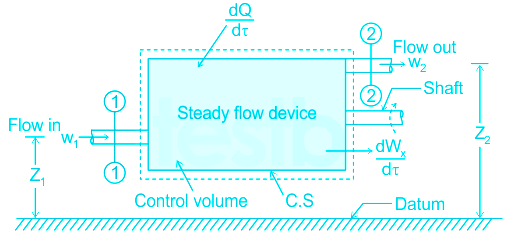
\({h_1} + \frac{{V_1^2}}{2} + {z_1}g + \frac{{dQ}}{{dm}} = {h_2} + \frac{{V_2^2}}{2} + {z_2}g + \frac{{dW}}{{dm}}\;\;\;\;(1)\)
Eq (1) is the Steady flow energy equation in mass form.
\({\dot m_1}({h_1} + \frac{{V_1^2}}{2} + {z_1}g) + \dot Q = {\dot m_2}\left( {{h_2} + \frac{{V_2^2}}{2} + {z_2}g} \right) + \dot W\;\;\;\;\;(2)\)
Eq (2) is the Steady flow energy equation in rate form.
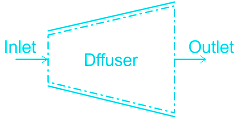
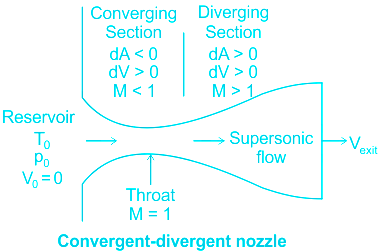
This equation can be applied to a wide variety of processes like pipeline flows, heat transfer processes, mechanical power generation in engines and turbines, flow through nozzle and diffusers etc.
Eg. nozzle and diffuser having converging and diverging passage.
![]()
Euler's Equation:
In fluid flow, numerous forces acting on the fluid element. When the forces due to gravity Fg and pressure force Fp are considered then it is known as Euler's equation of motion.
\(\frac{{dp}}{ρ } + gdz + vdv = 0\;\;\;\;\;(1)\)
Euler's equation is derived considering the fluid element along a streamline.
Bernoulli's equation:
Bernoulli's equation is obtained by integrating the Euler's equation of motion.
\(\frac{p}{{ρ g}} + \frac{{{v^2}}}{{2g}} + z = C\)
Following assumptions are made in the derivation of Bernoulli's equation:
- Flow is ideal i.e inviscous.
- Flow is steady i.e. time variation is zero.
- Flow is incompressible i.e. ρ is constant.
- Flow is irrotaional i.e. ωx = ωy = ωz = 0.
Laplace Equation:
If ϕ(x, y, z) represents a function, then the Laplace equation is used to check the possibility of the existence of such function which is given by:
\(\frac{\partial ^2\phi}{\partial x^2}+\frac{\partial ^2\phi}{\partial y^2}+\frac{\partial ^2\phi}{\partial z^2}=0\)


 Time Taken: -
 Bank
Bank


 SSC
SSC


 Railway


 State
State


 Other
Other


 Teaching


 Insurance


 Medical


 Engineering


 Defence


 GATE
GATE


 NTA CUET

 UPSC
UPSC

 MBA Entrance


 LAW
LAW

 ReNEET UG 2026
 SSC Selection Post (Phase 14) 2026
 RRB NTPC 2026
 SSC CGL Tier-I 2026
 SSC JE 2026
 SBI PO Prelims 2026
 SSC Steno Grade C & D 2026
 SBI Clerk Prelims 2026
 IBPS PO Prelims 2026
 IBPS Clerk Prelims 2026
 SSC CPO Tier I 2026
 NDA II 2026
 CDS II 2026