Please wait...

CDS II 2021 Mathematics Test - 12
Menu grid icon
Result Result point icon
CDS II 2021 Mathematics Test - 12
  • Goals icon

    /

    Score
  • Trophy icon

    -

    Rank
White alarm icon Time Taken: -
Result frame illustration
  • Question 1/10
    1 / -0.33

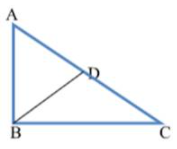
    From a certain point on a straight road, a person observes a tower in the west direction at a distance of 200m. he walks some distance along the road and finds that the same tower is 300 m south of him. What is the shortest distance of the tower from the road?

    Solutions

    Let the tower be at B

    Initially man was at point C then the distance BC was 200m

    After moving, man comes at position A distance AB=300m

    AC= 100√13 (By Pythagoras theorem)

    Shortest distance will be BD

    Let DC = x then AD = 100√13 – x

    In Triangle BDC, BD = (200)2 – x2

    In Triangle ABD, BD=(300)2 – (100√13 – x)2

    Equating the two values of BD we get, x=400/√13

    Calculating BDwe get 600/√13


  • Question 2/10
    1 / -0.33

    If cot A = 1/2 and cot B = 2, then what is the value of A + B ?

    Solutions


  • Question 3/10
    1 / -0.33

    Two trains running at 40 kmph and 50 kmph cross each other in 10 seconds when they run in opposite direction. When they run in same direction a person in the faster train observes that he crossed the other train in 36 seconds. Find the lengths of the slower trains.

    Solutions

    Let p and q be the lengths of the slow and faster trains respectively .

    OPPOSITE DIRECTION-

    When trains are travelling in the opposite directions ,their relative speed ` 

    Distance covered= Sum of length of 2 trains = p + q

    Then according to the given condition we have

    SAME DIRECTION-

    When trains are travelling in the same direction, since we are given the time noted by a person in the faster train as 32 seconds the distance covered is equal to the length of the slower train.

    So, distance covered= q

    The length of the slower train=150m.


  • Question 4/10
    1 / -0.33

    In a family, the average age of 24 members and their gardener is 15 years. If the age of the gardener is left out their average age decreases by 1. Find the age of the gardener?

    Solutions

    Total people = 24 + 1 = 25

    Average = 15

    Sum of the age of 24 members and their gardener = 25 × 15 = 375

    Now If the age of the gardener is left out their average age decreases by 1

    New average = 15 – 1 = 14

    Sum of age of 24 members = 24 × 14 = 336

    So age of gardener = 375 – 336 = 39 years


  • Question 5/10
    1 / -0.33

    The number of values of x satisfying  where x is a natural number less than or equal to 100 is:

    Solutions

    Steps to draw wavy curve method-


  • Question 6/10
    1 / -0.33

    If 6 arithmetic means are inserted between 1 and 9/2 , find the 4TH arithmetic mean.

    Solutions


  • Question 7/10
    1 / -0.33

    The difference between the interests earned on a principal under a certain rate of compound interest in ath year and (a+1)th year is more than that in the bth year and (b+1)th year if-

    Solutions

    The amounts at the end of a year, in compound interest, are in Geometric Progression with common ratio . Similarly the interest accrue in each year, in compound

    interest, are also in Geometric Progression of the same common ratio, i.e. .

    Also , i.e. the progressions are increasing.

    Also the difference between any two consecutive terms, say interest for ist year and interest for (i + 1)st year will be aRi+1 - aRi

    Hence, the difference in the interest for the ath and (a+1)th year will be more than that for the bth and (b+1)th year if a>b due to the increasing accountability of the common ratio in the geometric progression formed by the interest rate.


  • Question 8/10
    1 / -0.33

    The length of the diagonal of a cube is 5√3 cm. The volume of the cube is (in cm3)

    Solutions

    The diagonal of the cube [BF] measures 5√3 cm.

    Assume that one side length is, a cm.

    ∴ EF = DE = BD = a cm.

    Applying Pythagoras theorem for triangle EDF [∠DEF = 90°] we get,

    DF2 = DE2 + EF2

    ⇒ DF2 = 2×a2

    ⇒ DF = √2 × a cm.

    Now, consider ΔBDF where ∠BDF = 90°

    Applying Pythagoras theorem for ΔBDF:

    BF2 = DF2 + DB2

    ⇒ BF2 = 2a2 + a2 = 3a2

    As, BF = 5√3 cm.

    ∴ 25 × 3 = 3a2

    ⇒ a = 5cm.

    The volume of the cube = a3 = 53 = 125 cm3


  • Question 9/10
    1 / -0.33

    The shadow of a pole of height (√3+1) metres standing on the ground is found to be 2 metres longer when the elevation is 30o than when elevation was a. Then, a =

    Solutions

    We have


  • Question 10/10
    1 / -0.33

    If in an examination the scores of Shruthi & Tanuja are in the ratio 8:11, then the ratio of sum of Tanuja’s score and 2 times Shruthi’s scores to the sum of Shruthi’s score and 3 times the Tanuja score is

    Solutions

    Let Shruthi’s score be 8x then, Tanuja’s score is 11x.


Close button icon
User Profile
-

Correct (-)

Wrong (-)

Skipped (-)


  • 1
  • 2
  • 3
  • 4
  • 5
  • 6
  • 7
  • 8
  • 9
  • 10
Mockers logo Get latest Exam Updates
& Study Material Alerts!
No, Thanks
Arrow pointer icon
Click on Allow to receive notifications
Notification bell icon ×
Open Now