Please wait...
/
-
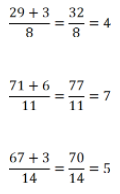
Study the given pattern carefully and select the number that can replace the question mark (?) in it.
Verify mobile number to view the solution
According to the question:
Hence, the correct answer is 5.
Arrange the given words in which they occur in the dictionary.
1. QUOTE
2. QUIET
3. QUEST
4. QUINT
The sequence followed is:
Find the odd letters from the given alternatives.
The logic here is:
Hence, the odd letter is TVWZ.
Choose the right option for * in order of the equation (13 * 9) * (14 * 11) * 13 = 3
From the options when we take these sequences:
×, ÷, –, ÷
We will get:
Given, (13 * 9) * (14 * 11) * 13 = 3
After placing the sign in place of (*)
LHS = (13 × 9) ÷ (14 – 11) ÷ 13
⇒ 117 ÷ 3 ÷ 13
⇒ 39 ÷ 13
⇒ 3 = RHS
Identifying by interchanging which 2 sign (operation) the equation, 18 + 12 ÷ 5 × 6 – 2 = 15 can be made valid.
Given equation, 18 + 12 ÷ 5 × 6 – 2 = 15
According to options:
After changing sign by taking option D.
LHS = 18 + 12 – 5 × 6 ÷ 2
= 18 + 12 – 15
= 30 – 15
= 15 = RHS
Three different positions of a dice are given below in the question. What will come opposite to 3:
If we move in an anti-clockwise direction from 3 in 3rd cube, then 2 is obtained first. Further, if we move from 2 in anti-clockwise direction in 1st cube then 4 is obtained first.
∴ 4 will come opposite to 3.
The statements below are followed by two conclusions labeled I and II. Assuming that the information in the statements is true, even if it appears at variance with generally established facts, decide which conclusion(s) logically and definitely follow(s) from the information given in the statements.
Statements:
1). Some manure are ammonia.
2). Some ammonia are potash.
Conclusion:
I. Some ammonia are manure.
II. Some potash are ammonia.
Minimum possible diagram:
Conclusion I: Some ammonia are manure. (Definite, the opposite of statement is always true)
Conclusion II: Some potash are ammonia. (Definite, the opposite of statement is always true)
Six persons A, B, C, D, E and F are sitting in two rows, three in each. E is not at the end of any row. D is second to the left of F. C, the neighbor of E is sitting diagonally opposite to D. B is the neighbor of F. Who is facing B?
The sitting arrangement is:
Thus, E is facing B.
Select the option in which the given figure is embedded.
Here the question figure is correctly embedded in the answer figure as shown below:
Select the correct option to complete the following pattern.
Here, the answer figure that will complete the question figure is as shown below:
Correct (-)
Wrong (-)
Skipped (-)


 Time Taken: -
 Bank
Bank


 SSC
SSC


 Railway


 State
State


 Other
Other


 Teaching


 Insurance


 Medical


 Engineering


 Defence


 GATE
GATE


 NTA CUET

 UPSC
UPSC

 MBA Entrance


 LAW
LAW

 JEE Advanced 2026
 CUET UG 2026
 NEET UG 2026
 NDA I 2026
 UP Police Constable 2026
 SSC Selection Post (Phase 14) 2026
 AIIMS NORCET-10 2026
 SSC GD 2025-26
 RRB NTPC 2026
 CDS I 2026
 SSC CGL Tier-I 2026
 SSC JE 2026
 UPSC (CSE) 2026
 SBI PO Prelims 2026
 SSC Steno Grade C & D 2026