Please wait...

NDA II 2022 Mathematics Test - 6
Menu grid icon
Result Result point icon
NDA II 2022 Mathematics Test - 6
  • Goals icon

    /

    Score
  • Trophy icon

    -

    Rank
White alarm icon Time Taken: -
Result frame illustration
  • Question 1/10
    2.5 / -0.83

    Find the equation of the plane parallel to the plane 2x-3y+5z+7=0and passing through the point (3,4,-1).

    Solutions

    Any plane parallel to 2x-3y+5z+7=0 is given by 2x-3y+5z+d=0

    Since it passes through (3, 4, -1)

    2x3-3x4+5x(-1)+d=0

    d=11

    required equation is

    2x-3y+5z+11=0


  • Question 2/10
    2.5 / -0.83

    Find the distance between parallel planes x+2y-2z+4=0 and x+2y-2z-8=0

    Solutions


  • Question 3/10
    2.5 / -0.83

    Find the equation of the line passing through the point (2, 3) and perpendicular to the line 3x + 5y = 4

    Solutions

    Given: The given line is 3x + 5y = 4. 
    then the slope of the given line = -3/5

    Formula to be used: The product of slopes of two perpendicular lines = - 1.

    The slope of this line is – 3/5

    ∴ the slope of the perpendicular line = 5/3 
    now we have a slope of the line and the point (2,3) from where the line is passing 
    then the equation of line will be 

    The equation of the line can be written in the form

    (Y-y1)=m(X-x1)
    (y-3)=(5/3)(x-2)
    3y-9=5x-10
    5x-3y=1

    The required equation of the line is

    5x-3y=1


  • Question 4/10
    2.5 / -0.83

    Find the equation of the plane passing through (1,4,-2) and parallel to the plane 2x-y+3z+7=0

    Solutions

    Plane parallel to given plane 2x-y+3z+d=0

    Since it passes through (1,4,-2)

    d=8

    required equation is 2x-y+3z+8=0


  • Question 5/10
    2.5 / -0.83

    Find the distance of the point (3, -5) from the line 3x – 4y = 27

    Solutions

    Given: Point (3,-5) and line 3x – 4y = 27

    To find: The distance of the point (3, -5) from the line 3x – 4y = 27

    Formula used:

    We know that the distance between a point P(m,n) and a line ax + by + c = 0 is given

    by,

    The distance of the point (3,-5) from the line 3x – 4y = 27 is 2/5 unit.


  • Question 6/10
    2.5 / -0.83

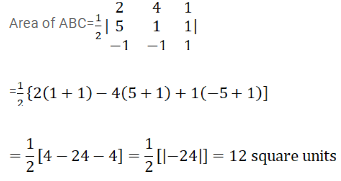
    Find the area of the triangle formed by the lines x + y = 6, x – 3y = 2 and 5x – 3y + 2 = 0.

    Solutions

    The given equations are x + y = 6 …(i)

    x – 3y = 2 …(ii) and

    5x – 3y + 2 = 0 or 5x – 3y = -2 …(iii)

    Let eq. (i), (ii) and (iii) represents the sides AB, BC and AC respectively of ΔABC
    Firstly, we solve the equation (i) and (ii)

    x + y = 6 …(i)

    x – 3y = 2 …(ii)

    Subtracting eq. (ii) from (i), we get

    x + y – x + 3y = 6 – 2

    ⇒ 4y = 4

    ⇒ y = 1

    Putting the value of y = 1 in eq. (i), we get

    x + 1 = 6

    ⇒ x = 5

    Thus, AB and BC intersect at (5, 1)

    Now, we solve eq. (ii) and (iii)

    x – 3y = 2 …(ii)

    5x – 3y = -2 …(iii)

    Subtracting eq. (ii) from (iii), we get

    5x – 3y – x + 3y = – 2 – 2

    ⇒ 4x = - 4

    ⇒ x = -1

    Putting the value of x = -1 in eq. (ii), we get

    – 1 – 3y = 2

    ⇒ -3y = 2 + 1

    ⇒ -3y = 3

    ⇒ y = -1

    Thus, BC and AC intersect at (-1, -1)

    Now, we solve eq. (iii) and (i)

    5x – 3y = -2 …(iii)

    x + y = 6 …(i)

    From eq. (i), we get

    x = 6 – y

    Putting the value of x in eq. (iii), we get

    5(6 – y) – 3y = -2

    ⇒ 30 – 5y – 3y = -2

    ⇒ 30 – 8y = -2

    ⇒ -8y = -32

    ⇒ y = 4

    Putting the value of y = 4 in eq. (i), we get

    x + 4 = 6

    ⇒ x = 6 – 4

    ⇒ x = 2

    Thus, AC and AB intersect at (2, 4) So, vertices of triangle ABC are: (5, 1), (-1, -1) and (2, 4)
     

  • Question 7/10
    2.5 / -0.83

    Show that the points A(-3,2), B(-5,-5), C(2,-3) and D(4,4) are the vertices of a rhombus. Find the area of this rhombus.

    Solutions

    The given points are A(-3,2), B(-5,-5), C(2,-3), D(4,4)

    Thus, diagonal AC is not equal to diagonal BD.

    Therefore ABCD is a quadrilateral with equal sides and unequal diagonals.

    Hence, ABCD a rhombus.

    Area of a rhombus=1/2× (product of diagonals)


  • Question 8/10
    2.5 / -0.83

    If G (-2, 1) is the centroid of a ∆ABC and two of its vertices are A(1, -6) and B(-5, 2) , find the third vertex of the triangle.

    Solutions

    Two vertices of ∆ABC are A(1, -6) and B(-5, 2)

    Let the third vertex be C(a, b).

    Then the coordinates of its centroid are

    a= -2 and b=7

    Therefore, the third vertex of ∆ABC is C(-2,7).


  • Question 9/10
    2.5 / -0.83

    For what value of y, are the points P(1, 4), Q(3,y) and R(-3, 16) are collinear?

    Solutions

    P(1, 4), Q(3,y) and R(-3, 16) are the given points. Then

    (x1=1, y1=4), (x2=3, y2=y), (x3=-3, y3=16)

    It is given that points P,Q and R are collinear.

    Therefore,

    x1(y2-y3)+ x2(y3-y1)+ x3(y1-y2)=0

    ⇒ 1(y-16)+3(16-4)-3(4-y)=0

    ⇒ 1(y-16)+3(12)-3(4-y)=0

    ⇒ y-16+36-12+3y=0

    ⇒ 8+4y=0

    ⇒ y=-8/4=-2

    so, for y=-2 points are collinear.


  • Question 10/10
    2.5 / -0.83

    If the mean deviation of the numbers 1, 1 + d, 1 + 2d, ... , 1 + 100d from their mean is 255, then the d is equal to

    Solutions


Close button icon
User Profile
-

Correct (-)

Wrong (-)

Skipped (-)


  • 1
  • 2
  • 3
  • 4
  • 5
  • 6
  • 7
  • 8
  • 9
  • 10
Mockers logo Get latest Exam Updates
& Study Material Alerts!
No, Thanks
Arrow pointer icon
Click on Allow to receive notifications
Notification bell icon ×
Open Now
