Please wait...

NDA II 2022 Mathematics Test - 7
Menu grid icon
Result Result point icon
NDA II 2022 Mathematics Test - 7
  • Goals icon

    /

    Score
  • Trophy icon

    -

    Rank
White alarm icon Time Taken: -
Result frame illustration
  • Question 1/10
    2.5 / -0.83

    If in a frequency distribution, the mean and median are 21 and 22 respectively, then its mode is approximately

    Solutions

    The empirical relation between Mean, Median and Mode is

    Mode + 2Mean = 3 Median

    ⇒ Mode = 3 × 22 – 2 × 21

    = 66 – 42 = 24.


  • Question 2/10
    2.5 / -0.83

    The mean of two samples of sizes 200 and 300 were found to be 25, 10 respectively. Their standard deviation were 3 and 4 respectively. The variance of combined sample of size 500 is

    Solutions


  • Question 3/10
    2.5 / -0.83

    If the mean and standard deviation of 10 observations are 20 and 2 respectively. The sum of squares of all the observations is—

    Solutions


  • Question 4/10
    2.5 / -0.83

    In a single throw of two dice, find Probability (an odd number on the first die and a 6 on the second).

    Solutions

    In a single throw of two dice, find

    P (an odd number on the first die and a 6 on the second)
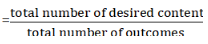
    Total outcomes are (1, 1), (1, 2), (1, 3), (1, 4), (1, 5), (1, 6),

    (2, 1), (2, 2), (2, 3), (2, 4), (2, 5), (2, 6),

    (3, 1), (3, 2), (3, 3), (3, 4), (3, 5), (3, 6),

    (4, 1), (4, 2), (4, 3), (4, 4), (4, 5), (4, 6) ,

    (5, 1), (5, 2), (5, 3), (5, 4), (5, 5), (5, 6) ,

    (6, 1), (6, 2), (6, 3), (6, 4), (6, 5), (6, 6)

    Desired outcomes are (1, 6), (3, 6), (5, 6)

    Total no.of outcomes are 36 and desired outcomes are 3

    Therefore, probability of getting odd on the first die and 6 on the second die

    =3/36=1/12

    Conclusion: Probability of getting odd on the first die and 6 on the second die, when two dice are rolled is 1/12


  • Question 5/10
    2.5 / -0.83

    An urn contains 9 red, 7 white, and 4 black balls. A ball is drawn at random. Find the probability that the ball is drawn is red or white.

    Solutions

    We know that,

    Probability of occurrence of an event

    By permutation and combination, total no.of ways to pick r objects from given n objects

    is nCr

    Now, total no.of ways to pick a ball from 20 balls is 20C1 = 20

    Our desired output is to pick a white or red ball.

    So, no.of ways to pick a white or red

    ball from 16 balls(because there are a total of 16 balls which are either red or white) is 16C1 = 16

    Therefore, the probability of picking a white or red ball =16/20=4/5

    Conclusion: Probability of picking a white or red ball from 9 red, 7 white, and 4 black balls is 4/5.


  • Question 6/10
    2.5 / -0.83

    Three unbiased coins are tossed once. Find the probability of getting exactly 2 tails.

    Solutions

    We know that,

    Probability of occurrence of an event

    Let T be tails and H be heads Total possible outcomes = TTT, TTH, THT, HTT, THH, HTH, HHT, HHH

    Desired outcomes are exactly two tails.

    So, desired outputs are TTH, THT, HTT

    Total no. of outcomes are 8 and desired outcomes are 3

    Therefore, the probability of getting exactly 2 tails =3/8

    Conclusion: Probability of getting exactly two tails is 3/8


  • Question 7/10
    2.5 / -0.83

    Tickets numbered from 1 to 12 are mixed up together, and then a ticket is withdrawn at random. Find the probability that the ticket has a number which is a multiple of 2 or 3.

    Solutions

    We know that,

    Probability of occurrence of an event

    Total no. of outcomes are 12

    Desired output is picking a number which is multiple of 2 or 3.

    So, desire outputs are 2, 3, 4, 6, 8, 9, 10, 12.

    Total no. of desired outputs are 8

    Therefore, the probability of getting a number which is multiple of 2 or 3 = 8/12= 2/3

    Conclusion: Probability of picking a ticket which is multiple of 2 or 3 is 2/3


  • Question 8/10
    2.5 / -0.83

    What is the probability that in a group of two people, both will have the same birthday, assuming that there are 365 days in a year and no one has his/her birthday on 29th February?

    Solutions

    We know that,

    Probability of occurring = 1 - the probability of not occurring

    Let’s calculate for the probability of not occurring, i.e. probability such that both of them don’t have a birthday on the same day. For suppose the first person has a birthday on a particular day then the other person can have a birthday in the remaining 364 days

    Probability of not having the same birthday=364/365

    Probability of having same birthday = 1 – probability of not having the same Birthday

    Conclusion: Probability of two persons having the same birthday is 1/365


  • Question 9/10
    2.5 / -0.83

    If A and B are two events associated with a random experiment for which P(A) = 0.60, P(A or B) = 0.85 and P(A and B) = 0.42, find P(B).

    Solutions

    Given: P(A) = 0.60, P(A or B) = 0.85 and P(A and B) = 0.42

    To find: P(B) Formula used : P(A or B) = P(A) + P(B) - P(A and B)

    Substituting in the above formula we get,

    0.85 = 0.60 + P(B) – 0.42

    0.85 = 0.18 + P(B)

    0.85 – 0.18 = P(B)

    0.67 = P(B)

    P(B) = 0.67


  • Question 10/10
    2.5 / -0.83

    Let A and B be two mutually exclusive events of a random experiment such that P(not A) = 0.65 and P(A or B) = 0.65, find P(B).

    Solutions

    Given: A and B are mutually exclusive events P(not A) = P  = 0.65 , P(A or B) = 0.65

    To find: P(B)

    Formula used:

    P(A) = 1 – P

    P(A or B) = P(A) + P(B) - P(A and B)

    For mutually exclusive events A and B, P(A and B) = 0

    P(A) = 1 – P(not A)

    P(A) = 1 – 0.65

    P(A) = 0.35

    Substituting in the above formula we get,

    0.65 = 0.35 + P(B)

    P(B) = 0.65 – 0.35

    P(B) = 0.30


Close button icon
User Profile
-

Correct (-)

Wrong (-)

Skipped (-)


  • 1
  • 2
  • 3
  • 4
  • 5
  • 6
  • 7
  • 8
  • 9
  • 10
Mockers logo Get latest Exam Updates
& Study Material Alerts!
No, Thanks
Arrow pointer icon
Click on Allow to receive notifications
Notification bell icon ×
Open Now