Please wait...

Aptitude Test 231
Menu grid icon
Result Result point icon
Aptitude Test 231
  • Goals icon

    /

    Score
  • Trophy icon

    -

    Rank
White alarm icon Time Taken: -
Result frame illustration
  • Question 1/10
    1 / -0.33

    40% of the men are more than 30 years old and 70% of the men are less than or equal to 40 years old. 25% of all men play golf. If 30% of the men above the age of 40 play golf, what percentage of the golf players are less than or equal to 40 years?

    Solutions

    Let the total number of men be 100.

    Then, 25 men play golf.

    70 men are less than or equal to 40 years old.

    Remaining 30 men are above 40 years old.

    Number of golf players above 40 years old = 30% of 30 = 30 * 30/100 = 9

    Number of golf players less than or equal to 40 years old = 25 - 9 = 16

    Required percentage = 100 * 16/25 = 64%


  • Question 2/10
    1 / -0.33

    Directions For Questions

    In the following questions, two statements numbered I and II are given. On solving them, we get quantities I and II respectively. Solve for both the quantities and choose the correct option.

    ...view full instructions


    Quantity I: Perimeter of a semicircular field is 108 meters then what is area of circular field having radius twice the radius of semicircular field?

    Quantity II: Cost of fencing a square field having area 1444 m² at the rate of ₹40/meter?

    Solutions

    Perimeter of semicircle = (Rx22/7) + 2R = 108 m

    Radius = 21 meter

    Then, Radius of circle = 2 x 21 = 42 meter

    Area = (22/7) x 42² = 5544 m²

    Quantity II:

    Area of square = (side)² = 1444 m²

    Side = 38 meter

    Cost of fencing = 4 x 38 x 40 = ₹6080

    Hence, Quantity I < Quantity II


  • Question 3/10
    1 / -0.33

    Directions For Questions

    In the following questions, two statements numbered I and II are given. On solving them, we get quantities I and II respectively. Solve for both the quantities and choose the correct option.

    ...view full instructions


    Quantity I: What is the length of train B which crosses a pole in 12 sec and another train of length 360m running in opposite direction with a speed of 60m/sec in 8sec?

    Quantity II: Difference between CI and SI at the rate of 6% for three years on ₹22500.

    Solutions

    Let length of train B = D meter

    Since same train crosses pole, so speed remains same.

    Speed of train B = D/12 m/sec

    Relative speed = (60 + D/12)

    (60 + D/12) = (D + 360)/8

    (720 + D)/12 = (D + 360)/8

    8 x (720 + D) = 12 x (D + 360)

    5760 + 8D = 12D + 4320

    4D = 1440

    D = 360

    Hence, length of train B = 360m

    Quantity II:

    Initial amount = 22500, Rate = 6%, time = 3 years

    CI - SI = 22500 x (6/100)² x (306/100)

    CI - SI = 247.86

    Hence, Quantity I > Quantity II


  • Question 4/10
    1 / -0.33

    Directions For Questions

    In the following questions, two statements numbered I and II are given. On solving them, we get quantities I and II respectively. Solve for both the quantities and choose the correct option.

    ...view full instructions


    Quantity I: Ratio of the ages of father and son is 13:8 and sum of the ages of father 25 years hence and son 15 years ago is 115 years. Then what is the age of father 15 years hence?

    Quantity II: On selling 20 apples for ₹60 there is a loss equal to cost price of 8 apples, then what is the cost price of 16 apples?

    Solutions

    Let the present age of father and son be 13Y and 8Y respectively.

    Age of the father after 25 years = (13Y + 25)

    Age of the son 15 years ago= (8Y - 15)

    So, (13Y + 25) + (8Y - 15) = 115

    21Y + 10 = 115

    Y = 5

    So, Age of the father 15 years hence = (13 x 5) + 15 = 80 years.

    Quantity II:

    We know that

    Loss = (Cost price - Selling price)

    So, on selling 20 apples

    (CP of 20 apple) - (SP of 20 apple) = (CP of 8 apples)

    CP of 12 apple = SP of 20 apple = 60

    CP of 12 apple = 60

    CP of one apple = 60/12 = ₹5

    So, CP of 16 apples = ₹80

    Hence, Quantity I = Quantity II


  • Question 5/10
    1 / -0.33

    Find the wrong term in the series given below.

    39, 45, 57, 87, 145, 275

    Solutions

    The pattern adds the number to product of a prime number and the number following it:

    39 + 2 x 3 = 45

    45 + 3 x 4 = 57

    57 + 5 x 6 = 87

    87 + 7 x 8 = 143

    143 + 11 x 12 = 275


  • Question 6/10
    1 / -0.33

    Find the wrong term in the series given below.

    8.4, 8.9, 9.5, 10.0, 10.8

    Solutions

    The pattern is shown below:

    √70= 8.4

    √80= 8.9

    √90= 9.5

    √100= 10.0

    √110= 10.5


  • Question 7/10
    1 / -0.33

    A certain sum amounts to Rs. 8988.80 in two years and to Rs. 9528.12 in three years, at a certain rate of compound interest per annum. Find the principal and rate of interest?

    Solutions

    Consider option 1:

    Principal = 7800, R = 6%

    Amount after 2 years = 7800 x (1 + 0.06)2 = 8764.08

    Hence, option 1 is not correct answer

    Consider option 2:

    Amount after 2 years = 6900 x (1 + 0.12)2 = 8655.36

    Hence, option 2 is not correct answer

    Consider option 3:

    Amount after 2 years = 8000 x (1 + 0.06)= 8988.8

    Amount after 3 years = 8000 x (1 + 0.06)= 9528.12

    Hence, option 3 is the correct answer.


  • Question 8/10
    1 / -0.33

    Find the wrong term in the series given below.

    11392, 2880, 738, 192, 52, 15

    Solutions

    The pattern is shown below:

    11392/4 + 25 = 2880

    2880/4 + 2= 736

    736/4 + 23 = 192

    192/4 + 22 = 52

    52/4 + 21 = 15


  • Question 9/10
    1 / -0.33

    Directions For Questions

    Directions : Read the data carefully and answer the following questions.

    Paragraph shows some information about total patients that are admitted in three hospitals(A,B,C) suffering from three diseases P, Q and R.Each patient is suffering from one of the three diseases.

    Total patients in hospital A suffering from diseases is 37.5% of total patients in all the three hospitals suffering from diseases.

    Hospital A: Total patients suffering from disease P is 8/15 of total patients in the hospital. Number of patients suffering from disease Q is double the number of patients suffering from disease R. Number of patients suffering from disease R is 35.

    Hospital B: Total patients suffering from disease Q is 10 less than that of in hospital A. Ratio of number of patients suffering from diseases P, Q and R is 15: 12: 5 respectively.

    Hospital C: Total patients suffering from disease P is 80% of total patients suffering from disease Q. Ratio of number of patients suffering from disease P to number of patients suffering from disease R is 16: 7.

    ...view full instructions


    Find the total number of patients in all the three hospitals together who are suffering from disease P.

    Solutions

    Let total patients in all the three hospitals suffering from diseases = 100x

    Total patients in hospital A suffering from diseases = 37.5% of 100x = 37.5x

    Hospital A:

    Total patients suffering from disease P = 37.5x * (8/15) = 20x

    Remaining patients = 37.5x - 20x = 17.5x

    Let number of patients suffering from disease R and diseases Q is 'a' and '2a' respectively.

    a + 2a = 17.5x

    3a = 17.5x

    a = 17.5x/3

    Number of patients suffering from disease R = a = 17.5x/3 = 35

    x = (35 * 3)/17.5

    x = 6

    Number of patients suffering from disease Q = 2a = 70

    Total patients suffering from disease P = 20x = 120

    Total patients suffering from diseases in Hospital A = 37.5x = 225

    Total patients in all the three hospitals suffering from diseases = 100x = 600

    Hospital B:

    Total patients suffering from disease Q = 70 - 10 = 60

    Total patients suffering from disease P = 60 * (15/12) = 75

    Total patients suffering from disease R = 60 * (5/12) = 25

    Total patients suffering from diseases in Hospital B = 60 + 75 + 25 = 160

    Hospital C:

    Total patients suffering from diseases in Hospital C = 600 - (225 + 160) = 215

    Let total patients suffering from disease Q = 100y

    Total patients suffering from disease P = 80% of 100y = 80y

    Total patients suffering from disease R = 80y * (7/16) = 35y

    Total patients suffering from diseases in Hospital C = 100y + 80y + 35y = 215

    215y = 215

    y = 1

    Total patients suffering from disease P = 80y = 80

    Total patients suffering from disease Q = 100y = 100

    Total patients suffering from disease R = 35y = 35
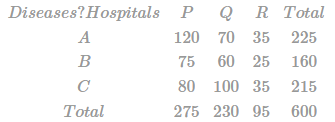
    Total number of patients in all the three hospitals together who are suffering from disease P = 275


  • Question 10/10
    1 / -0.33

    Directions For Questions

    Directions : Read the data carefully and answer the following questions.

    Paragraph shows some information about total patients that are admitted in three hospitals(A,B,C) suffering from three diseases P, Q and R.Each patient is suffering from one of the three diseases.

    Total patients in hospital A suffering from diseases is 37.5% of total patients in all the three hospitals suffering from diseases.

    Hospital A: Total patients suffering from disease P is 8/15 of total patients in the hospital. Number of patients suffering from disease Q is double the number of patients suffering from disease R. Number of patients suffering from disease R is 35.

    Hospital B: Total patients suffering from disease Q is 10 less than that of in hospital A. Ratio of number of patients suffering from diseases P, Q and R is 15: 12: 5 respectively.

    Hospital C: Total patients suffering from disease P is 80% of total patients suffering from disease Q. Ratio of number of patients suffering from disease P to number of patients suffering from disease R is 16: 7.

    ...view full instructions


    Total patients in hospital B is approximately what percent of total patients in all the three hospitals together?

    Solutions

    Let total patients in all the three hospitals suffering from diseases = 100x

    Total patients in hospital A suffering from diseases = 37.5% of 100x = 37.5x

    Hospital A:

    Total patients suffering from disease P = 37.5x * (8/15) = 20x

    Remaining patients = 37.5x - 20x = 17.5x

    Let number of patients suffering from disease R and diseases Q is 'a' and '2a' respectively.

    a + 2a = 17.5x

    3a = 17.5x

    a = 17.5x/3

    Number of patients suffering from disease R = a = 17.5x/3 = 35

    x = (35 * 3)/17.5

    x = 6

    Number of patients suffering from disease Q = 2a = 70

    Total patients suffering from disease P = 20x = 120

    Total patients suffering from diseases in Hospital A = 37.5x = 225

    Total patients in all the three hospitals suffering from diseases = 100x = 600

    Hospital B:

    Total patients suffering from disease Q = 70 - 10 = 60

    Total patients suffering from disease P = 60 * (15/12) = 75

    Total patients suffering from disease R = 60 * (5/12) = 25

    Total patients suffering from diseases in Hospital B = 60 + 75 + 25 = 160

    Hospital C:

    Total patients suffering from diseases in Hospital C = 600 - (225 + 160) = 215

    Let total patients suffering from disease Q = 100y

    Total patients suffering from disease P = 80% of 100y = 80y

    Total patients suffering from disease R = 80y * (7/16) = 35y

    Total patients suffering from diseases in Hospital C = 100y + 80y + 35y = 215

    215y = 215

    y = 1

    Total patients suffering from disease P = 80y = 80

    Total patients suffering from disease Q = 100y = 100

    Total patients suffering from disease R = 35y = 35


    Total patients in hospital B = 160

    Total patients in all the three hospitals together = 600

    Required per cent = (160/600) * 100 = 26.67%


Close button icon
User Profile
-

Correct (-)

Wrong (-)

Skipped (-)


  • 1
  • 2
  • 3
  • 4
  • 5
  • 6
  • 7
  • 8
  • 9
  • 10
Mockers logo Get latest Exam Updates
& Study Material Alerts!
No, Thanks
Arrow pointer icon
Click on Allow to receive notifications
Notification bell icon ×
Open Now
