Please wait...

IBPS PO 2023 Reasoning Test - 8
Menu grid icon
Result Result point icon
IBPS PO 2023 Reasoning Test - 8
  • Goals icon

    /

    Score
  • Trophy icon

    -

    Rank
White alarm icon Time Taken: -
Result frame illustration
  • Question 1/10
    1 / -0.25

    Directions For Questions

    Direction: Read the following information carefully and answer the questions given below.

    In a family of three-generation, there are seven members and two married couples. C is the sister of B, who is the male child of F. D is the spouse of A. A is the paternal grandmother of E who is the son of F. C is unmarried member of the family. G is the male member of the family. F is the mother of B.

    ...view full instructions


    Who is/are the grandson of D?

    Solutions

    Seven members: A, B, C, D, E, F and G

    Clearly, both B and E are the grandson of D.

  • Question 2/10
    1 / -0.25

    Directions For Questions

    Direction: Study the following information carefully and answer the following questions.

    K, L, M, P, Q, R, S, and T are sitting around a square table in such a way that four of them sit at four corners of the square while four sit in the middle of each of the four sides. All of them are facing towards the center. Only one person sits between Q and R. S sits at one of the corners of the square. R is not immediate neighbor of M. K is not an immediate neighbor of R. S and L sit diagonally opposite to each other. P sits third to the right of S. Q sits third to the left of M who doesn’t sit in the middle of the sides.

    ...view full instructions


    What is the position of L with respect to M?

    Solutions

    Persons: K, L, M, P, Q, R, S and T

    Steps:

    1) P sits third to the right of S.

    2) Q sits third to the left of M who doesn’t sit in the middle of the sides.

    Case 1:

    Case 2:

    Case 3:

    3) Only one person sits between Q and R.

    4) R is not immediate neighbor of M.

    The above conditions are not satisfied in case 3.

    Case 1:

    Case 2:

    5) K is not an immediate neighbor of R.

    Case 1:

    Case 2:

    6) S and L sit diagonally opposite to each other.

    The above condition is not satisfied in case 2.

    7) The remaining person is T.

    The final arrangement will be as shown:

    Hence, L sits second to the right of M.

    Hence B is correct.

  • Question 3/10
    1 / -0.25

    Directions For Questions

    Direction: Study the following information carefully and answer the following questions.

    K, L, M, P, Q, R, S, and T are sitting around a square table in such a way that four of them sit at four corners of the square while four sit in the middle of each of the four sides. All of them are facing towards the center. Only one person sits between Q and R. S sits at one of the corners of the square. R is not immediate neighbor of M. K is not an immediate neighbor of R. S and L sit diagonally opposite to each other. P sits third to the right of S. Q sits third to the left of M who doesn’t sit in the middle of the sides.

    ...view full instructions


    Who sits exactly between Q and R, when counted from left of Q?

    Solutions

    Persons: K, L, M, P, Q, R, S and T

    Steps:

    1) P sits third to the right of S.

    2) Q sits third to the left of M who doesn’t sit in the middle of the sides.

    Case 1:

    Case 2:

    Case 3:

    3) Only one person sits between Q and R.

    4) R is not immediate neighbor of M.

    The above conditions are not satisfied in case 3.

    Case 1:

    Case 2:

    5) K is not an immediate neighbor of R.

    Case 1:

    Case 2:

    6) S and L sit diagonally opposite to each other.

    The above condition is not satisfied in case 2.

    7) The remaining person is T.

    The final arrangement will be as shown:

    Hence, T sits exactly between Q and R.

  • Question 4/10
    1 / -0.25

    Directions For Questions

    Direction: Study the following information carefully and answer the following questions.

    K, L, M, P, Q, R, S, and T are sitting around a square table in such a way that four of them sit at four corners of the square while four sit in the middle of each of the four sides. All of them are facing towards the center. Only one person sits between Q and R. S sits at one of the corners of the square. R is not immediate neighbor of M. K is not an immediate neighbor of R. S and L sit diagonally opposite to each other. P sits third to the right of S. Q sits third to the left of M who doesn’t sit in the middle of the sides.

    ...view full instructions


    Which of the following pairs represents the persons seated in the center of the sides and face each other?

    Solutions

    Persons: K, L, M, P, Q, R, S and T

    Steps:

    1) P sits third to the right of S.

    2) Q sits third to the left of M who doesn’t sit in the middle of the sides.

    Case 1:

    Case 2:

    Case 3:

    3) Only one person sits between Q and R.

    4) R is not immediate neighbor of M.

    The above conditions are not satisfied in case 3.

    Case 1:

    Case 2:

    5) K is not an immediate neighbor of R.

    Case 1:

    Case 2:

    6) S and L sit diagonally opposite to each other.

    The above condition is not satisfied in case 2.

    7) The remaining person is T.

    The final arrangement will be as shown:

    Therefore, P and Q sit at the center of the sides and face each other.

    Hence, option D is the correct answer.

  • Question 5/10
    1 / -0.25

    Directions For Questions

    Direction: Study the following information carefully and answer the following questions.

    K, L, M, P, Q, R, S, and T are sitting around a square table in such a way that four of them sit at four corners of the square while four sit in the middle of each of the four sides. All of them are facing towards the center. Only one person sits between Q and R. S sits at one of the corners of the square. R is not immediate neighbor of M. K is not an immediate neighbor of R. S and L sit diagonally opposite to each other. P sits third to the right of S. Q sits third to the left of M who doesn’t sit in the middle of the sides.

    ...view full instructions


    Who sits immediate right of K?

    Solutions

    Persons: K, L, M, P, Q, R, S and T

    Steps:

    1) P sits third to the right of S.

    2) Q sits third to the left of M who doesn’t sit in the middle of the sides.

    Case 1:

    Case 2:

    Case 3:

    3) Only one person sits between Q and R.

    4) R is not immediate neighbor of M.

    The above conditions are not satisfied in case 3.

    Case 1:

    Case 2:

    5) K is not an immediate neighbor of R.

    Case 1:

    Case 2:

    6) S and L sit diagonally opposite to each other.

    The above condition is not satisfied in case 2.

    7) The remaining person is T.

    The final arrangement will be as shown:

    Hence, M sits to the immediate right of K.

  • Question 6/10
    1 / -0.25

    Directions For Questions

    Direction: Study the following information carefully and answer the following questions.

    K, L, M, P, Q, R, S, and T are sitting around a square table in such a way that four of them sit at four corners of the square while four sit in the middle of each of the four sides. All of them are facing towards the center. Only one person sits between Q and R. S sits at one of the corners of the square. R is not immediate neighbor of M. K is not an immediate neighbor of R. S and L sit diagonally opposite to each other. P sits third to the right of S. Q sits third to the left of M who doesn’t sit in the middle of the sides.

    ...view full instructions


    How many persons sit between M and P when counted from right of M?

    Solutions

    Persons: K, L, M, P, Q, R, S and T

    Steps:

    1) P sits third to the right of S.

    2) Q sits third to the left of M who doesn’t sit in the middle of the sides.

    Case 1:

    Case 2:

    Case 3:

    3) Only one person sits between Q and R.

    4) R is not immediate neighbor of M.

    The above conditions are not satisfied in case 3.

    Case 1:

    Case 2:

    5) K is not an immediate neighbor of R.

    Case 1:

    Case 2:

    6) S and L sit diagonally opposite to each other.

    The above condition is not satisfied in case 2.

    7) The remaining person is T.

    The final arrangement will be as shown:

    Hence, no person sits between M and P when counted form right of M.

  • Question 7/10
    1 / -0.25

    Directions For Questions

    Direction: Read the following information carefully and answer the questions given below:

    12 people A, B, C, G, H, J, M, N, O, S, T and U are sitting opposite to each other in two different rows (not necessarily in the same order). Six people are facing towards north and other six are facing towards south. N is sitting exactly opposite to S but S is sitting fourth to the right of H. S is neither facing north nor is sitting at any of the extreme ends. M is sitting second to the right of N. O is sitting opposite to the person sitting immediate right of M. Two persons are sitting between G and T and M is one of them. U is sitting opposite to the person sitting immediate right to G. B is neither an immediate neighbour of S nor is sitting at any of the extreme ends. A is sitting second to the left of J.

    ...view full instructions


    Who among the following persons are sitting at the extreme ends of both rows?

    Solutions

    12 people: A, B, C, G, H, J, M, N, O, S, T and U.

    Facing directions: North and south.

    Steps:

    1) N is sitting exactly opposite to S but S is sitting fourth to the right of H.

    2) S is neither facing north nor is sitting at any of the extreme ends.

    So, S and H are facing south and N is facing north.
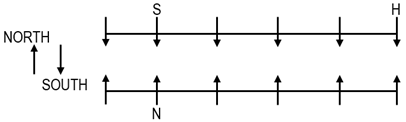
    3) M is sitting second to the right of N.

    4) O is sitting opposite to the person sitting immediate right to M.

    So, M is facing north and O is facing south.
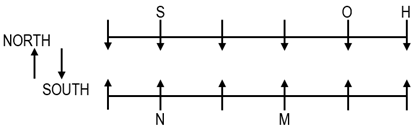
    5) Two persons are sitting between G and T and M is one of them.

    So, G and T facing north.

    6) U is sitting opposite to the person sitting immediate right to G.

    So, U is facing south.
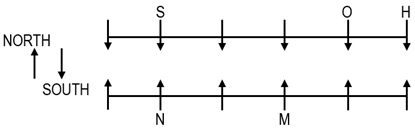
    7) B is neither an immediate neighbour of S nor is sitting at any of the extreme ends.

    So, B sits between M and T.
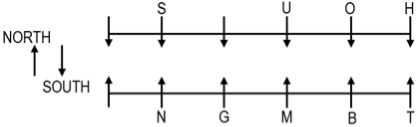
    8) A is sitting second to the left of J.

    So, both A and J face south.

    The remaining person is C and C sits to the immediate left of N.

    The final arrangement will be:
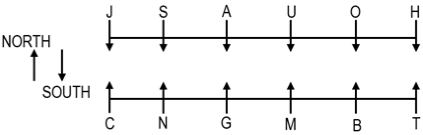
    Hence, C, J, H, T are sitting at the extreme ends of both rows.

  • Question 8/10
    1 / -0.25

    Directions For Questions

    Direction: Read the following information carefully and answer the questions given below:

    12 people A, B, C, G, H, J, M, N, O, S, T and U are sitting opposite to each other in two different rows (not necessarily in the same order). Six people are facing towards north and other six are facing towards south. N is sitting exactly opposite to S but S is sitting fourth to the right of H. S is neither facing north nor is sitting at any of the extreme ends. M is sitting second to the right of N. O is sitting opposite to the person sitting immediate right of M. Two persons are sitting between G and T and M is one of them. U is sitting opposite to the person sitting immediate right to G. B is neither an immediate neighbour of S nor is sitting at any of the extreme ends. A is sitting second to the left of J.

    ...view full instructions


    Who among the following is sitting exactly opposite to O?

    Solutions

    12 people: A, B, C, G, H, J, M, N, O, S, T and U.

    Facing directions: North and south.

    Steps:

    1) N is sitting exactly opposite to S but S is sitting fourth to the right of H.

    2) S is neither facing north nor is sitting at any of the extreme ends.

    So, S and H are facing south and N is facing north.

    3) M is sitting second to the right of N.

    4) O is sitting opposite to the person sitting immediate right to M.

    So, M is facing north and O is facing south.

    5) Two persons are sitting between G and T and M is one of them.

    So, G and T facing north.

    6) U is sitting opposite to the person sitting immediate right to G.

    So, U is facing south.

    7) B is neither an immediate neighbour of S nor is sitting at any of the extreme ends.

    So, B sits between M and T.

    8) A is sitting second to the left of J.

    So, both A and J face south.

    The remaining person is C and C sits to the immediate left of N.

    The final arrangement will be:

    Hence, B is sitting exactly opposite to O.

  • Question 9/10
    1 / -0.25

    Directions For Questions

    Direction: Read the following information carefully and answer the questions given below:

    12 people A, B, C, G, H, J, M, N, O, S, T and U are sitting opposite to each other in two different rows (not necessarily in the same order). Six people are facing towards north and other six are facing towards south. N is sitting exactly opposite to S but S is sitting fourth to the right of H. S is neither facing north nor is sitting at any of the extreme ends. M is sitting second to the right of N. O is sitting opposite to the person sitting immediate right of M. Two persons are sitting between G and T and M is one of them. U is sitting opposite to the person sitting immediate right to G. B is neither an immediate neighbour of S nor is sitting at any of the extreme ends. A is sitting second to the left of J.

    ...view full instructions


    Who among the following persons are not facing in the same direction?

    Solutions

    12 people: A, B, C, G, H, J, M, N, O, S, T and U.

    Facing directions: North and south.

    Steps:

    1) N is sitting exactly opposite to S but S is sitting fourth to the right of H.

    2) S is neither facing north nor is sitting at any of the extreme ends.

    So, S and H are facing south and N is facing north.

    3) M is sitting second to the right of N.

    4) O is sitting opposite to the person sitting immediate right to M.

    So, M is facing north and O is facing south.

    5) Two persons are sitting between G and T and M is one of them.

    So, G and T facing north.

    6) U is sitting opposite to the person sitting immediate right to G.

    So, U is facing south.

    7) B is neither an immediate neighbour of S nor is sitting at any of the extreme ends.

    So, B sits between M and T.

    8) A is sitting second to the left of J.

    So, both A and J face south.

    The remaining person is C and C sits to the immediate left of N.

    The final arrangement will be:

    B and C are facing in the north direction whereas U is facing in the south direction.

    Hence, B, C, U is the correct answer.

  • Question 10/10
    1 / -0.25

    Directions For Questions

    Direction: Read the following information carefully and answer the questions given below:

    12 people A, B, C, G, H, J, M, N, O, S, T and U are sitting opposite to each other in two different rows (not necessarily in the same order). Six people are facing towards north and other six are facing towards south. N is sitting exactly opposite to S but S is sitting fourth to the right of H. S is neither facing north nor is sitting at any of the extreme ends. M is sitting second to the right of N. O is sitting opposite to the person sitting immediate right of M. Two persons are sitting between G and T and M is one of them. U is sitting opposite to the person sitting immediate right to G. B is neither an immediate neighbour of S nor is sitting at any of the extreme ends. A is sitting second to the left of J.

    ...view full instructions


    Who among the following is sitting between S and U?

    Solutions

    12 people: A, B, C, G, H, J, M, N, O, S, T and U.

    Facing directions: North and south.

    Steps:

    1) N is sitting exactly opposite to S but S is sitting fourth to the right of H.

    2) S is neither facing north nor is sitting at any of the extreme ends.

    So, S and H are facing south and N is facing north.

    3) M is sitting second to the right of N.

    4) O is sitting opposite to the person sitting immediate right to M.

    So, M is facing north and O is facing south.

    5) Two persons are sitting between G and T and M is one of them.

    So, G and T facing north.

    6) U is sitting opposite to the person sitting immediate right to G.

    So, U is facing south.

    7) B is neither an immediate neighbour of S nor is sitting at any of the extreme ends.

    So, B sits between M and T.

    8) A is sitting second to the left of J.

    So, both A and J face south.

    The remaining person is C and C sits to the immediate left of N.

    The final arrangement will be:

    Hence, A is sitting between S and U.

Close button icon
User Profile
-

Correct (-)

Wrong (-)

Skipped (-)


  • 1
  • 2
  • 3
  • 4
  • 5
  • 6
  • 7
  • 8
  • 9
  • 10
Mockers logo Get latest Exam Updates
& Study Material Alerts!
No, Thanks
Arrow pointer icon
Click on Allow to receive notifications
Notification bell icon ×
Open Now
