Please wait...

UP Police Constable 2024 Numerical Ability Test - 1
Menu grid icon
Result Result point icon
UP Police Constable 2024 Numerical Ability Test - 1
  • Goals icon

    /

    Score
  • Trophy icon

    -

    Rank
White alarm icon Time Taken: -
Result frame illustration
  • Question 1/10
    2 / -0.5

    Find the compound interest, compounding annually on ₹75,000 for 3 years, if the rate of interest is 5% for the first year, 6% for the second year and 8% for the third year.

    Solutions

    Given:

    Principal: ₹75,000

    Rate of interest for the first year: 5%

    Rate of interest for the second year: 6%

    Rate of interest for the third year: 8%

    Concept:

    Compound interest is calculated individually for each time period.

    Calculation:

    ⇒ CI for first year = 5/100 × 75000 = ₹3750

    ⇒ New Principal for second year = 75000 + 3750 = ₹78750

    ⇒ CI for second year = 6/100 × 78750 = ₹4725

    ⇒ New Principal for third year = 78750 + 4725 = ₹83475

    ⇒ CI for third year = 8/100 × 83475 = ₹6678

    Therefore, the compound interest for 3 years will be ₹15,153 (i.e., ₹3750 + ₹4725 + ₹6678).

  • Question 2/10
    2 / -0.5

    14 persons can complete 5/12 part of a work in 18 days, working 7 hours daily. How many hours working daily will 21 persons complete the rest of the work in 15 days? 

    Solutions

    Given:

    14 persons can complete 5/12 of a work in 18 days, working 7 hours daily

    21 persons need to complete the rest of the work in 15 days

    Concept:

    M1D1H1/W1 = M2D2H2/W2

    Solution:

    According to question,

    If 14 persons complete 5 part of the work then remaining work is 7 part.

    (14 × 18 × 7)/5 = (21 × 15 × H)/7

    Therefore, they will need to work for approximately  hours daily to complete the rest of the work in 15 days.

  • Question 3/10
    2 / -0.5

    Pipes A and B can empty a full tank in 16 hours and 24 hours, respectively. Pipe C alone can fill the empty tank in 4 hours. If A, B and C are opened together, the tank will be 35% full after :

    Solutions

    Given:

    Pipe A can empty the tank in 16 hours

    Pipe B can empty the tank in 24 hours

    Pipe C can fill the tank in 4 hours

    Concept used:

    Work = Efficiency × Time

    Efficiency ∝ 1/Time

    Calculation:

    According to the question,
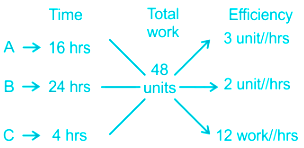
    Efficiency of A = -3units/hr

    Efficiency of B = -2 units/ hr

    Efficiency of C = 12 units/hr

    Here negative sign indicates the emptying nature of the pipes.

    Total work = 48 units

    35% of work = (35/100) × 48 = 16.8 units

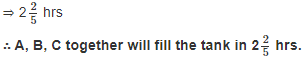
    Time to fill the tank by A, B, and C together =  16.8/(12 - 3 - 2)

    ⇒ 16.8/7 = 12/5
    Alternate Method 

    A's efficiency = 1/16

    B's efficiency = 1/24

    C's efficiency = 1/4

    Total efficiency = 1/4 - 1/24 - 1/16 (pipes A and B are the emptying the tank Hence their efficiency is taken negatively here)

    ⇒ (12 - 3 - 2)/48 = 7/48

    The time taken to fill the 100% tank = 48/7 hrs

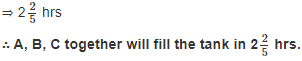
    Time taken to fill 35% of the tank = 48× 35/(7 × 100) 

    ⇒ 12/5 hrs
  • Question 4/10
    2 / -0.5

    A sum of ₹5,076 was to be divided among A, B and C in the ratio 3 ∶ 5 ∶ 4 but it was divided by mistake, in the ratio   As a result:

    Solutions

    Given:

    Sum = ₹5,076

    Actual ratio = 3 ∶ 5 ∶ 4

    Amount got by A = 5076 × (20/47)

    ⇒ 2160

    Amount got by B = 5076 × (12/47)

    ⇒ 1296

    Amount got by C = 5076 × (15/47)

    ⇒ 1620

    Amount should get by A = 5076 × (3/12)

    ⇒ 1269

    Amount should get by B = 5076 × (5/12)

    ⇒ 2115

    Amount should get by C = 5076 × (4/12)

    ⇒ 1692

    Difference in actual amount of A = 2160 - 1269

    ⇒ 891 gain

    Difference in actual amount of B= 2115 - 1296

    ⇒ 819 lost

    Difference in actual amount of C= 1692 - 1620

    ⇒ 72 lost

    ∴ The required answer is Option 3.

  • Question 5/10
    2 / -0.5

    Kabir climb up a hill at a speed of 3 miles per hour and comes down at 5 miles per hour. If total time taken for the total journey is 10 hours, then what was the distance between hill top and foothills?

    Solutions

    Given

    Up speed: 3 mph, Down speed: 5 mph

    Total time: 10 hours

    Concept:

    Harmonic mean for two speeds and the time-distance relationship

    Calculation:

    Therefore, the distance between the hilltop and the foothills is 18.75 miles

  • Question 6/10
    2 / -0.5

    Select the option that is related to the third letter-group in the same way as the second letter-group is related to the first letter-group.

    METAL : OCVYN :: REUSE : ?

    Solutions

    The positions of the letters according to the English alphabet series:

    The pattern for this is as follows;

    Hence, the correct answer is "TCWQG".

  • Question 7/10
    2 / -0.5

    If < means –, > means +, = means × and $ means ÷, then what is the value of 29 > 30 $ 5 < 4?

    Solutions

    Given that:-

    29 > 30 $ 5 < 4

    • Putting the value on above equation:-

    29 + 30 ÷ 5 - 4

    • Apply BODMAS rule:-

    = 29 + 6 - 4

    = 35 - 4

    = 31

    Hence, "option 3" is the correct answer.

  • Question 8/10
    2 / -0.5

    Select the word which is related to the third word in the same way as the second word is related to the first word:

    Wrist : Shoulder :: Ankle : _______

    Solutions

    The logic followed here is:-

    • The wrist is the ending joint of the arm whereas the shoulder is the beginning joint of the arm

    Similarly,

    • The ankle is the ending joint of the arm whereas the hip is the beginning joint of the leg

    Hence, "option 1" is the correct answer.

    Additional Information

    Joints:

    • Joints are where two bones meet.
    • They make the skeleton flexible — without them, movement would be impossible.

    Joints allow our bodies to move in many ways.

    • Some joints open and close like a hinge (such as knees and elbows),
    • whereas others allow for more complicated movement — a shoulder or hip joint, for example, allows for backward, forward, sideways, and rotating movement.

    Joints are classified by their range of movement:

    • Immovable, or fibrous, joints don't move.
    • Partially movable, or cartilaginous (pronounced: kar-tuh-LAH-juh-nus), joints move a little.
    • Freely movable, or synovial (pronounced: sih-NO-vee-ul), joints move in many directions.
  • Question 9/10
    2 / -0.5

    1, 4, 9, 16,_______, 36, 49 are the missing numbers in the number series.

    Solutions

    The logic followed here is:-

    Hence, "option 4" is the correct answer.

  • Question 10/10
    2 / -0.5

    Select the option which is related to the third word in the same way that the second word is related to the first word.

    Prose : Poetry :: Conversation : ________

    Solutions

    The logic followed here is:-

    • Prose and poetry are forms of literature.
    • Similarly, conversation and song are forms of vocalization.

    Hence, "option 3" is the correct answer.

Close button icon
User Profile
-

Correct (-)

Wrong (-)

Skipped (-)


  • 1
  • 2
  • 3
  • 4
  • 5
  • 6
  • 7
  • 8
  • 9
  • 10
Mockers logo Get latest Exam Updates
& Study Material Alerts!
No, Thanks
Arrow pointer icon
Click on Allow to receive notifications
Notification bell icon ×
Open Now
