Please wait...

SSC Selection Post-XII 2024 (Graduation) Reasoning Test - 3
Menu grid icon
Result Result point icon
SSC Selection Post-XII 2024 (Graduation) Reasoning Test - 3
  • Goals icon

    /

    Score
  • Trophy icon

    -

    Rank
White alarm icon Time Taken: -
Result frame illustration
  • Question 1/10
    2 / -0.5

    Select the option figure in which the given figure (X) is embedded as its part (rotation is NOT allowed).

    Solutions

    The embedded part of this image is:

    Hence, the correct answer is "Option (2)".

  • Question 2/10
    2 / -0.5

    Two Statements are given followed by two conclusions numbered I and II. Assuming the statements to be true, even if they seem to be at variance with commonly known facts, decide which of the conclusions logically follow(s) from the statements.

    Statements:

    No girl is a horse.

    Rachel is a girl.

    Conclusions:

    I. Rachel is not a horse.

    II. All girls are not Rachel.

    Solutions

    Statements:

    No girl is a horse.

    Rachel is a girl.

    The Venn diagram as per the given statements:

    Conclusions:

    I. Rachel is not a horse. → Follow (Rachel is a girl, and no girl is a horse, which means Rachel is not a horse is definitely true)

    II. All girls are not Rachel. → Does not follow (Rachel is a girl, which means all girls are Rachel)

    Hence, the correct answer is "Only conclusion (I) follows".

  • Question 3/10
    2 / -0.5

    Select the option that is related to the third letter cluster in the same way as the second letter cluster is related to the first letter cluster.

    KITCHEN : TIKCNEH :: PLUMBER : ?

    Solutions

    Given:

    KITCHEN : TIKCNEH :: PLUMBER : ?

    Logic: The alphabet changes diagonally which is in odd places.

    KITCHEN : TIKCNEH →

    Here, 'PLUMBER' is coded as 'ULPMREB'.

    Hence, the correct answer is "Option (2)".

  • Question 4/10
    2 / -0.5

    Six brothers Aman, Bunty, Chandu, Deepak, Emad and Faisal, each has a different height. Bunty is taller than only three brothers. Faisal is only taller than Deepak. Chandu is shorter than Aman only. Who is the fourth tallest among the brothers?

    Solutions

    As per the given information:

    1. Bunty is taller than only three brothers.

    _ > _ >  Bunty > _ > _ > _

    2. Faisal is only taller than Deepak.

    _ > _ >  Bunty > _ > Faisal > Deepak

    3. Chandu is shorter than Aman only.

    Aman > Chandu >  Bunty > _ > Faisal > Deepak

    4. The remaining brother Emad is taller than Faisal and shorter than Bunty.

    Aman > Chandu >  Bunty > Emad > Faisal > Deepak

    Here, 'Emad' is the fourth tallest.

    Hence, the correct answer is "Option (2)".

  • Question 5/10
    2 / -0.5

    Which two numbers should be interchanged to make the given equation correct?

    84 ÷ 6 + 16 - 14 × 2 = 10

    Solutions

    Here, we use the table given below:
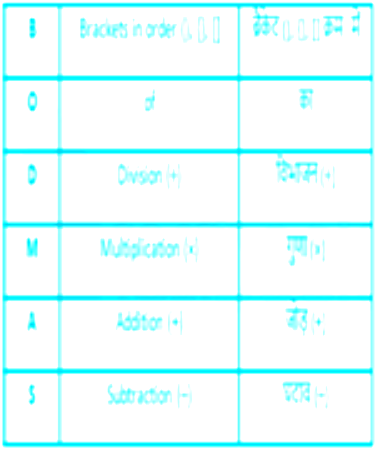
    Given equations:

    ⇒ 84 ÷ 6 + 16 - 14 × 2 = 10

    Checking all the given options:

    (1) 6 and 14

    ⇒ 84 ÷ 6 + 16 - 14 × 2 = 10

    After interchanging:

    ⇒ 84 ÷ 14 + 16 - 6 × 2 = 10

    Apply BODMAS rule:

    ⇒ 6 + 16 - 6 × 2

    ⇒ 6 + 16 - 12

    ⇒ 22 - 12 = 10

    ⇒ '84 ÷ 14 + 16 - 6 × 2 = 10'

    Here, the equation is satisfied.

    (2) 2 and 84

    ⇒ 84 ÷ 6 + 16 - 14 × 2 = 10

    After interchanging:

    ⇒ 2 ÷ 6 + 16 - 14 × 84 = 10

    Apply BODMAS rule:

    ⇒ 0.33 + 16 - 14 × 84

    ⇒ 0.33 + 16 - 1176

    ⇒ (-1159.67)

    ⇒ '2 ÷ 6 + 16 - 14 × 84 = (-1159.67)'

    Here, the equation is not satisfied.

    (3) 10 and 14

    ⇒ 84 ÷ 6 + 16 - 14 × 2 = 10

    After interchanging:

    ⇒ 84 ÷ 6 + 16 - 10 × 2 = 14

    Apply BODMAS rule:

    ⇒ 14 + 16 - 10 × 2

    ⇒ 14 + 16 - 20

    ⇒ 30 - 20 = 10

    ⇒ '84 ÷ 6 + 16 - 10 × 2 = 10'

    Here, the equation is not satisfied.

    (4) 6 and 10

    ⇒ 84 ÷ 6 + 16 - 14 × 2 = 10

    After interchanging:

    ⇒ 84 ÷ 10 + 16 - 14 × 2 = 6

    Apply BODMAS rule:

    ⇒ 8.4 + 16 - 14 × 2

    ⇒ 8.4 + 16 - 28

    ⇒ 24.4 - 28 = (-3.6)

    ⇒ '84 ÷ 10 + 16 - 14 × 2 = (-3.6)'

    Here, the equation is not satisfied.

    Hence, the correct answer is "Option (1)".

  • Question 6/10
    2 / -0.5

    In a certain code language, ‘HERO' is coded as '7, 4, 17, 14', 'ICON' is coded as '8, 2, 14, 13'. What is the code for 'JOIN' in that code language?

    Solutions

    Here, we use the table given below:

    Logic: 1 is subtracted from each alphabet positional value to form code.

    ‘HERO' is coded as '7, 4, 17, 14' →

  • Question 7/10
    2 / -0.5

    Two Statements are given followed by two conclusions numbered I and II. Assuming the statements to be true, even if they seem to be at variance with commonly known facts, decide which of the conclusions logically follow(s) from the statements.

    Statements:

    Some kings are rich.

    Some rich are proud.

    Conclusions:

    I. Some kings are not proud.

    II. Some rich are not proud. 

    Solutions

    Statements:

    Some kings are rich.

    Some rich are proud.

    The Venn diagram as per the given statements is:

    Conclusions:

    I. Some kings are not proud → Does not follow (Because there is no definite relation given between kings and proud, so it can be possible but not definitely true)

    II. Some rich are not proud → Does not follow (Both the statements are positive so the conclusion should also be positive, Some rich are not proud can be possible but not definitely true)

    Hence, the correct answer is "Neither conclusion I nor II follows".

  • Question 8/10
    2 / -0.5

    In a certain code language, 'SPEAKER' is written as 'RQDBJFQ'. How will 'MOBILE’ be written in that language?

    Solutions

    Here, we use the table given below:

    Logic: 1 is subtracted and 1 is added alternately to the position value according to the English alphabetic series.

    'SPEAKER' is written as 'RQDBJFQ' →

    Here, 'MOBILE’ is written as 'LPAJKF'.

    Hence, the correct answer is "Option (4)".

  • Question 9/10
    2 / -0.5

    Study the given pattern carefully and select the number that can replace the question mark (?) in it.

    First row- 6, 216, 180

    Second row- 8, 512, 448

    Third row- 10, 1000, ?

    Solutions

    Given:

    First row- 6, 216, 180

    Second row- 8, 512, 448

    Third row- 10, 1000, ? 

    Logic: 'Row wise'

    First row → [(First no.), (First no. × First no. × First no.), {First no. × First no. × (First no. - 1)}]

    First row- 6, 216, 180→

    ⇒ [(6), (6 × 6 × 6), {6 × 6 × (6 - 1)}]

    ⇒ [(6), (6 × 6 × 6), {6 × 6 × (5)}]

    ⇒ (6, 216, 180)

    Second row- 8, 512, 448→

    ⇒ [(8), (8 × 8 × 8), {8 × 8 × (8 - 1)}]

    ⇒ [(8), (8 × 8 × 8), {8 × 8 × (7)}]

    ⇒ (8, 512, 448)

    Similarly,

    Third row- 10, 1000, ?→

    ⇒ [(10), (10 × 10 × 10), {10 × 10 × (10 - 1)}]

    ⇒ [(10), (10 × 10 × 10), {10 × 10 × (9)}]

    ⇒ (10, 1000, 900)

    Here, the question mark(?) is replaced by '900'.

    Hence, the correct answer is "Option (3)".

  • Question 10/10
    2 / -0.5

    Select the option that is related to the third number in the same way as the second number is related to the first number.

    5 : 125 :: 8 : ?

    Solutions

    Given:

    5 : 125 :: 8 : ?

    Logic:

    Second number = (First number)3

    5 : 125 →

    125 = (5)3

    Similarly, for '8 : ?' →

    (8)3 = 512

    Here, '8 : 512' is the correct pair.

    Hence, the correct answer is "Option (1)".

Close button icon
User Profile
-

Correct (-)

Wrong (-)

Skipped (-)


  • 1
  • 2
  • 3
  • 4
  • 5
  • 6
  • 7
  • 8
  • 9
  • 10
Mockers logo Get latest Exam Updates
& Study Material Alerts!
No, Thanks
Arrow pointer icon
Click on Allow to receive notifications
Notification bell icon ×
Open Now
