Please wait...

SSC Selection Post-XII 2024 (HS) Reasoning Test - 8
Menu grid icon
Result Result point icon
SSC Selection Post-XII 2024 (HS) Reasoning Test - 8
  • Goals icon

    /

    Score
  • Trophy icon

    -

    Rank
White alarm icon Time Taken: -
Result frame illustration
  • Question 1/10
    2 / -0.5

    What will come in the place of the question mark (?) in the following equation if '+' and '-' are interchanged and '×' and '÷' are interchanged?

    42 × 7 ÷ 13 - 87 + 12 = ?

    Solutions

    Given equation: 42 × 7 ÷ 13 - 87 + 12 = ?

    If '+' and '-' are interchanged and '×' and '÷' are interchanged, then the equation becomes:

    42 ÷ 7 × 13 + 87 - 12 = ?

    ⇒ 6 × 13 + 87 - 12 = ?

    ⇒ 78 + 87 - 12 = ?

    ⇒ 165 - 12 = ?

    ⇒ 153 = ?

    Hence, ‘153’ is the correct answer.

  • Question 2/10
    2 / -0.5

    Rashmi is shorter than Monika who is shorter than Prerna. Sana is shorter than Rashmi. Harshita is taller than Prerna. Uma is shorter than Nikita and taller than Harshita. Who among them is the shortest?

    Solutions

    As per the given information,

    1) Rashmi is shorter than Monika who is shorter than Prerna.

    Prerna > Monika > Rashmi

    2) Harshita is taller than Prerna.

    Harshita > Prerna > Monika > Rashmi

    3) Uma is shorter than Nikita and taller than Harshita.

    Nikita > Uma > Harshita > Prerna > Monika > Rashmi

    4) Sana is shorter than Rashmi.

    Nikita > Uma > Harshita > Prerna > Monika > Rashmi > Sana

    Here, we can see that Sana is the shortest.

    Hence, the correct answer is "Sana".

  • Question 3/10
    2 / -0.5

    Arrange the following words in a logical and meaningful order.

    1. chapter

    2. sentence

    3. letter

    4. phrase

    5. word

    Solutions

    The correct arrangement in a logical and meaningful order is,

    3) letter

    5) word

    4) phrase

    2) sentence

    1) chapter

    Hence, the correct answer is "3, 5, 4, 2, 1".

  • Question 4/10
    2 / -0.5

    Which of the following four options can replace the question mark (?) in the following series?

    66, 87, 110, ?, 162, 191

    Solutions

    Given:

    66, 87, 110, ?, 162, 191

    The logic followed in the given series is:

    Here, the missing term is '135'.

    Hence, the correct answer is "Option (4)".

  • Question 5/10
    2 / -0.5

    Seven girls Mansi, Shweta, Monika, Payal, Aarti, Kajal and Laxmi are sitting around a circular table facing opposite to the centre (not necessarily in the same order). Kajal is second to the left of Laxmi. Payal is the immediate neighbour of both Mansi and Laxmi. Monika is not the immediate neighbour of Laxmi. Aarti is second to the left of Kajal. Who is sitting second to the left of Payal?

    Solutions

    As per the given information, the sitting arrangement is:

    1. Kajal is second to the left of Laxmi and Payal is the immediate neighbour of both Mansi and Laxmi.

    2. Aarti is second to the left of Kajal and Monika is not the immediate neighbour of Laxmi.

    3. The remaining girl Shweta is sitting to the right of Kajal.

    Here, 'Shweta' is sitting second to the left of Payal.

    Hence, the correct answer is "Option (4)".

  • Question 6/10
    2 / -0.5

    Select the word-pair that best represents a relationship similar to the one expressed in the word-pair given below.

    (The words should be considered meaningful words, and should not be related to each other based on the number of letters/consonants/vowels in the word.)

    Mustang : Horse

    Solutions

    Mustang is a specific breed or type of Horse.

    Similarly;

    The Burmese cat is a breed of domestic cat, originating in Burma, believed to have its roots near the Thai-Burma border and developed in the United States and Britain.

    Hence, the correct answer is "Burmese : Cat".

  • Question 7/10
    2 / -0.5

    Which answer figure will complete the pattern of the question figure?

    Solutions

    The logic followed here is:

    Hence,  "Option (2)" is the correct answer.

  • Question 8/10
    2 / -0.5

    Pointing to Kapil, Shilpa said, "His mother's brother is the father of my son Ashish". How is Kapil related to Shilpa?

    Solutions

    By using the following symbols in the table given below, we can draw the following family tree:

    Given statement: Pointing towards Kapil, Shilpa said, "His mother's brother is the father of my son Ashish".

    → Shilpa said that Kapil's mother's brother i.e. Kapil's maternal uncle is the father of Shilpa's son Ashish.

    Clearly, Kapil is the nephew of Shilpa.

    Hence, the correct answer is "Nephew".

  • Question 9/10
    2 / -0.5

    Three Statements are given followed by Three conclusions numbered I, II and III. Assuming the statements to be true, even if they seem to be at variance with commonly known facts, decide which of the conclusions logically follow(s) from the statements.

    Statements:

    All valleys are mountains.

    No sea is a mountain.

    Some plains are seas.

    Conclusions:

    I. Some valleys are plains.

    II. No plain is a mountain.

    III. No sea is a valley.

    Solutions

    Given Statements:

    All valleys are mountains.

    No sea is a mountain.

    Some plains are seas.

    The least possible Venn diagram for the given statement is:

    Conclusions:

    I. Some valleys are plains - False (Because, No definite relation given between valleys and plains, So, Some valleys are plains can be possible only).

    II. No plain is a mountain - False (Because, No definite relation given between plain and mountain, So, No plain is a mountain can be possible only).

    III. No sea is a valley - True (Because, All the valleys are mountains and No mountain is Sea, so No sea is a valley).

    So, Only conclusion III follows.

    Hence, the correct answer is "Option 2".

  • Question 10/10
    2 / -0.5

    Which two numbers and two signs should be interchanged in the following equation to make it correct?

    7 × 14 ÷ 6 + 12 + 6 = 30

    Solutions

    Here, we use the BODMAS table given below:
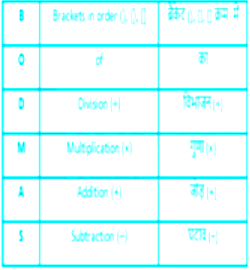
    Given:

    ⇒ 7 × 14 ÷ 6 + 12 + 6 = 30

    (1) 7 and 6 × and ÷

    ⇒ 7 × 14 ÷ 6 + 12 + 6 = 30

    After interchanging the sign and number:

    ⇒ 6 ÷ 14 × 7 + 12 + 7 = 30

    Apply BODMAS rule:

    ⇒ 0.428 × 7 + 12 + 7

    ⇒ 3 + 12 + 7

    ⇒ 15 + 7 = 22

    Here, the equation is not satisfied.

    (2) 7 and 14, × and ÷

    ⇒ 7 × 14 ÷ 6 + 12 + 6 = 30

    After interchanging the sign and number:

    ⇒ 14 ÷ 7 × 6 + 12 + 6 = 30

    Apply BODMAS rule:

    ⇒ 2 × 6 + 12 + 6

    ⇒ 12 + 12 + 6

    ⇒ 24 + 6 = 30

    ⇒ '14 ÷ 7 × 6 + 12 + 6 = 30'

    Here, the equation is satisfied.

    (3) 7 and 6, ÷ and +

    ⇒ 7 × 14 ÷ 6 + 12 + 6 = 30

    After interchanging the sign and number:

    ⇒ 6 × 14 + 7 ÷ 12 ÷ 7 = 30

    Apply BODMAS rule:

    ⇒ 6 × 14 + 7 ÷ 1.714

    ⇒ 6 × 14 + 4.08

    ⇒ 84 + 4.08

    ⇒ 88.08

    Here, the equation is not satisfied.

    (4) 7 and 14, × and +

    ⇒ 7 × 14 ÷ 6 + 12 + 6 = 30

    After interchanging the sign and number:

    ⇒ 14 + 7 ÷ 6 × 12 × 6 = 30

    Apply BODMAS rule:

    ⇒ 14 + 7 ÷ 6 × 12 × 6

    ⇒ 14 + 1.166 × 12 × 6

    ⇒ 14 + 84 = 98

    Here, the equation is not satisfied.

    Hence, the correct answer is "Option (3)".

Close button icon
User Profile
-

Correct (-)

Wrong (-)

Skipped (-)


  • 1
  • 2
  • 3
  • 4
  • 5
  • 6
  • 7
  • 8
  • 9
  • 10
Mockers logo Get latest Exam Updates
& Study Material Alerts!
No, Thanks
Arrow pointer icon
Click on Allow to receive notifications
Notification bell icon ×
Open Now
