Please wait...

IBPS RRB OS-1 2024 Reasoning Test - 2
Menu grid icon
Result Result point icon
IBPS RRB OS-1 2024 Reasoning Test - 2
  • Goals icon

    /

    Score
  • Trophy icon

    -

    Rank
White alarm icon Time Taken: -
Result frame illustration
  • Question 1/10
    1 / -0.25

    Directions For Questions

    Direction: Read the given information carefully and answer the following questions.

    P, Q, R, S, T, U, and V are seven employees working in three departments Marketing, Finance and Production. In each department, not more than three persons are working. P and U do not work in the same department. R and V do not work in the Production department. P works with T in the same department. S neither works in the Finance department nor the marketing department. P, R, and S work in different departments. U does not work with S. Only two persons work in the Finance department. V works in the Marketing department and does not work with U.

    ...view full instructions


    Which two employees belong to Finance department?

    Solutions

    There are three departments and Seven employees. Three departments are Finance, Production, and Marketing. Seven Employees are P, Q, R, S, T, U, and V.

    1) V works in the Marketing department and S neither works in the Finance department nor the marketing department.

    So, S works in the Production Department and V works in the Marketing Department.

    2) P, R, and S work in different departments and P works with T in the same department.

    We know the position of S but the R and P department is not known to us. So, there will be two cases. In one of the cases, we will assume R belongs to the Finance department and in another belong to the Marketing department.

    3) U does not work with S. P and U do not work in the same department. V does not work with U. 

    According to the given conditions U cannot work with V, P, and S. We cannot place U in any department in Case 1. So, Case 1 would be eliminated.

    4) Only two persons work in the Finance department. Also, according to the given conditions not more than three people work in the same department. So, Q works in the Production department.

    The final arrangement is:

    Hence, U and R belong to the Finance department.

  • Question 2/10
    1 / -0.25

    Directions For Questions

    Direction: Read the given information carefully and answer the following questions.

    P, Q, R, S, T, U, and V are seven employees working in three departments Marketing, Finance and Production. In each department, not more than three persons are working. P and U do not work in the same department. R and V do not work in the Production department. P works with T in the same department. S neither works in the Finance department nor the marketing department. P, R, and S work in different departments. U does not work with S. Only two persons work in the Finance department. V works in the Marketing department and does not work with U.

    ...view full instructions


    Q works in which department?

    Solutions

    There are three departments and Seven employees. Three departments are Finance, Production, and Marketing. Seven Employees are P, Q, R, S, T, U, and V.

    1) V works in the Marketing department and S neither works in the Finance department nor the marketing department.

    So, S works in the Production Department and V works in the Marketing Department.

    2) P, R, and S work in different departments and P works with T in the same department.

    We know the position of S but the R and P department is not known to us. So, there will be two cases. In one of the cases, we will assume R belongs to the Finance department and in another belong to the Marketing department.

    3) U does not work with S. P and U do not work in the same department. V does not work with U. 

    According to the given conditions U cannot work with V, P, and S. We cannot place U in any department in Case 1. So, Case 1 would be eliminated.

    4) Only two persons work in the Finance department. Also, according to the given conditions not more than three people work in the same department. So, Q works in the Production department.

    The final arrangement is:

    Hence, Q belongs to the Production department.

  • Question 3/10
    1 / -0.25

    Directions For Questions

    Direction: Read the given information carefully and answer the following questions.

    P, Q, R, S, T, U, and V are seven employees working in three departments Marketing, Finance and Production. In each department, not more than three persons are working. P and U do not work in the same department. R and V do not work in the Production department. P works with T in the same department. S neither works in the Finance department nor the marketing department. P, R, and S work in different departments. U does not work with S. Only two persons work in the Finance department. V works in the Marketing department and does not work with U.

    ...view full instructions


    Which of the following works in Production Department?

    Solutions

    There are three departments and Seven employees. Three departments are Finance, Production, and Marketing. Seven Employees are P, Q, R, S, T, U, and V.

    1) V works in the Marketing department and S neither works in the Finance department nor the marketing department.

    So, S works in the Production Department and V works in the Marketing Department.

    2) P, R, and S work in different departments and P works with T in the same department.

    We know the position of S but the R and P department is not known to us. So, there will be two cases. In one of the cases, we will assume R belongs to the Finance department and in another belong to the Marketing department.

    3) U does not work with S. P and U do not work in the same department. V does not work with U. 

    According to the given conditions U cannot work with V, P, and S. We cannot place U in any department in Case 1. So, Case 1 would be eliminated.

    4) Only two persons work in the Finance department. Also, according to the given conditions not more than three people work in the same department. So, Q works in the Production department.

    The final arrangement is:

    S and Q work in the production department. Hence, S works in the Production department.

  • Question 4/10
    1 / -0.25

    Directions For Questions

    Directions: Read the given information carefully and answer the following questions.

    Each of the six persons Somya, Rohit, Chintu, Amit, John, and Preeti has a different number of chocolates. The numbers of chocolates they have are 2, 3, 5, 6, 8, and 10 but not necessarily in the same order.

    The Number of chocolate Rohit has is the product of John and Chintu’s chocolate. Amit’s chocolate is the sum of John and Somya's chocolate. Amit does not have the maximum number of chocolates. Somya has less chocolate than John

    ...view full instructions


    Who has the maximum number of chocolates?

    Solutions

    Six Persons: Somya, Rohit, Chintu, Amit, John, and Preeti.

    Number of chocolates: 2, 3, 5, 6, 8, and 10

    1) The Number of chocolate Rohit has is the product of John and Chintu’s chocolate.

    Rohit chocolates = John’s chocolate* Chintu’s chocolate

    We know, 10=5*2 and 6=3*2

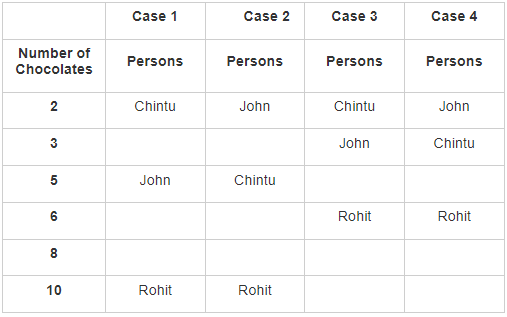
    So, Rohit could have either 10 chocolates or 6 chocolates. If Rohit has 10 chocolates then John and Chintu could have 5 and 2 chocolates but not necessarily in the same order. If Rohit has 6 chocolates then John and Chintu could have 3 and 2 chocolates but not necessarily in the same order. It gives rise to four cases.
    2) Somya has less chocolate than John.

    Number of Chocolates John could have is 2, 3, and 5.

    If John has two chocolate then the condition that Somya has less chocolate than John could not be followed. So, Cases 2 and 4 are eliminated.

    If John has three chocolates then Somya would have 2 chocolates. But, Chintu already has 2 chocolates. So, Case 3 is eliminated.

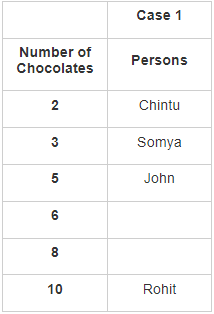
    If John has five chocolates then Somya would have 3 chocolates in Case 1.
    3) Amit’s chocolate is the sum of John and Somya's chocolate. Amit does not have the maximum number of chocolates.

    Amit’s chocolate = John’s chocolate + Somya’s chocolate.

    John has 5 chocolates and Somya has 3 chocolates. So, Amit has 8 chocolates (8=5+3)

    4) Preeti would have 6 chocolates because that is the left for Preeti.

    The final arrangement is:
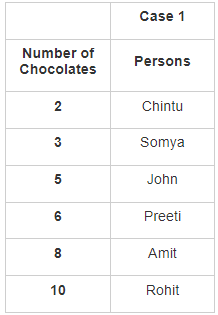
    Hence, Rohit has the maximum number of chocolates.

  • Question 5/10
    1 / -0.25

    Directions For Questions

    Directions: Read the given information carefully and answer the following questions.

    Each of the six persons Somya, Rohit, Chintu, Amit, John, and Preeti has a different number of chocolates. The numbers of chocolates they have are 2, 3, 5, 6, 8, and 10 but not necessarily in the same order.

    The Number of chocolate Rohit has is the product of John and Chintu’s chocolate. Amit’s chocolate is the sum of John and Somya's chocolate. Amit does not have the maximum number of chocolates. Somya has less chocolate than John

    ...view full instructions


    How many chocolates Preeti has?

    Solutions

    Six Persons: Somya, Rohit, Chintu, Amit, John, and Preeti.

    Number of chocolates: 2, 3, 5, 6, 8, and 10

    1) The Number of chocolate Rohit has is the product of John and Chintu’s chocolate.

    Rohit chocolates = John’s chocolate* Chintu’s chocolate

    We know, 10=5*2 and 6=3*2

    So, Rohit could have either 10 chocolates or 6 chocolates. If Rohit has 10 chocolates then John and Chintu could have 5 and 2 chocolates but not necessarily in the same order. If Rohit has 6 chocolates then John and Chintu could have 3 and 2 chocolates but not necessarily in the same order. It gives rise to four cases.

    2) Somya has less chocolate than John.

    Number of Chocolates John could have is 2, 3, and 5.

    If John has two chocolate then the condition that Somya has less chocolate than John could not be followed. So, Cases 2 and 4 are eliminated.

    If John has three chocolates then Somya would have 2 chocolates. But, Chintu already has 2 chocolates. So, Case 3 is eliminated.

    If John has five chocolates then Somya would have 3 chocolates in Case 1.

    3) Amit’s chocolate is the sum of John and Somya's chocolate. Amit does not have the maximum number of chocolates.

    Amit’s chocolate = John’s chocolate + Somya’s chocolate.

    John has 5 chocolates and Somya has 3 chocolates. So, Amit has 8 chocolates (8=5+3)

    4) Preeti would have 6 chocolates because that is the left for Preeti.

    The final arrangement is:

    Hence, Preeti has Six chocolates.

  • Question 6/10
    1 / -0.25

    Directions For Questions

    Directions: Read the given information carefully and answer the following questions.

    Each of the six persons Somya, Rohit, Chintu, Amit, John, and Preeti has a different number of chocolates. The numbers of chocolates they have are 2, 3, 5, 6, 8, and 10 but not necessarily in the same order.

    The Number of chocolate Rohit has is the product of John and Chintu’s chocolate. Amit’s chocolate is the sum of John and Somya's chocolate. Amit does not have the maximum number of chocolates. Somya has less chocolate than John

    ...view full instructions


    What is the difference of the number of chocolates Chintu and Amit have?

    Solutions

    Six Persons: Somya, Rohit, Chintu, Amit, John, and Preeti.

    Number of chocolates: 2, 3, 5, 6, 8, and 10

    1) The Number of chocolate Rohit has is the product of John and Chintu’s chocolate.

    Rohit chocolates = John’s chocolate* Chintu’s chocolate

    We know, 10=5*2 and 6=3*2

    So, Rohit could have either 10 chocolates or 6 chocolates. If Rohit has 10 chocolates then John and Chintu could have 5 and 2 chocolates but not necessarily in the same order. If Rohit has 6 chocolates then John and Chintu could have 3 and 2 chocolates but not necessarily in the same order. It gives rise to four cases.

    2) Somya has less chocolate than John.

    Number of Chocolates John could have is 2, 3, and 5.

    If John has two chocolate then the condition that Somya has less chocolate than John could not be followed. So, Cases 2 and 4 are eliminated.

    If John has three chocolates then Somya would have 2 chocolates. But, Chintu already has 2 chocolates. So, Case 3 is eliminated.

    If John has five chocolates then Somya would have 3 chocolates in Case 1.

    3) Amit’s chocolate is the sum of John and Somya's chocolate. Amit does not have the maximum number of chocolates.

    Amit’s chocolate = John’s chocolate + Somya’s chocolate.

    John has 5 chocolates and Somya has 3 chocolates. So, Amit has 8 chocolates (8=5+3)

    4) Preeti would have 6 chocolates because that is the left for Preeti.

    The final arrangement is:

    Chintu has 2 chocolates and Amit has 8 chocolates. So, the difference between Chintu and Amit chocolate is Six.

  • Question 7/10
    1 / -0.25

    Directions For Questions

    Directions: Read the instructions carefully to answer the following questions:

    There are ten persons sitting in two parallel rows in such a manner that five persons - P, Q, R, S, T are sitting in a row - 1 facing towards the south direction and five persons - A, B, C, D, E are sitting in a row - 2 facing towards the north, such that all persons in both the rows facing each other.

    Q is sitting at the end of the row (either left or right). A is sitting opposite to the one who is second to the right of Q. A and D are immediate neighbours of each other and D is second to the right of E. S is third to the left of R and is not neighbour of T. R is opposite to B.

    ...view full instructions


    Who is sitting opposite to E?

    Solutions

    1) A is sitting opposite to the one who is second to the right of Q. 

    2) Q is sitting at the end of the row (either left or right)

    So, Q will sit at the right end of the row:

    3) A and D are immediate neighbours of each other and D is second to the right of E:

    So, D will sit to the immediate right of A.

    4) S is third to the left of R and is not neighbour of T.

    5) R is opposite to B.

    So, B will sit immediate left of E and C will sit to the immediate right of D:

    Here, S is not the neighbour of T, so T will sit immediate left of R and P will sit immediate right of S.

    So, the final figure according to the question is:

    Hence, is sitting opposite to E.

  • Question 8/10
    1 / -0.25

    Directions For Questions

    Directions: Read the instructions carefully to answer the following questions:

    There are ten persons sitting in two parallel rows in such a manner that five persons - P, Q, R, S, T are sitting in a row - 1 facing towards the south direction and five persons - A, B, C, D, E are sitting in a row - 2 facing towards the north, such that all persons in both the rows facing each other.

    Q is sitting at the end of the row (either left or right). A is sitting opposite to the one who is second to the right of Q. A and D are immediate neighbours of each other and D is second to the right of E. S is third to the left of R and is not neighbour of T. R is opposite to B.

    ...view full instructions


    Which pair of persons is sitting diagonally opposite to each other?

    Solutions

    1)  A is sitting opposite to the one who is second to the right of Q. 

    2) Q is sitting at the end of the row (either left or right)

    So, Q will sit at the right end of the row:

    3) A and D are immediate neighbours of each other and D is second to the right of E:

    So, D will sit to the immediate right of A.

    4) S is third to the left of R and is not a neighbour of T.

    5) R is opposite to B.

    So, B will sit immediate left of E and C will sit to the immediate right of D:

    Here, S is not the neighbour of T, so T will sit immediate left of R and P will sit immediate right of S.

    So, the final figure according to the question is:

    Hence, Both 1 and 2 (RC and BQ) are sitting diagonally opposite to each other.

  • Question 9/10
    1 / -0.25

    Directions For Questions

    Directions: Read the instructions carefully to answer the following questions:

    There are ten persons sitting in two parallel rows in such a manner that five persons - P, Q, R, S, T are sitting in a row - 1 facing towards the south direction and five persons - A, B, C, D, E are sitting in a row - 2 facing towards the north, such that all persons in both the rows facing each other.

    Q is sitting at the end of the row (either left or right). A is sitting opposite to the one who is second to the right of Q. A and D are immediate neighbours of each other and D is second to the right of E. S is third to the left of R and is not neighbour of T. R is opposite to B.

    ...view full instructions


    Who is third to the right of the one who is opposite to R?

    Solutions

    1)  A is sitting opposite to the one who is second to the right of Q. 

    2) Q is sitting at the end of the row (either left or right)

    So, Q will sit at the right end of the row:

    3) A and D are immediate neighbours of each other and D is second to the right of E:

    So, D will sit to the immediate right of A.

    4) S is third to the left of R and is not a neighbour of T.

    5) R is opposite to B.

    So, B will sit immediate left of E and C will sit to the immediate right of D:

    Here, S is not the neighbour of T, so T will sit immediate left of R and P will sit immediate right of S.

    So, the final figure according to the question is:

    Here, opposite of R is B

    And 3rd to the right of B is D

    Hence, D is third to the right of the one who is opposite to R.

  • Question 10/10
    1 / -0.25

    Directions For Questions

    Directions: Read the instructions carefully to answer the following questions:

    There are ten persons sitting in two parallel rows in such a manner that five persons - P, Q, R, S, T are sitting in a row - 1 facing towards the south direction and five persons - A, B, C, D, E are sitting in a row - 2 facing towards the north, such that all persons in both the rows facing each other.

    Q is sitting at the end of the row (either left or right). A is sitting opposite to the one who is second to the right of Q. A and D are immediate neighbours of each other and D is second to the right of E. S is third to the left of R and is not neighbour of T. R is opposite to B.

    ...view full instructions


    Four of the following five are alike in a certain way thus form a group. Which one of the following does not belong to that group?

    Solutions

    1)  A is sitting opposite to the one who is second to the right of Q. 

    2) Q is sitting at the end of the row (either left or right)

    So, Q will sit at the right end of the row:

    3) A and D are immediate neighbours of each other and D is second to the right of E:

    So, D will sit to the immediate right of A.

    4) S is third to the left of R and is not neighbour of T.

    5) R is opposite to B.

    So, B will sit immediate left of E and C will sit to the immediate right of D:

    Here, S is not the neighbour of T, so T will sit immediate left of R and P will sit immediate right of S.

    So, the final figure according to the question is:

    Here, R, C, Q, B are sitting at the end of the rows except P.

    Hence, P does not belong to that group.

Close button icon
User Profile
-

Correct (-)

Wrong (-)

Skipped (-)


  • 1
  • 2
  • 3
  • 4
  • 5
  • 6
  • 7
  • 8
  • 9
  • 10
Mockers logo Get latest Exam Updates
& Study Material Alerts!
No, Thanks
Arrow pointer icon
Click on Allow to receive notifications
Notification bell icon ×
Open Now