Please wait...

IBPS RRB OS-1 2024 Reasoning Test - 6
Menu grid icon
Result Result point icon
IBPS RRB OS-1 2024 Reasoning Test - 6
  • Goals icon

    /

    Score
  • Trophy icon

    -

    Rank
White alarm icon Time Taken: -
Result frame illustration
  • Question 1/10
    1 / -0.25

    Directions For Questions

    Directions: Read the following information carefully and answer the questions given below.

    Seven boxes – Q, R, S, T, U, V and W – are placed one above the other not necessarily in the same order. Each box has a different number of chocolates among – 38, 49, 60, 67, 76, 83 and 92 – not necessarily in the same order.

    Three boxes are placed between Q and the box which has perfect square number of chocolates. Q is placed immediately above R. T has twice the number of chocolates with R. Five boxes are placed between R and S. The number of boxes placed above W is the same as the number of boxes placed below V. The difference between the number of chocolates between R and S is twice the difference between the number of chocolates between S and U. W is placed immediately above the box which has the highest number of chocolates but has more chocolates than T.

    ...view full instructions


    How many boxes are placed between the boxes which has the least and the highest number of chocolates?

    Solutions

    Boxes – 7; Q, R, S, T, U, V and W;

    Number of chocolates – 7; 38, 49, 60, 67, 76, 83 and 92;  

    1. Three boxes are placed between Q and the box which has perfect square number of chocolates.

    2. Q is placed immediately above R.

    3. T has twice the number of chocolates with R.

    From this we get the possible arrangement as follows. Hence, we can say that T has 76 chocolates in both the cases.
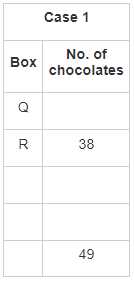
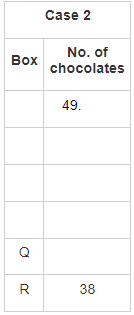
    4. Five boxes are placed between R and S.

    From this we can say that case 1 is eliminated, as we cannot place S.
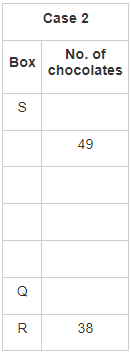
    5. The number of boxes placed above W is the same as the number of boxes placed below V.

    6. The difference between the number of chocolates between R and S is twice the difference between the number of chocolates between S and U.

    From this we can say that as R has 38 chocolates and U has 60 chocolates, hence, we can say that S has 60 chocolates. W and V are placed third from the ends, in any order. T is placed in the middle of the stack.

    From this we get the arrangement as follows.
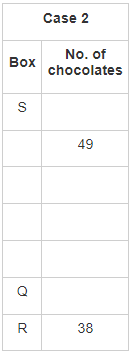
    7. W is placed immediately above the box which has the highest number of chocolates but has more chocolates than T.

    From this we get the final arrangement as follows.
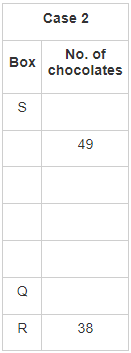
    No boxes are placed between the boxes which has the least and the highest number of chocolates.

    Hence, none is the correct answer.

  • Question 2/10
    1 / -0.25

    Directions For Questions

    Directions: Read the following information carefully and answer the questions given below.

    Seven boxes – Q, R, S, T, U, V and W – are placed one above the other not necessarily in the same order. Each box has a different number of chocolates among – 38, 49, 60, 67, 76, 83 and 92 – not necessarily in the same order.

    Three boxes are placed between Q and the box which has perfect square number of chocolates. Q is placed immediately above R. T has twice the number of chocolates with R. Five boxes are placed between R and S. The number of boxes placed above W is the same as the number of boxes placed below V. The difference between the number of chocolates between R and S is twice the difference between the number of chocolates between S and U. W is placed immediately above the box which has the highest number of chocolates but has more chocolates than T.

    ...view full instructions


    What is the sum of the number of chocolates with T and S?

    Solutions

    Boxes – 7; Q, R, S, T, U, V and W;

    Number of chocolates – 7; 38, 49, 60, 67, 76, 83 and 92;  

    1. Three boxes are placed between Q and the box which has perfect square number of chocolates.

    2. Q is placed immediately above R.

    3. T has twice the number of chocolates with R.

    From this we get the possible arrangement as follows. Hence, we can say that T has 76 chocolates in both the cases.

    4. Five boxes are placed between R and S.

    From this we can say that case 1 is eliminated, as we cannot place S.

    5. The number of boxes placed above W is the same as the number of boxes placed below V.

    6. The difference between the number of chocolates between R and S is twice the difference between the number of chocolates between S and U.

    From this we can say that as R has 38 chocolates and U has 60 chocolates, hence, we can say that S has 60 chocolates. W and V are placed third from the ends, in any order. T is placed in the middle of the stack.

    From this we get the arrangement as follows.

    7. W is placed immediately above the box which has the highest number of chocolates but has more chocolates than T.

    From this we get the final arrangement as follows.

    Hence, the sum of the number of chocolates with T and S is  76 + 60 = 136.

  • Question 3/10
    1 / -0.25

    Directions For Questions

    Directions: Read the following information carefully and answer the questions given below.

    Seven boxes – Q, R, S, T, U, V and W – are placed one above the other not necessarily in the same order. Each box has a different number of chocolates among – 38, 49, 60, 67, 76, 83 and 92 – not necessarily in the same order.

    Three boxes are placed between Q and the box which has perfect square number of chocolates. Q is placed immediately above R. T has twice the number of chocolates with R. Five boxes are placed between R and S. The number of boxes placed above W is the same as the number of boxes placed below V. The difference between the number of chocolates between R and S is twice the difference between the number of chocolates between S and U. W is placed immediately above the box which has the highest number of chocolates but has more chocolates than T.

    ...view full instructions


    Four of the following five are alike in a certain way and hence form a group. Find the one which does not belong to that group.

    Solutions

    Boxes – 7; Q, R, S, T, U, V and W;

    Number of chocolates – 7; 38, 49, 60, 67, 76, 83 and 92;  

    1. Three boxes are placed between Q and the box which has perfect square number of chocolates.

    2. Q is placed immediately above R.

    3. T has twice the number of chocolates with R.

    From this we get the possible arrangement as follows. Hence, we can say that T has 76 chocolates in both the cases.

    4. Five boxes are placed between R and S.

    From this we can say that case 1 is eliminated, as we cannot place S.

    5. The number of boxes placed above W is the same as the number of boxes placed below V.

    6. The difference between the number of chocolates between R and S is twice the difference between the number of chocolates between S and U.

    From this we can say that as R has 38 chocolates and U has 60 chocolates, hence, we can say that S has 60 chocolates. W and V are placed third from the ends, in any order. T is placed in the middle of the stack.

    From this we get the arrangement as follows.

    7. W is placed immediately above the box which has the highest number of chocolates but has more chocolates than T.

    From this we get the final arrangement as follows.

    Except W, T, in other options, first box is placed above the second box.

    Hence, W, T is the odd man out.

  • Question 4/10
    1 / -0.25

    Directions For Questions

    Directions: Read the following information carefully and answer the questions given below.

    Seven boxes – Q, R, S, T, U, V and W – are placed one above the other not necessarily in the same order. Each box has a different number of chocolates among – 38, 49, 60, 67, 76, 83 and 92 – not necessarily in the same order.

    Three boxes are placed between Q and the box which has perfect square number of chocolates. Q is placed immediately above R. T has twice the number of chocolates with R. Five boxes are placed between R and S. The number of boxes placed above W is the same as the number of boxes placed below V. The difference between the number of chocolates between R and S is twice the difference between the number of chocolates between S and U. W is placed immediately above the box which has the highest number of chocolates but has more chocolates than T.

    ...view full instructions


    Which box is placed immediately above the box which is placed third from bottom?

    Solutions

    Boxes – 7; Q, R, S, T, U, V and W;

    Number of chocolates – 7; 38, 49, 60, 67, 76, 83 and 92;  

    1. Three boxes are placed between Q and the box which has perfect square number of chocolates.

    2. Q is placed immediately above R.

    3. T has twice the number of chocolates with R.

    From this we get the possible arrangement as follows. Hence, we can say that T has 76 chocolates in both the cases.

    4. Five boxes are placed between R and S.

    From this we can say that case 1 is eliminated, as we cannot place S.

    5. The number of boxes placed above W is the same as the number of boxes placed below V.

    6. The difference between the number of chocolates between R and S is twice the difference between the number of chocolates between S and U.

    From this we can say that as R has 38 chocolates and U has 60 chocolates, hence, we can say that S has 60 chocolates. W and V are placed third from the ends, in any order. T is placed in the middle of the stack.

    From this we get the arrangement as follows.

    7. W is placed immediately above the box which has the highest number of chocolates but has more chocolates than T.

    From this we get the final arrangement as follows.

    Box W is placed third from bottom,

    Hence, box T is placed immediately above box W.

  • Question 5/10
    1 / -0.25

    Find the odd one out from the given options:

    Solutions

    The pattern followed here is:

    1) NS → N + 5 = S

    2) IM → I + 4 = M

    3) UY → U + 4 = Y

    4) KO → K + 4 = O

    5) FJ → F + 4 = J

    Thus, NS does not fulfil the above condition. So, it is the odd one out from the given options.

  • Question 6/10
    1 / -0.25

    Directions For Questions

    Direction: Study the following information and answer the given questions below.

    Seven persons Purvi, Jay, Vijay, Jagruti, Hina, Kamal, and Rajesh work in seven different companies i.e. Adobe, Microsoft, Google, Mivi, Oyo, Apple, and Byjus but not in the same order. They have different professions i.e. Site manager, Head of Sales, Marketing head, App developer, HR manager, Testing engineer, and Software engineer but again not in the same order.

    Purvi is a Software engineer and works in Google. One of them works in Mivi as a Testing engineer. Kamal works in Byjus and Jay works in Apple. Neither Jagruti nor Vijay works in Oyo. Hina is the Head of sales in one of the companies. The one who is a Site manager works in Microsoft. Jagruti is a Marketing head in a company. Rajesh is not a Site manager.

    ...view full instructions


    Who works in Adobe?

    Solutions

    Given:

    Seven persons: Purvi, Jay, Vijay, Jagruti, Hina, Kamal, and Rajesh.

    Seven companies: Adobe, Microsoft, Google, Mivi, Oyo, Apple, and Byjus.

    Seven professions: Site manager, Head of Sales, Marketing head, App developer, HR manager, Testing engineer, and Software engineer.

    i) Purvi is a Software engineer and works in Google.

    ii) One of them works in Mivi as a Testing engineer.

    iii) Kamal works in Byjus and Jay works in Apple.

    iv) Neither Jagruti nor Vijay works in Oyo.

    v) Hina is the Head of Sales in one of the companies.

    vi) The one who is a Site manager works in Microsoft.

    vii) Jagruti is a Marketing head in a company.

    viii) Rajesh is not a Site manager.

    This simplifies that Vijay works in Microsoft and Rajesh works in Mivi.

    So, the final arrangement is,

    Hence, 'Jagruti' works in Adobe.

  • Question 7/10
    1 / -0.25

    Directions For Questions

    Direction: Study the following information and answer the given questions below.

    Seven persons Purvi, Jay, Vijay, Jagruti, Hina, Kamal, and Rajesh work in seven different companies i.e. Adobe, Microsoft, Google, Mivi, Oyo, Apple, and Byjus but not in the same order. They have different professions i.e. Site manager, Head of Sales, Marketing head, App developer, HR manager, Testing engineer, and Software engineer but again not in the same order.

    Purvi is a Software engineer and works in Google. One of them works in Mivi as a Testing engineer. Kamal works in Byjus and Jay works in Apple. Neither Jagruti nor Vijay works in Oyo. Hina is the Head of sales in one of the companies. The one who is a Site manager works in Microsoft. Jagruti is a Marketing head in a company. Rajesh is not a Site manager.

    ...view full instructions


    Which of the following is a wrong pair?

    Solutions

    Given:

    Seven persons: Purvi, Jay, Vijay, Jagruti, Hina, Kamal, and Rajesh.

    Seven companies: Adobe, Microsoft, Google, Mivi, Oyo, Apple, and Byjus.

    Seven professions: Site manager, Head of Sales, Marketing head, App developer, HR manager, Testing engineer, and Software engineer.

    i) Purvi is a Software engineer and works in Google.

    ii) One of them works in Mivi as a Testing engineer.

    iii) Kamal works in Byjus and Jay works in Apple.

    iv) Neither Jagruti nor Vijay works in Oyo.

    v) Hina is the Head of Sales in one of the companies.

    vi) The one who is a Site manager works in Microsoft.

    vii) Jagruti is a Marketing head in a company.

    viii) Rajesh is not a Site manager.

    This simplifies that Vijay works in Microsoft and Rajesh works in Mivi.

    So, the final arrangement is,

    Vijay works in Microsoft as a Site manager.

    Hence, 'Vijay - HR manager' is a wrong pair.

  • Question 8/10
    1 / -0.25

    Directions For Questions

    Direction: Study the following information and answer the given questions below.

    Seven persons Purvi, Jay, Vijay, Jagruti, Hina, Kamal, and Rajesh work in seven different companies i.e. Adobe, Microsoft, Google, Mivi, Oyo, Apple, and Byjus but not in the same order. They have different professions i.e. Site manager, Head of Sales, Marketing head, App developer, HR manager, Testing engineer, and Software engineer but again not in the same order.

    Purvi is a Software engineer and works in Google. One of them works in Mivi as a Testing engineer. Kamal works in Byjus and Jay works in Apple. Neither Jagruti nor Vijay works in Oyo. Hina is the Head of sales in one of the companies. The one who is a Site manager works in Microsoft. Jagruti is a Marketing head in a company. Rajesh is not a Site manager.

    ...view full instructions


    What is the profession of Jay?

    Solutions

    Given:

    Seven persons: Purvi, Jay, Vijay, Jagruti, Hina, Kamal, and Rajesh.

    Seven companies: Adobe, Microsoft, Google, Mivi, Oyo, Apple, and Byjus.

    Seven professions: Site manager, Head of Sales, Marketing head, App developer, HR manager, Testing engineer, and Software engineer.

    i) Purvi is a Software engineer and works in Google.

    ii) One of them works in Mivi as a Testing engineer.

    iii) Kamal works in Byjus and Jay works in Apple.

    iv) Neither Jagruti nor Vijay works in Oyo.

    v) Hina is the Head of Sales in one of the companies.

    vi) The one who is a Site manager works in Microsoft.

    vii) Jagruti is a Marketing head in a company.

    Hence, profession of Jay is either App developer or HR manager.

  • Question 9/10
    1 / -0.25

    Directions For Questions

    Direction: Study the following information and answer the given questions below.

    Seven persons Purvi, Jay, Vijay, Jagruti, Hina, Kamal, and Rajesh work in seven different companies i.e. Adobe, Microsoft, Google, Mivi, Oyo, Apple, and Byjus but not in the same order. They have different professions i.e. Site manager, Head of Sales, Marketing head, App developer, HR manager, Testing engineer, and Software engineer but again not in the same order.

    Purvi is a Software engineer and works in Google. One of them works in Mivi as a Testing engineer. Kamal works in Byjus and Jay works in Apple. Neither Jagruti nor Vijay works in Oyo. Hina is the Head of sales in one of the companies. The one who is a Site manager works in Microsoft. Jagruti is a Marketing head in a company. Rajesh is not a Site manager.

    ...view full instructions


    If App developer works in Byjus then HR manager will be working in ___.

    Solutions

    Given,

    Seven persons: Purvi, Jay, Vijay, Jagruti, Hina, Kamal, and Rajesh.

    Seven companies: Adobe, Microsoft, Google, Mivi, Oyo, Apple, and Byjus.

    Seven professions: Site manager, Head of Sales, Marketing head, App developer, HR manager, Testing engineer, and Software engineer.

    i) Purvi is a Software engineer and works in Google.

    ii) One of them works in Mivi as a Testing engineer.

    iii) Kamal works in Byjus and Jay works in Apple.

    iv) Neither Jagruti nor Vijay works in Oyo.

    v) Hina is the Head of Sales in one of the companies.

    vi) The one who is a Site manager works in Microsoft.

    vii) Jagruti is a Marketing head in a company.

    viii) Rajesh is not a Site manager.

    This simplifies that Vijay works in Microsoft and Rajesh works in Mivi.

    So, the final arrangement is,

    Hence, if App developer works in Byjus then HR manager will be working in 'Apple'.

  • Question 10/10
    1 / -0.25

    Directions For Questions

    Direction: Study the following information and answer the given questions below.

    Seven persons Purvi, Jay, Vijay, Jagruti, Hina, Kamal, and Rajesh work in seven different companies i.e. Adobe, Microsoft, Google, Mivi, Oyo, Apple, and Byjus but not in the same order. They have different professions i.e. Site manager, Head of Sales, Marketing head, App developer, HR manager, Testing engineer, and Software engineer but again not in the same order.

    Purvi is a Software engineer and works in Google. One of them works in Mivi as a Testing engineer. Kamal works in Byjus and Jay works in Apple. Neither Jagruti nor Vijay works in Oyo. Hina is the Head of sales in one of the companies. The one who is a Site manager works in Microsoft. Jagruti is a Marketing head in a company. Rajesh is not a Site manager.

    ...view full instructions


    Rajesh works in ___ as a ___.

    Solutions

    Given,

    Seven persons: Purvi, Jay, Vijay, Jagruti, Hina, Kamal, and Rajesh.

    Seven companies: Adobe, Microsoft, Google, Mivi, Oyo, Apple, and Byjus.

    Seven professions: Site manager, Head of Sales, Marketing head, App developer, HR manager, Testing engineer, and Software engineer.

    i) Purvi is a Software engineer and works in Google.

    ii) One of them works in Mivi as a Testing engineer.

    iii) Kamal works in Byjus and Jay works in Apple.

    iv) Neither Jagruti nor Vijay works in Oyo.

    v) Hina is the Head of Sales in one of the companies.

    vi) The one who is a Site manager works in Microsoft.

    vii) Jagruti is a Marketing head in a company.

    viii) Rajesh is not a Site manager.

    This simplifies that Vijay works in Microsoft and Rajesh works in Mivi.

    So, the final arrangement is,

    Hence, Rajesh works in 'Mivi' as a 'Testing engineer'.

Close button icon
User Profile
-

Correct (-)

Wrong (-)

Skipped (-)


  • 1
  • 2
  • 3
  • 4
  • 5
  • 6
  • 7
  • 8
  • 9
  • 10
Mockers logo Get latest Exam Updates
& Study Material Alerts!
No, Thanks
Arrow pointer icon
Click on Allow to receive notifications
Notification bell icon ×
Open Now