Please wait...

IBPS Clerk 2024 Reasoning Test - 2
Menu grid icon
Result Result point icon
IBPS Clerk 2024 Reasoning Test - 2
  • Goals icon

    /

    Score
  • Trophy icon

    -

    Rank
White alarm icon Time Taken: -
Result frame illustration
  • Question 1/10
    1 / -0.25

    Directions For Questions

    Directions: Read the information given below carefully and answer the questions that follow.

    Ten persons are sitting in two parallel rows containing five persons each, in such a way that there is an equal distance between adjacent persons. In row – 1 A, B, C, D and E are seated (but not necessarily in the same order) and all of them are facing south. In row – 2 Z, X, W, Y and V are seated (but not necessarily in the same order) and all of them are facing north. Therefore, in the given seating arrangement each person seated in a row faces another person of the other row.

    A is sitting third to the right of B. The one who is facing A is sitting second to the left of Z. The one who is facing Z is sitting to the immediate left of C. The person sitting opposite to the C is the immediate neighbour of Y. X is sitting third to the right of Y. E is sitting to the any of position to the left of the one who is sitting opposite of X. V is sitting to the any of position to the left of the one who is facing E.

    ...view full instructions


    Who sits to the immediate left of the V?

    Solutions

    Row – 1: A, B, C, D and E

    Row – 2: Z, X, W, Y and V

    1) A is sitting third to the right of B. The one who is facing A is sitting second to the left of Z.

    4) X is sitting third to the right of Y and E is sitting to the any of position to the left of the one who is sitting opposite of X. (This eliminates the case 2 as if X is at the extreme right corner then there is no place for E)

    5) V is sitting third to the left of the one who is facing E.

    The remaining person in row 1 & 2 will complete the arrangement.

    The one who is sitting opposite A sits to the immediate left of the V

    Hence, option 3 is correct.

  • Question 2/10
    1 / -0.25

    Directions For Questions

    Directions: Read the information given below carefully and answer the questions that follow.

    Ten persons are sitting in two parallel rows containing five persons each, in such a way that there is an equal distance between adjacent persons. In row – 1 A, B, C, D and E are seated (but not necessarily in the same order) and all of them are facing south. In row – 2 Z, X, W, Y and V are seated (but not necessarily in the same order) and all of them are facing north. Therefore, in the given seating arrangement each person seated in a row faces another person of the other row.

    A is sitting third to the right of B. The one who is facing A is sitting second to the left of Z. The one who is facing Z is sitting to the immediate left of C. The person sitting opposite to the C is the immediate neighbour of Y. X is sitting third to the right of Y. E is sitting to the any of position to the left of the one who is sitting opposite of X. V is sitting to the any of position to the left of the one who is facing E.

    ...view full instructions


    Who is sitting exactly between the C and E?

    Solutions

    Row – 1: A, B, C, D and E

    Row – 2: Z, X, W, Y and V

    1) A is sitting third to the right of B. The one who is facing A is sitting second to the left of Z.

    4) X is sitting third to the right of Y and E is sitting to the any of position to the left of the one who is sitting opposite of X. (This eliminates the case 2 as if X is at the extreme right corner then there is no place for E)

    5) V is sitting third to the left of the one who is facing E.

    The remaining person in row 1 & 2 will complete the arrangement.

    Hence, DB is sitting exactly between the C and E in row 1.

  • Question 3/10
    1 / -0.25

    Directions For Questions

    Directions: Read the information given below carefully and answer the questions that follow.

    Ten persons are sitting in two parallel rows containing five persons each, in such a way that there is an equal distance between adjacent persons. In row – 1 A, B, C, D and E are seated (but not necessarily in the same order) and all of them are facing south. In row – 2 Z, X, W, Y and V are seated (but not necessarily in the same order) and all of them are facing north. Therefore, in the given seating arrangement each person seated in a row faces another person of the other row.

    A is sitting third to the right of B. The one who is facing A is sitting second to the left of Z. The one who is facing Z is sitting to the immediate left of C. The person sitting opposite to the C is the immediate neighbour of Y. X is sitting third to the right of Y. E is sitting to the any of position to the left of the one who is sitting opposite of X. V is sitting to the any of position to the left of the one who is facing E.

    ...view full instructions


    Find the odd one out?

    Solutions

    Row – 1: A, B, C, D and E

    Row – 2: Z, X, W, Y and V

    1) A is sitting third to the right of B. The one who is facing A is sitting second to the left of Z.

    4) X is sitting third to the right of Y and E is sitting to the any of position to the left of the one who is sitting opposite of X. (This eliminates the case 2 as if X is at the extreme right corner then there is no place for E)

    5) V is sitting third to the left of the one who is facing E.

    The remaining person in row 1 & 2 will complete the arrangement.

    We see the above arrangement; All people are sitting at the corner of the row except Z. Z is not sitting in the corner of any row.

    Hence, Z is the correct answer.

  • Question 4/10
    1 / -0.25

    Refer to the series given below and answer the following questions:

    A % 5 6 I N $ C @ * U 1 & E !1 G 4 Y U & 8 P R # O L € 3 W

    If we eliminate all numbers from this series then, which of the following element is in eleventh position from left end?

    Solutions

    Given series: (Left) A % 5 6 I N $ C @ * U 1 & E !1 G 4 Y U & 8 P R # O L € 3 W (Right).

    After eliminating all the numbers we get new series as follow:

    (Left) A % I N $ C @ * U & E ! G Y U & P R # O L € W (Right)

    Eleventh element from left end: E.

    Hence, the answer is E.

  • Question 5/10
    1 / -0.25

    Refer to the series given below and answer the following questions:

    A % 5 6 I N $ C @ * U 1 & E !1 G 4 Y U & 8 P R # O L € 3 W

    Which is the second element to the left of the fifth element from the right?

    Solutions

    Given series: (Left) A % 5 6 I N $ C @ * U 1 & E !1 G 4 Y U & 8 P R # O L € 3 W (Right).

    Fifth element from the right: O.

    Second to the left of the fifth element: R.

    Hence, the answer is R.

  • Question 6/10
    1 / -0.25

    Refer to the series given below and answer the following questions:

    A % 5 6 I N $ C @ * U 1 & E !1 G 4 Y U & 8 P R # O L € 3 W

    Which of the following is in the middle of the tenth element from the left end and ninth element from the right end in the given arrangement?

    Solutions

    Given series : (Left) A % 5 6 I N $ C @ * U 1 & E !1 G 4 Y U & 8 P R # O L € 3 W (Right)

    Tenth element from left side = *

    Ninth element from right side = 8 

    (Left) A % 5 6 I N $ C @ * U 1 & E ! 1 G 4 Y U & 8 P R # O L € 3 W (Right)

    Terms between * and 8 = U 1 & E ! 1 G 4 Y U &

    Hence, the exact middle term is 1.

  • Question 7/10
    1 / -0.25

    Directions For Questions

    Direction: Read the following information carefully and answer the question that follows.

    Eight persons -  A, B, C, D, E, F, G, and H attend a seminar on different dates - 7th and 18th of different months - January, March, July, and September in a year. Only one person attends the seminar each day but not necessarily in the same order. 

    Two persons attend the seminar between E and C. E attends the seminar on the month which has 30 days. F attends the seminar on 7th March. G is not the person who attends the seminar first. H attends the seminar immediately after E. Only one person attend the seminar before B. The number of persons who attend the seminar before A is one more than the number of persons who attend the seminar after A.

    ...view full instructions


    Which of the following Month and date combination is true for C?

    Solutions

    Eight persons -  A, B, C, D, E, F, G, and H.

    Months - January, March, July, and September.

    Date - 7th and 18th.

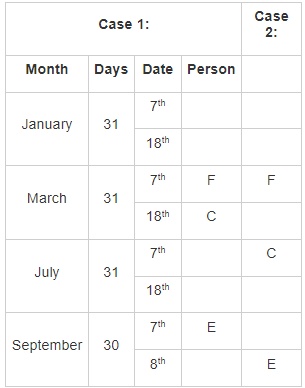
    1) Two persons attend the seminar between E and C.

    2) E attends the seminar on the month which has 30 days.

    3) F attends the seminar on 7th March.
    Case 1:

    Case 2:

    Month

    Days

    Date

    Person


    January

    31

    7th


    18th


    March

    31

    7th

    F

    F

    18th

    C


    July

    31

    7th


    C

    18th


    September

    30

    7th

    E


    8th


    E

    4)  H attends the seminar immediately after E. This will eliminate case 2.

    5) Only one person attend the seminar before B.

    6) Number of persons attend the seminar before A is one more than the number of persons attend the seminar after A. 

    7) G is not the person who attends the seminar first.

    Month

    Days

    Date

    Person

    January

    31

    7th

    D

    18th

    B

    March

    31

    7th

    F

    18th

    C

    July

    31

    7th

    A

    18th

    G

    September

    30

    7th

    E

    8th

    H

    Hence, C attends the seminar on 18th - March.

  • Question 8/10
    1 / -0.25

    Directions For Questions

    Direction: Read the following information carefully and answer the question that follows.

    Eight persons -  A, B, C, D, E, F, G, and H attend a seminar on different dates - 7th and 18th of different months - January, March, July, and September in a year. Only one person attends the seminar each day but not necessarily in the same order.

    Two persons attend the seminar between E and C. E attends the seminar on the month which has 30 days. F attends the seminar on 7th March. G is not the person who attends the seminar first. H attends the seminar immediately after E. Only one person attend the seminar before B. The number of persons who attend the seminar before A is one more than the number of persons who attend the seminar after A.

    ...view full instructions


    Who will attend the seminar on 18th July?

    Solutions

    Eight persons -  A, B, C, D, E, F, G, and H.

    Months - January, March, July, and September.

    Date - 7th and 18th.

    1) Two persons attend the seminar between E and C.

    2)  E attends the seminar on the month which has 30 days.

    3)  F attends the seminar on 7th March.

    Case 1:

    Case 2:

    Month

    Days

    Date

    Person


    January

    31

    7th


    18th


    March

    31

    7th

    F

    F

    18th

    C


    July

    31

    7th


    C

    18th


    September

    30

    7th

    E


    8th


    E

    4)  H attends the seminar immediately after E. This will eliminate case 2.

    5) Only one person attend the seminar before B.

    6) Number of persons attend the seminar before A is one more than the number of persons attend the seminar after A. 

    7) G is not the person who attends the seminar first.

    Month

    Days

    Date

    Person

    January

    31

    7th

    D

    18th

    B

    March

    31

    7th

    F

    18th

    C

    July

    31

    7th

    A

    18th

    G

    September

    30

    7th

    E

    8th

    H

    Hence, G attends the seminar on 18th July.

  • Question 9/10
    1 / -0.25

    Directions For Questions

    Direction: Read the following information carefully and answer the question that follows.

    Eight persons -  A, B, C, D, E, F, G, and H attend a seminar on different dates - 7th and 18th of different months - January, March, July, and September in a year. Only one person attends the seminar each day but not necessarily in the same order. 

    Two persons attend the seminar between E and C. E attends the seminar on the month which has 30 days. F attends the seminar on 7th March. G is not the person who attends the seminar first. H attends the seminar immediately after E. Only one person attend the seminar before B. The number of persons who attend the seminar before A is one more than the number of persons who attend the seminar after A.

    ...view full instructions


    How many persons attend the seminar after D?

    Solutions

    Eight persons -  A, B, C, D, E, F, G, and H.

    Months - January, March, July, and September.

    Date - 7th and 18th.

    1) Two persons attend the seminar between E and C.

    2)  E attends the seminar on the month which has 30 days.

    3)  F attends the seminar on 7th March.

    Case 1:

    Case 2:

    Month

    Days

    Date

    Person


    January

    31

    7th


    18th


    March

    31

    7th

    F

    F

    18th

    C


    July

    31

    7th


    C

    18th


    September

    30

    7th

    E


    8th


    E

    4)  H attends the seminar immediately after E. This will eliminate case 2.

    5) Only one person attend the seminar before B.

    6) Number of persons attend the seminar before A is one more than the number of persons attend the seminar after A. 

    7) G is not the person who attends the seminar first.

    Month

    Days

    Date

    Person

    January

    31

    7th

    D

    18th

    B

    March

    31

    7th

    F

    18th

    C

    July

    31

    7th

    A

    18th

    G

    September

    30

    7th

    E

    8th

    H

    Hence, seven persons attend the seminar after D.

  • Question 10/10
    1 / -0.25

    Directions For Questions

    Direction: Read the following information carefully and answer the question that follows.

    Eight persons -  A, B, C, D, E, F, G, and H attend a seminar on different dates - 7th and 18th of different months - January, March, July, and September in a year. Only one person attends the seminar each day but not necessarily in the same order. 

    Two persons attend the seminar between E and C. E attends the seminar on the month which has 30 days. F attends the seminar on 7th March. G is not the person who attends the seminar first. H attends the seminar immediately after E. Only one person attend the seminar before B. The number of persons who attend the seminar before A is one more than the number of persons who attend the seminar after A.

    ...view full instructions


    Who attends the seminar immediately before G?

    Solutions

    Eight persons -  A, B, C, D, E, F, G, and H.

    Months - January, March, July, and September.

    Date - 7th and 18th.

    1) Two persons attend the seminar between E and C.

    2)  E attends the seminar on the month which has 30 days.

    3)  F attends the seminar on 7th March.

    4)  H attends the seminar immediately after E. This will eliminate case 2.

    5) Only one person attend the seminar before B.

    6) Number of persons attend the seminar before A is one more than the number of persons attend the seminar after A. 

    7) G is not the person who attends the seminar first.

    Month

    Days

    Date

    Person

    January

    31

    7th

    D

    18th

    B

    March

    31

    7th

    F

    18th

    C

    July

    31

    7th

    A

    18th

    G

    September

    30

    7th

    E

    8th

    H

    Hence, A attends the seminar immediately before G.

Close button icon
User Profile
-

Correct (-)

Wrong (-)

Skipped (-)


  • 1
  • 2
  • 3
  • 4
  • 5
  • 6
  • 7
  • 8
  • 9
  • 10
Mockers logo Get latest Exam Updates
& Study Material Alerts!
No, Thanks
Arrow pointer icon
Click on Allow to receive notifications
Notification bell icon ×
Open Now
