Please wait...

SSC CGL 2024 Aptitude Test - 3
Menu grid icon
Result Result point icon
SSC CGL 2024 Aptitude Test - 3
  • Goals icon

    /

    Score
  • Trophy icon

    -

    Rank
White alarm icon Time Taken: -
Result frame illustration
  • Question 1/10
    2 / -0.5

    If an integer 'k' is divisible by 3, 5 and 10 , then what will be the next larger integer divisible by all these numbers?

    Solutions

    Given:

    An integer 'k' is divisible by 3, 5 and 10.

    Concept used:

    LCM is the smallest common multiple of two or more numbers.

    Calculation:

    LCM (3, 5, 10) = 30

    Since 'k' is divisible by 3, 5, and 10, k must be a multiple of 30.

    So, only 2k is a possible multiple of 30 here.

    ∴ 2k will be the next larger integer divisible by all these numbers.

  • Question 2/10
    2 / -0.5

    Asha and Bhuvan can do a piece of work in 6 days and 9 days, respectively. They work on alternate days, starting with Asha on the first day. In how many days will the work be completed?

    Solutions

    Given: 

    Days taken by Asha to complete the work = 6 days

    Days taken by Bhuvan to complete the work = 9 days

    Concept Used:

    Assuming the work as LCM of 6 & 9

    Calculation:

    ⇒ Let the work be 18 units.

    ⇒ Work done by Asha in one day = 18 ÷ 6 = 3 units / day

    ⇒ Work done by Bhuvan in one day = 18 ÷ 9 = 2 units / day

    ⇒ When they work together alternatively,

    ⇒ Work done in 2 days = 2 + 3 = 5 units

    ⇒ Work done in another 2 days = 5 units

    ⇒ Work done in another 2 days = 5 units

    ⇒ In this way they will complete 15 units in 6 days.

    ⇒ Then, Asha's turn will come and she will do remaining 3 units on 7th day

    Hence, the work will be completed in 7 days.

    Shortcut Trick

    Work done in 2 days = 2 + 3 = 5 units 

    ⇒  6 days. =15 unit 

    Then, Asha's turn will come and she will do the remaining 3 units on 7th day

  • Question 3/10
    2 / -0.5

    A pupil multiplied a figure by 3/5 rather than 5/3. What is the percentage error in the calculation?

    Solutions

    Given:

    Wrong number multiplied = 3/5

    Correct number should be multiplied = 5/3

    Calculation:

    Let the figure be 15a

    So, the wrong number after multiplying = 15a × (3/5)

    ⇒ 9a

    Correct number which should have get = 15a × (5/3)

    ⇒ 25a

    Difference of error = 25a - 9a

    ⇒ 16a

    % of error = (16a/25a) × 100

    ⇒ 64

    So, error % = 64 %

    ∴ The percentage error in the calculation is 64.

  • Question 4/10
    2 / -0.5

    ΔABC is similar to ΔPQR. AB = 4 cm, BC = 8 cm and AC = 10 cm. If QR = 16 cm, then what is the area of ΔPQR in cm2?

    Solutions

    Given:

    ΔABC is similar to ΔPQR.

    Length of sides in ΔABC: AB = 4 cm, BC = 8 cm, AC = 10 cm.

    QR = 16 cm in ΔPQR.

    Concept Used:

    The ratio of the areas of two similar triangles is equal to the square of the ratio of their corresponding sides.

    Area of scalene triangle = √s(s - a)(s - b)(s - c), 

    where s = semi perimeter = sum of sides/2,  and a, b, c are the sides of triangle.

    Solution:

    For ΔABC and ΔPQR, since ΔABC ~ ΔPQR, the ratio of corresponding sides QR/BC = 16/8 = 2.

    The ratio of the areas of ΔABC and ΔPQR will be the square of the ratio of their corresponding sides.

    ⇒ Area(ΔPQR)/Area(ΔABC) = (QR/BC)² = 2² = 4.

    Now the area of ΔABC

    ⇒ s = (4 + 8 + 10)/2 = 11 cm

    ⇒ Area of ΔABC = √11(11 - 4)(11 - 8)(11 - 10)

    ⇒ √11 × 7 × 3 × 1 = √231 cm2

    Area of ΔPQR = 4 × Area of ΔABC = 4√231 cm2

    ∴ Option 2 is the correct answer.

  • Question 5/10
    2 / -0.5

    The percentage marks obtained by 6 students in different subjects are given below. The maximum marks for each subject have been indicated in the table.

    Subject

    Student

    Physics Mathematics Hindi Geography English History
    Maximum marks → 80 150 100 75 120 50
    P 70 44 88 88 70 38
    Q 90 40 54 92 65 40
    R 85 32 70 64 55 30
    S 75 70 58 80 60 35
    T 65 60 45 88 50 42
    U 60 50 60 72 25 48

    What are the average marks obtained by all students in Geography?

    Solutions

    Given:

    The percentage marks obtained by 6 students in different subjects are given below. The maximum marks for each subject have been indicated in the table.

    Concept used:

    Calculation:

    According to the question,

    Marks of P in geography = 88% of 75 = 0.88 × 75 = 66 marks

    Marks of Q in geography = 92% of 75 = 0.92 × 75 = 69 marks

    Marks of R in geography = 64% of 75 = 0.64 × 75 = 48 marks

    Marks of S in geography = 80% of 75 = 0.80 × 75 = 60 marks

    Marks of T in geography = 88% of 75 = 0.88 × 75 = 66 marks

    Marks of U in geography = 72% of 75 = 0.72 × 75 = 54 marks

    Total marks obtained by students in Geography = 66 + 69 + 48 + 60 + 66 + 54 = 363

    Average marks obtained by students in Geography = 363/6 = 60.5

    ∴ The average marks obtained by all students in Geography is 60.5.

    Mistake Points

    The maximum mark in Geography is 75. Please note that the marks of students are given in the percentage.

    For example, P's marks in Geography = 88% of 75 = 66 marks

    So the sum of marks of all students in geography = 363

    Average = 363/6 = 60.5

  • Question 6/10
    2 / -0.5

    Find the volume of a sphere whose diameter is 42 m.

    Solutions

    Given:

    Diameter = 42m

    Formula used:

  • Question 7/10
    2 / -0.5

    A train can completely cross a 1000-metre long bridge in 15 seconds. It can completely cross another 1300-metre long bridge in 19 seconds. What is the length of the train?

    Solutions

    Given:

    A train can completely cross a 1000-metre long bridge in 15 seconds.

    It can completely cross another 1300-metre long bridge in 19 seconds.

    Concept used:

    Speed = Distance/Time

    Calculation:

    Let the length of the train be 'x'

    According to the question,

    (1000 + x)/15 = (1300 + x)/19

    ⇒ (1000 + x) × 19 = (1300 + x) × 15

    ⇒ 19000 + 19x = 19500 + 15x

    ⇒ 4x = 500

    ⇒ x = 500/4 = 125 m

    ∴ The length of the train is 125 m.

  • Question 8/10
    2 / -0.5

    Directions For Questions

    The following bar graph shows the production of various models of mobiles in the year 2019 and 2020. The total production is 40 lakhs during 2019 and 65 lakhs in 2020.

    ...view full instructions


    What is the total production of model A mobiles in 2020 and model E mobiles in 2019?

    Solutions

    Given:

    The following bar graph shows the production of various models of mobiles in the year 2019 and 2020.

    The total production is 40 lakhs during 2019 and 65 lakhs in 2020.

    Calculations:

    According to the question,

    The total production of model A mobiles in 2020 = 40% of 65 lakhs = 0.40 × 65 lakhs = 26 lakhs

    The total production of model E mobiles in 2019 = 15% of 40 lakhs = 0.15 × 40 lakhs = 6 lakhs

    The total production of model A mobiles in 2020 and model E mobiles in 2019 = 26 lakhs + 6 lakhs = 32 lakhs

    ∴ The total production of model A mobiles in 2020 and model E mobiles in 2019 is 32,00,000.

  • Question 9/10
    2 / -0.5

    A solution contains a mixture of acid and base in the ratio 17 : 3. How much fraction of the mixture must be drawn off and substituted by the base so that the ratio of acid and base in the resultant mixture in the solution becomes 1 : 1?

    Solutions

    Given:

    Initial ratio of acid and base = 17 : 3

    Final mixture of acid and base = 1 : 1

    Calculation:

    Let the acid and base be 17x litres and 3x litres resp

    ⇒ Total mixture = 20x

    Let the drawn part of the mixture be 'y' liters

    Acid in (20 - y) litres mixture

    ⇒ (20x - y) × (17/20) = (340x - 17y)/20         ----(i)

    Now adding 'y' litres of base to the mixture

    Base in the resultant mixture

    ⇒ (3/20) × (20x - y) + y = (60x + 17y)/20      ----(ii)

    According to the question, ratio of acid and base in resultant mixture is 1:1

    Thus, equating Equations (1) and (2)

    (340x - 17y)/20 = (60x + 17y)/20

    ⇒ 340x - 17y = 60x + 17y 

    ⇒ 34y = 280x

    ⇒ y/x = 280/34

    ⇒ y/x = 140/17

    Total mixture = 20x = (20 × 17) liters

    Mixture to be removed and replaced = y = 140 liters

    ⇒ Required fraction = (140)/(20 × 17) = 7/17

    ∴ 7/17 fraction of the mixture must be drawn off and substituted by the base so that the ratio of acid and base in the resultant mixture in the solution becomes  1:1

    Shortcut Trick

    Let us remove some quantity of the mixture from the solution.

    After that
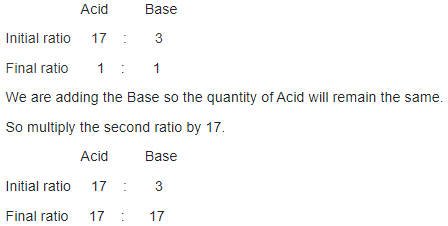
    So Base added = 17 - 3 = 14 units

    Here note that the initial quantity of mixture = Final quantity of mixture

    So

    Initial quantity of mixture = 17 + 17 = 34 units

    the required ratio = 14/34 = 7/17

  • Question 10/10
    2 / -0.5

    The population of a country has been declining at 1% every decade. If the projected population of the country in 2030 is given as 1940598, what was the population of the country in 2000?

    Solutions

    Given:

    Decline in population every dacade = 1%

    Projected population in 2030 = 1940598

    Concept Used:

    ⇒ P = 1940598 × 1.03061 = 2,000,000

    Therefore, the population of the country in 2000 is 2000000.

    Mistake Points

    Please note that the rate is 1% every decade.

    3 decades = 30 years

    so

    2000 + 30 = 2030

    There is no mistake in the question.

Close button icon
User Profile
-

Correct (-)

Wrong (-)

Skipped (-)


  • 1
  • 2
  • 3
  • 4
  • 5
  • 6
  • 7
  • 8
  • 9
  • 10
Mockers logo Get latest Exam Updates
& Study Material Alerts!
No, Thanks
Arrow pointer icon
Click on Allow to receive notifications
Notification bell icon ×
Open Now
