Verify mobile number to view the solution
Solutions
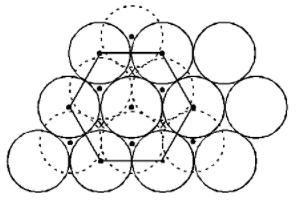
hcp = AB AB AB ...............pattern repeat
For calculating voids between two layers A and B.
The dots are representing tetrahedral voids.
no. of tetrahdral voids = 3 + 1 +1/3 × 6 = 6
so in one complete unit cell total tetrahedral voids = 12, out of which 8 are completely inside but rest are shared by other unit cells.
Octahedral voids = 3 = represented by (x).
So total octahedral voids = 6 = All are completely inside.
[4R = √3 a]


 Time Taken: -
 Bank
Bank


 SSC
SSC


 Railway


 State
State


 Other
Other


 Teaching


 Insurance


 Medical


 Engineering


 Defence


 GATE
GATE


 NTA CUET

 UPSC
UPSC

 MBA Entrance


 LAW
LAW

 ReNEET UG 2026
 CUET UG 2026
 UP Police Constable 2026
 SSC Selection Post (Phase 14) 2026
 SSC GD 2025-26
 RRB NTPC 2026
 SSC CGL Tier-I 2026
 SSC JE 2026
 UPSC (CSE) 2026
 SBI PO Prelims 2026
 SSC Steno Grade C & D 2026
 SBI Clerk Prelims 2026
 IBPS PO Prelims 2026
 IBPS Clerk Prelims 2026
 SSC CPO Tier I 2026