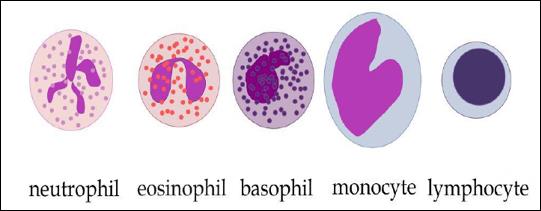
(a) When circulating in the bloodstream and inactivated, neutrophils are spherical.
Once activated, they change shape and become more amorphous or amoeba-like and can extend pseudopods as they hunt for antigens.
(b) Eosinophil cells are 12 - 17 µm in diameter - larger than neutrophils, and about 3 times the size of a red blood cell. You can see that eosinophils only have two lobes to their nucleus.
(c) In blood, basophils are round, but the shape changes as they migrate into tissues. They generally have a multilobed nucleus and no evidence of nucleoli.
Basophils also have an abundance of condensed chromatin around the periphery of the nucleus.
(d) Monocytes are the largest type of white blood cells and can be up to 20µm in diameter.
They have a large eccentrically placed nucleus, which is kidney bean-shaped. They have abundant cytoplasm and some fine pink/purple granules in the cytoplasm.
(e) Lymphocytes can look like monocytes, except that lymphocytes do not have a kidney-bean shaped nucleus, and lymphocytes are usually smaller.
They have a small spherical nucleus and have abundant dark staining condensed chromatin. Not much cytoplasm can be seen, and it is basophilic (pale blue/purple staining).


 Time Taken: -
 Bank
Bank


 SSC
SSC


 Railway


 State
State


 Other
Other


 Teaching


 Insurance


 Medical


 Engineering


 Defence


 GATE
GATE


 NTA CUET

 UPSC
UPSC

 MBA Entrance


 LAW
LAW

 JEE Advanced 2026
 CUET UG 2026
 NEET UG 2026
 UP Police Constable 2026
 SSC Selection Post (Phase 14) 2026
 SSC GD 2025-26
 RRB NTPC 2026
 SSC CGL Tier-I 2026
 SSC JE 2026
 UPSC (CSE) 2026
 SBI PO Prelims 2026
 SSC Steno Grade C & D 2026