Please wait...

Laws Of Motion Test - 15
Menu grid icon
Result Result point icon
Laws Of Motion Test - 15
  • Goals icon

    /

    Score
  • Trophy icon

    -

    Rank
White alarm icon Time Taken: -
Result frame illustration
  • Question 1/10
    1 / -0

    A constant force acting on a body of mass 3 kg changes its speed from 2 m/s to 3.5 m/s in 10 second. If the direction of motion of the body remains unchanged, what is the magnitude and direction of the force?

    Solutions

    Given : Mass, m = 3 kg;

    Initial Velocity, u = 2m/s;

    Final velocity, v = 3.5 m/s

    Time taken, t = 10 seconds

    v = u+at

    3.5 = 2 +a x 10
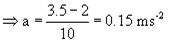
    F = ma = 3 x 0.15 = 0.45 N

    Since the applied force increase the speed of the body, it acts along the direction of motion.

  • Question 2/10
    1 / -0

    The product of mass and velocity is known as

    Solutions

    The product of velocity and mass is known as momentum which is a vector quantity.

  • Question 3/10
    1 / -0

    In cgs system the gravitational unit of force is gram weight (g wt).Then 1g wt (or g f) =_______ dyne.

    Solutions

    For SI to CGS conversion,

    1 Kg = 103 g

    1 m = 102 cm

    => In CGS System,

    1 N (Kg.m/s2) = 105 dynes (g.cm/s2)

    => 1 g.wt = 9.8 m/s2 x 102 cm / 1 s2 x 10-3 g x 10-2 cm / 1 s x 105 dynes

    = 980 dynes (g.cm/s2)

  • Question 4/10
    1 / -0

    The dimensional formula of Plancks’s constant and angular momentum are

    Solutions

    Planck's Constant (h)  = 6.626176 x 10⁻³⁴  m2 kg/s
    So, Unit of planck constant=  m2 kg/s

    Dimensions =M L2 T −1   ________ (1)

    Angular momentum l = mvr

    Where, m-mass

    v-velocity

    r-radius

    Dimensions of angular momentum  =  M L T −1 L   = M  L2  T −1  _______________ (2)
    From (1) and (2). 

    Planck's constant and angular momentum have the same dimensions.

  • Question 5/10
    1 / -0

    Which of the following quantity has the unit of newton-second?

    Solutions

    Net external force F = dp/dt, so using dimensional analysis, unit of momentum should be the same as unit of force times unit of time which is Newton second.

  • Question 6/10
    1 / -0

     If newton is the unit of force in MKS system then, in CGS system 1N= ______ dyne

    Solutions

    1N = kg m /sec
    1 dyne = gram cm/sec
    Thus 1N in CGS system = 1000 gram 100 cm/sec
    That is 1N = 100000 dyne

  • Question 7/10
    1 / -0

    Three forces 2570_image008 act on an object of mass m = 2 kg. The acceleration of the object in m/s2 is:

    Solutions

    Force vector follows the principle of superposition which says all the force vectors can be vectorially added if applied on one point to get the net force vector. Hence we get
    F = F1 + F2 + F3 
    = (-2 + 3) i + (1 - 2) j
     F = i - j = ma
    Thus we get a = (i - j) /m
    = (i - j) / 2

  • Question 8/10
    1 / -0

     Newton’s second law of motion relates

    Solutions

    Newton's 2nd Law of motion states that rate of change of momentum is directly proportional to external force applied. Hence, it relates rate of change of momentum to external force applied.

  • Question 9/10
    1 / -0

    A cyclist of mass 30 kg exerts a force of 250 N to move his cycle. The acceleration is 4 ms−2. The force of friction between the road and tyres will be

    Solutions

    F = ma so a= 250/30

    a = 8.34

    now the result is 4mt/secsqure so reduction is 4.34

    so friction force will b 4.34 ×30

     F is 130.2 n

  • Question 10/10
    1 / -0

    The time rate of change of momentum is called:

    Solutions

    Time rate of change of angular momentum represents torque. Hence force is known as rate change of momentum. The rate of change of momentum is called force by Newton's second law of motion.

Close button icon
User Profile
-

Correct (-)

Wrong (-)

Skipped (-)


  • 1
  • 2
  • 3
  • 4
  • 5
  • 6
  • 7
  • 8
  • 9
  • 10
Mockers logo Get latest Exam Updates
& Study Material Alerts!
No, Thanks
Arrow pointer icon
Click on Allow to receive notifications
Notification bell icon ×
Open Now