Verify mobile number to view the solution
Solutions
Concept:
Gauss’s Law: Total electric flux through a closed surface is 1/εo times the charge enclosed in the surface i.e.
\({\rm{\Phi }} = \frac{q}{{{\epsilon_o}}}\)
But we know that Electrical flux through a closed surface is:
\(\oint \vec E \cdot \overrightarrow {ds} \)
\(\therefore\oint \vec E \cdot \overrightarrow {ds} = \frac{q}{{{\epsilon_o}}}\)
E = electric field
q = charge enclosed in the surface and
εo = permittivity of free space.
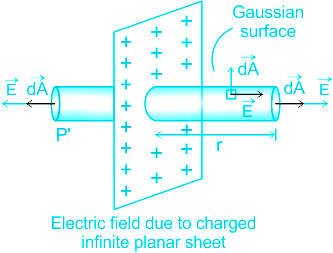
The electric field at a point due to an infinite sheet of charge is:
\(E=\frac{\sigma }{2{{\epsilon }_{0}}}\)
Where ϵo = Absolute electrical permittivity of free space, E = Electric field, and σ = surface charge density.
Thus, the field is uniform and does not depend on the distance from the plane sheet of charge. Therefore option 3 is correct.


 Time Taken: -
 Bank
Bank


 SSC
SSC


 Railway


 State
State


 Other
Other


 Teaching


 Insurance


 Medical


 Engineering


 Defence


 GATE
GATE


 NTA CUET

 UPSC
UPSC

 MBA Entrance


 LAW
LAW

 ReNEET UG 2026
 SSC Selection Post (Phase 14) 2026
 RRB NTPC 2026
 SSC CGL Tier-I 2026
 SSC JE 2026
 SBI PO Prelims 2026
 SSC Steno Grade C & D 2026
 SBI Clerk Prelims 2026
 IBPS PO Prelims 2026
 IBPS Clerk Prelims 2026
 SSC CPO Tier I 2026
 NDA II 2026
 CDS II 2026