Please wait...
/
-
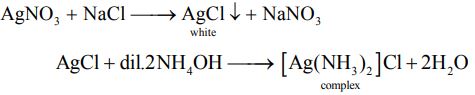
Aqueous solution of a salt when treated with AgNO3 solution gives a white precipitate, which dissolves in NH4OH. Radical present in the salt is:
Verify mobile number to view the solution
When Cl− , Br− and F− are treated with AgNO3 solution in presence of dilute HNO3, corresponding silver halide is obtained which is soluble in NH4OH, NaCN, and Na2 S2 O3 .
Which of the following combines with Fe (II) ions to form a brown complex?
Brown ring test with (FeSO4.. NO)
Which of the following will not produce a precipitate with AgNO3 solution?
With F− no precipitate is obtained because of low lattice energy of AgF, so it remains in ionized state
Chromyl chloride vapours are dissolved in NaOH and acetic acid and lead acetate solution is added, then:
A salt gives violet vapours when treated with conc. H2SO4 . It contains:
Iodine vapours are violet
∴ The salt must contain I− as
A salt is heated first with dil. H2SO4 and then with conc. H2SO4. No reaction takes place. It may be:
The salt must have group which is also present in the acid so reaction is not takes place.
Nitrates of all the metals are:
Nitrates and acetates of all metals are water soluble.
Which of the following precipitate does not dissolve even in large excess of NH4OH ?
AgCl and AgBr dissolve in NH4OH and form complexes but AgI doesn’t react with NH4OH. e.g.
When CO2 is passed into lime water it turns milky. When excess of CO2 is passed, milkyness disappears because?
A substance on treatment with dil H2SO4 liberates a colourless gas which produces A. turbidity with baryta water and B. turns acidified dichromate solution green. The reaction indicates the presence of:
Correct (-)
Wrong (-)
Skipped (-)


 Time Taken: -
 Bank
Bank


 SSC
SSC


 Railway


 State
State


 Other
Other


 Teaching


 Insurance


 Medical


 Engineering


 Defence


 GATE
GATE


 NTA CUET

 UPSC
UPSC

 MBA Entrance


 LAW
LAW

 ReNEET UG 2026
 CUET UG 2026
 UP Police Constable 2026
 SSC Selection Post (Phase 14) 2026
 SSC GD 2025-26
 RRB NTPC 2026
 SSC CGL Tier-I 2026
 SSC JE 2026
 UPSC (CSE) 2026
 SBI PO Prelims 2026
 SSC Steno Grade C & D 2026
 SBI Clerk Prelims 2026
 IBPS PO Prelims 2026
 IBPS Clerk Prelims 2026
 SSC CPO Tier I 2026