Verify mobile number to view the solution
Solutions
Concept:
Refraction of Light: When a ray of light is traveling from one transparent medium to another, it bends its path. This phenomenon is called refraction.
When the light changes its medium, its speed, and wavelength changes.
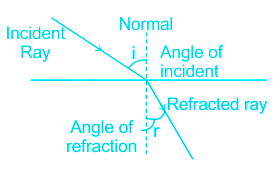
Where i is the angle of incidence, r is the angle of refraction.
Refractive Index:
The ratio of the speed of light in the vacuum to the speed of light in a given transparent medium is called the refractive index of the medium.
- When light travels from a medium with a higher refractive index to a lower one, then it bends away from normal. The angle of refraction is more than the angle of incidence.
- When light travels from a medium with a lower refractive index to a higher one, then it bends toward normal. The angle of refraction is less than the angle of incidence.
Snells Law of Refraction: The ratio of the sine of the angle of incidence to the sine of the angle of refraction is constant for two transparent medium.
\(\frac{sin\; i}{sin\; r} = \;\frac{n_2}{n_1}\)
n2 is the medium in which light is entering, n1 is the initial medium of light
When the ray of light is traveling from the medium with a higher refractive index to a lower one, for example, water to air, and the angle of refraction formed is 90 ° then the angle of incidence at that point is critical angle.
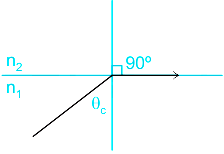
When medium 2 is air having refractive index n2 = 1, and medium 1 have refractive index n1 = μ, then critical angle θc can be represented by
\(\frac{sin\; θ_c}{sin \;90 °} = \frac{1}{μ}\)
\(\implies sin\; θ_c= \frac{1}{μ}\)
- The sine of critical angle is reciprocal of refractive index.
- When the incidence angle is more than the critical angle, then the ray of light reflects back in the same medium. This phenomenon is called Total Internal Reflection.
Calculation:
Given refractive index μ = 1. 62
\(sin\; θ_c= \frac{1}{μ}\)
\(sin\; θ _c= \frac{1}{1.62}\)
sin θc = 0. 62
So, 0.62 is the correct option.


 Time Taken: -
 Bank
Bank


 SSC
SSC


 Railway


 State
State


 Other
Other


 Teaching


 Insurance


 Medical


 Engineering


 Defence


 GATE
GATE


 NTA CUET

 UPSC
UPSC

 MBA Entrance


 LAW
LAW

 ReNEET UG 2026
 CUET UG 2026
 UP Police Constable 2026
 SSC Selection Post (Phase 14) 2026
 SSC GD 2025-26
 RRB NTPC 2026
 SSC CGL Tier-I 2026
 SSC JE 2026
 UPSC (CSE) 2026
 SBI PO Prelims 2026
 SSC Steno Grade C & D 2026
 SBI Clerk Prelims 2026
 IBPS PO Prelims 2026
 IBPS Clerk Prelims 2026
 SSC CPO Tier I 2026