Verify mobile number to view the solution
Solutions
CONCEPT:
Capacitor:
- The capacitor is a device in which electrical energy can be stored.
- In a capacitor two conducting plates are connected parallel to each other and carrying charges of equal magnitudes and opposite sign and separated by an insulating medium.
- The space between the two plates can either be a vacuum or an electric insulator such as glass, paper, air, or semi-conductor called a dielectric.
Parallel plate capacitor:
- A parallel plate capacitor consists of two large plane parallel conducting plates separated by a small distance.
- The space between the two plates can either be a vacuum or an electric insulator such as glass, paper, air, or semi-conductor called a dielectric.
- The electric field intensity at the outer region of the parallel plate capacitor is always zero whatever be the charge on the plate.
- The electric field intensity in the inner region between the plates of a parallel plate capacitor remains the same at every point.
- The electric field intensity in the inner region between the plates of a parallel plate capacitor is given as,
\(\Rightarrow E=\frac{σ}{\epsilon_o}=\frac{Q}{A\epsilon_o}\)
- The potential difference between the plates is given as,
\(\Rightarrow V=\frac{Qd}{A\epsilon_o}\)
- The capacitance C of the parallel plate capacitor is given as,
\(\Rightarrow C=\frac{Q}{V}=\frac{A\epsilon_o}{d}\)
Where A = area of the plates, d = distance between the plates, Q = charge on the plates, and σ = surface charge density
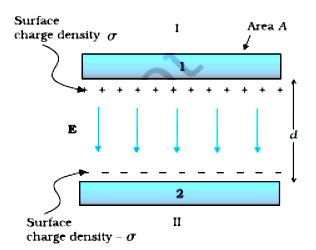
EXPLANATION:
- We know that the electric field intensity due to one plate of the capacitor on the other plate is given as,
\(\Rightarrow E=\frac{Q}{2A\epsilon_o}\) -----(1)
- The magnitude of electric force experienced by a charged particle in an electric field is given as,
⇒ F = Eqo -----(2)
Where E = electric field intensity, and qo = charge on the particle
By equation 1 and equation 2, the force on a plate due to the charge Q on the other plate is given as (qo = Q),
⇒ F = Eqo
\(\Rightarrow F=\frac{Q}{2A\epsilon_o}\times Q\)
\(\Rightarrow F=\frac{Q^2}{2A\epsilon_o}\)
- Hence, option 2 is correct.
 Additional Information
If the dielectric medium of dielectric constant K is filled between the plates:
- When the dielectric medium is filled in the space between the plates of the parallel plate capacitor, its capacitance increases.
The electric field intensity in the inner region between the plates of a parallel plate capacitor is given as,
\(\Rightarrow E'=\frac{σ}{\epsilon_oK}=\frac{Q}{A\epsilon_oK}\)
The potential difference between the plates is given as,
\(\Rightarrow V'=\frac{Qd}{A\epsilon_oK}\)
The capacitance C of the parallel plate capacitor is given as,
\(\Rightarrow C'=\frac{Q'}{V'}=\frac{A\epsilon_oK}{d}\)


 Time Taken: -
 Bank
Bank


 SSC
SSC


 Railway


 State
State


 Other
Other


 Teaching


 Insurance


 Medical


 Engineering


 Defence


 GATE
GATE


 NTA CUET

 UPSC
UPSC

 MBA Entrance


 LAW
LAW

 ReNEET UG 2026
 CUET UG 2026
 UP Police Constable 2026
 SSC Selection Post (Phase 14) 2026
 SSC GD 2025-26
 RRB NTPC 2026
 SSC CGL Tier-I 2026
 SSC JE 2026
 UPSC (CSE) 2026
 SBI PO Prelims 2026
 SSC Steno Grade C & D 2026
 SBI Clerk Prelims 2026
 IBPS PO Prelims 2026
 IBPS Clerk Prelims 2026
 SSC CPO Tier I 2026