Please wait...

Chemistry Test 131
Menu grid icon
Result Result point icon
Chemistry Test 131
  • Goals icon

    /

    Score
  • Trophy icon

    -

    Rank
White alarm icon Time Taken: -
Result frame illustration
  • Question 1/10
    4 / -1

    The correct oreder of increasing bond angles in the following species

    Solutions

    According to VESPR theory repulsion order

      lp - lp > lp - bp > bp - bp

    As the number of lone pairs of electrons increases, bond angle decreases due to repulsion between lp-lp, Moreover, as the electronegativity of central atom decreases, bond angle decreases.

    The correct order of increasing bond angle is Cl2O < ClO2- < ClO2
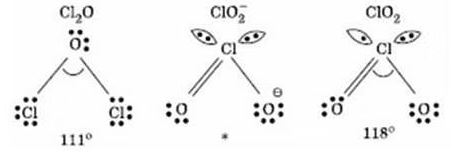
    In ClO2- there are 2 Ione pairs of electrons present on the central chlorine atom. Therefore the bond angle in ClO2is less than 118° which is the bond angle in ClO2 which has less number of electrons on chlorine. 


  • Question 2/10
    4 / -1

    The correct order of increasing covalent character of the following is

    Solutions

    Option b is correct  because as the charge increases covalent character also increases.


  • Question 3/10
    4 / -1

    If Z-axis is the molecular axis, then π molecular orbitals are formed by the overlap of

    Solutions

    px-px and py-py will form pi bond when z-axis is molecular axis as the options have only one of these so option (d) is the correct answer.


  • Question 4/10
    4 / -1

    The ionic species having largest size is

    Solutions

    Lihave larger size in aq.solution due to the presence of the water molecules present inside the solution surronds easily and become the solution to be more hydrated comparing to the corresponding element present in the aqeous solution.


  • Question 5/10
    4 / -1

    From the following species, which one is the easiest to remove one electron ?

    Solutions

    Ionisation Potential is directly proportional to positive oxidation state and inversely proportional to negative oxidation state.So, in O2- removal of electron is easiest.


  • Question 6/10
    4 / -1

    Electron gain enthalpy of inert gases is

    Solutions

    On moving down the group, there is an increase in the size of atoms. As a result, the tendency to accept an additional electron decreases and hence, the electron gain enthalpy decreases from Ne to Rn. However, He has small size and much higher tendency to accept an additional electron. Hence, its electron gain enthalpy is least positive of all the noble gases. 

    Thus, it is concluded that neon has the highest positive electrons gain enthalpy.


  • Question 7/10
    4 / -1

    The electron gain enthalpies of B,C,N and O are in the order

    Solutions

    Actually electron gain enthalphy and ionisation energy both are dependent on electronic configuration.

    Electronegativity means tendency to attract electron it doesnot matter where it will keep the electron

    Electron gain entalphy basically refer to attract e it must have space to keep electron in sub shell like spdf should be present order of electronegativity is

    F > O > N > Cl > Br  > I > S > C > P


  • Question 8/10
    4 / -1

    With respect to chlorine, hydrogen will be

    Solutions

    With respect to Chlorine hydrogen will be electropositive. Chlorine being a strong electronegative element tends to force hydrogen to loss electron and hydrogen acquire electropositive character so that chlorine can complete its octet .


  • Question 9/10
    4 / -1

    Which element has the greatest tendency to lose electrons ?

    Solutions

    Francium has the greatest tendency to lose electrons.


  • Question 10/10
    4 / -1

    Which of the following atomic numbers represents an alkali metals ?

    Solutions

    37 = Rb

    55 = Cs

    87 = Fr

    All belong to alkali metal group.

    So answer is (d)


Close button icon
User Profile
-

Correct (-)

Wrong (-)

Skipped (-)


  • 1
  • 2
  • 3
  • 4
  • 5
  • 6
  • 7
  • 8
  • 9
  • 10
Mockers logo Get latest Exam Updates
& Study Material Alerts!
No, Thanks
Arrow pointer icon
Click on Allow to receive notifications
Notification bell icon ×
Open Now
