Please wait...

NEET Test 120
Menu grid icon
Result Result point icon
NEET Test 120
  • Goals icon

    /

    Score
  • Trophy icon

    -

    Rank
White alarm icon Time Taken: -
Result frame illustration
  • Question 1/10
    4 / -1

    Formic acid can be distinguished from acetic acid by reaction with:

    Solutions

    Formic acid and acetic acid can be distinguished using 2,4-dinitrophenylhydrazine. 

    Formic acid is having aldehyde group, so it answers the above test. Forming yellow colour precipitate of 2,4-dinirto phenyl hydrazone. Whereas acetic acid does not. 
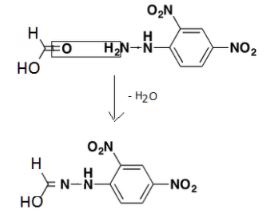
    Hence, the correct option is (C).


  • Question 2/10
    4 / -1

    The expression to compute pH of NH4CI solution is

    Solutions

    NH4Cl is a salt and it is formed from weak base NH4OH and strong acid HCl (via neutralization reaction)

    NH4OH +HCl —-> NH4Cl

    Now, since HCl is a strong acid it will dissociate completely as well as rapidly and gives H+ n Cl-

    And NH4OH is a weak base, it will dissociate slowly.

    So, at a particular time, H+ in the solution will be more as compared to NH4+ n OH-. Thus, solution will be acidic at that particular time.

    Now if you want to know the pH value, you can use the following equation :

    pH =0.5 {pKa -pKb -logC}

    Hence, the correct option is (A).


  • Question 3/10
    4 / -1

    What is the effect on the interference fringes in Young's double slit experiment if the width of the source slit is increased?

    Solutions

    When the widths of the two slits are increased, the fringes become brighter. However, the width of each slit should be considerably smaller than the separation between the slits. When the slits become so wide that this condition is not satisfied, the interference pattern disappears i.e., The fringes become less distinct.

    Hence, the correct option is (D).


  • Question 4/10
    4 / -1

    Solutions


  • Question 5/10
    4 / -1

    What is the role of NAD+ in cellular respiration?

    Solutions

    NAD+ is a coenzyme and an electron carrier. It acts as an electron acceptor in glycolysis and Krebs cycle through dehydrogenation processes and is then reduced to NADH. NADacts as an electron carrier which is later used to generate a proton gradient across the inner mitochondrial membrane and produce energy in the form of ATP.

    Hence, the correct option is (C).


  • Question 6/10
    4 / -1

    Artificial classification of plant kingdom is based on ________.

    Solutions

    Artificial classification of the plant kingdom is based on 'Morphological characteristics'.

    In the artificial system of classification, only a few characters of the plants are being considered, for example, the grouping of plants into shrubs and trees or the sexual system of Linnaeus based on a number of stamens and styles. The best known artificial system is of Linnaeus published in 1735. In the natural system of classification, all the important characters of the plant are being considered, and the plants are classified according to their related affinities. Bentham and Hooker gave the natural system of classification. Phylogeny system in phylogenetic system of classification the plants are classified according to their evolutionary and genetic affinities. This system of classification was proposed by Engler in 1886, Hutchinson in 1926.

    Hence, the correct option is (A).


  • Question 7/10
    4 / -1

    A particle moves from position acts on it. What is the work done by the force?

    Solutions


  • Question 8/10
    4 / -1

    A substance absorbs an amount of heat Q1 n going from one state to another and releases an amount of heat Qin coming back from the second state to the first state. How much work is done by the substance?

    Solutions

    From the first law of thermodynamics

    Here as the energy is supplied to the system by an external source, therefore there will be no change of internal energy. The change in heat will generate equivalent work.      

    Hence, the correct option is (B).


  • Question 9/10
    4 / -1

    Axial skeleton comprises 80 bones. Which of the following is/are not a part of axial skeleton?

    Solutions

    The axial skeleton supports the head, neck, back, and chest and thus forms the vertical axis of the body. It consists of the skull, vertebral column (including the sacrum and coccyx), and the thoracic cage, formed by the ribs and sternum.

    Hence, the correct option is (C).


  • Question 10/10
    4 / -1

    In electrophoresis, the DNA sample is loaded in the gel:

    Solutions

    Electrophoresis is an electrokinetic process that is used to separate charged particles in a fluid by using a field of electrical charge. It is often used for the separation of molecules or DNA basis their size, density, etc. The molecules are separated through an electric current and a gel. Electrophoresis is usually conducted in a box-like structure that has a positive charge on one end and a negative on the other. The electric field around the gel causes the negatively charged molecules to move towards the positive electrode and vice versa. Since DNA fragments are negatively-charged molecules they can be separated by forcing them to move towards the anode under an electric field through a medium/matrix.

    Hence, the correct option is (C).


Close button icon
User Profile
-

Correct (-)

Wrong (-)

Skipped (-)


  • 1
  • 2
  • 3
  • 4
  • 5
  • 6
  • 7
  • 8
  • 9
  • 10
Mockers logo Get latest Exam Updates
& Study Material Alerts!
No, Thanks
Arrow pointer icon
Click on Allow to receive notifications
Notification bell icon ×
Open Now
