Please wait...

Wave Optics Test - 6
Menu grid icon
Result Result point icon
Wave Optics Test - 6
  • Goals icon

    /

    Score
  • Trophy icon

    -

    Rank
White alarm icon Time Taken: -
Result frame illustration
  • Question 1/10
    1 / -0.25


    For distances much greater than Fresnel distance ZF


  • Question 2/10
    1 / -0.25


    Estimate the distance for which ray optics is good approximation for an aperture of 4 mm and wavelength 400 nm.


    Solutions


    Here,
    Aperture, a = 4 mm = 4 ×10⁻³ m
    Wavelength, λ= 400 nm = 400 ×10-9 m = 4 ×10⁻⁷ m  

    Ray optics is good approximation upto distances equal to Fresnel 's distance (ZF).
    Fresnel 's distance is given by,


  • Question 3/10
    1 / -0.25


    The critical angle for total internal reflection at a liquid –air interface is 42.5 If a ray of light traveling in air has an angle of incidence at the interface of 35  what angle does the refracted ray in the liquid make with the normal?


    Solutions


    From air to liquid:
    1 ->air
    2->liquid
     
    n1 sin θ1 = n2 sin θ2
    1 x sin35o =1.48sin θ2
    θ2 =arcsin((1xsin35o)/1.48)=22.8o


  • Question 4/10
    1 / -0.25


    According to Huygens construction relation between old and new wave fronts is


    Solutions


    The Huygens-Fresnel principle states that every point on a wavefront is a source of wavelets. These wavelets spread out in the forward direction, at the same speed as the source wave. The new wavefront is a line tangent to all of the wavelets.
    The correct answer is option B.


  • Question 5/10
    1 / -0.25


    We say that a light wave is linearly polarized in y direction if


  • Question 6/10
    1 / -0.25


    A parallel beam of light of wavelength 500 nm falls on a narrow slit and the resulting diffraction pattern is observed on a screen 1 m away. It is observed that the first minimum is at a distance of 2.5 mm from the centre of the screen. Find the width of the slit.


    Solutions


    Wavelength of light beam, λ

    Distance of the screen from the slit, D=1m

    For first minima, n=1

    Distance between the slits is  d

    Distance of the first minimum from the centre of the screen can be obtained as, x = 2.5mm = 2.5 ×10⁻³

    Now, n λ= xd/D

    ⇒d= n λD/x = 0.2mm

    Therefore, the width of the slits is 0.2 mm.


  • Question 7/10
    1 / -0.25


    Relation between ray and wave front is


    Solutions


    A wave front is a line representing all parts of a wave that are in phase and an equal number of wavelengths from the source of the wave. A ray is a line extending outward from the source and representing the direction of propagation of the wave at any point along it. Rays are perpendicular to wave fronts.


  • Question 8/10
    1 / -0.25


    Two plane mirrors intersect at right angles. A laser beam strikes the first of them at a point 11.5 cm from their point of intersection, as shown in figure For what angle of incidence at the first mirror will this ray strike the midpoint of the second mirror (which is 28.0 cm long) after reflecting from the first mirror? 
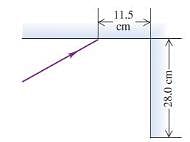
     

    Solutions


    Tan(90-i)=14/11.2
    Cot i=14/11.2
    I=cot-1(14/11.2)
    I=39.4o


  • Question 9/10
    1 / -0.25


    Two sources of light are coherent if they have


    Solutions


    In physics, two wave sources are perfectly coherent if they have a constant phase difference and the same frequency (amplitude may be different).
    As c be the speed of light which is constant.
    Using, c=νλ
    Now the same νgives the same λ. for the two light sources.
    Example: y1 ​=A1 ​sinwt and y2 ​=A2 ​sin(wt+ϕ) where ϕis constant.


  • Question 10/10
    1 / -0.25


    If we have two coherent sources  S1andS2  vibrating in phase, then for an arbitrary point P constructive interference is observed whenever the path difference is


    Solutions


    Constructive interference occurs when the path differences (S1 ​P −S2 ​P) is an integral multiple of λor (S1 ​P −S2 ​P)=n λ
    Where n=0,1 ,2 3,….


Close button icon
User Profile
-

Correct (-)

Wrong (-)

Skipped (-)


  • 1
  • 2
  • 3
  • 4
  • 5
  • 6
  • 7
  • 8
  • 9
  • 10
Mockers logo Get latest Exam Updates
& Study Material Alerts!
No, Thanks
Arrow pointer icon
Click on Allow to receive notifications
Notification bell icon ×
Open Now
