Please wait...
/
-
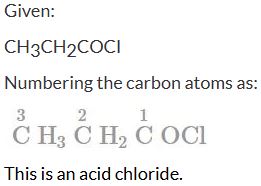
What is the name of the following compound?
CH3CH2COCI
Verify mobile number to view the solution
It consists of three carbon atoms in the parent chain and chloroformyl group (-COCI)
In the IUPAC name, the suffix "oyl chloride" is added. Therefore, the IUPAC name will be propanoyl chloride.
Identify the product for the following reaction.
CH ≡ CH + HOCI →
HOCI → OH- + CI+
CI+ shall attack acetylene as an electrophile and OH- will end the addition with a nucleophilic addition. Therefore, the final reaction will be:
Which of the following names is correct for
Since there are three carbon atoms in long chain and it contains 3 -CHO groups (one on each carbon atom).
IUPAC suffix "aldehyde" will added due to presence of functional group -CHO.
Therefore, the correct IUPAC name will be propane-1, 2, 3-tricarbaldehyde.
Propanal on treatment with dilute sodium hydroxide gives:
An alpha (α) hydrogen is the hydrogen which is bonded to alpha carbon. Alpha carbon is the first carbon which is bonded to the functional group. As propanal contains alpha hydrogen, it undergoes self aldol condensation to give beta hydroxy (aldol) compound. The reaction is as follows:
Which of the following organic compounds does not undergo diazotisation?
Benzylamine, on reaction with nitrous acid, gives unstable diazonium salt which in turn gives alcohol with a gas, that is nitrogen as shown below:
The coupling of diazonium salt of 4-amino benzene sulphonic acid with N, N-dimethyl benzamine produces
The coupling of diazonium salt of 4-aminobenzene sulphonic acid with N, N-dimethyl benzamine produces methyl orange.
Which among the following statements is incorrect?
Tertiary amines do not have any hydrogen atom attached directly to the nitrogen and hence, do not exhibit hydrogen bonding. Hence, the option (c) is incorrect.
Which of the following compounds give carbylamine reaction?
The carbylamine reaction (also known as the Hoffmann Isocyanide Synthesis) is the synthesis of an isocyanide by the reaction of a primary amine, chloroform, and base.
CH3NH2 + 3KOH + CHCl3 →CH3NC + 3KCl + 3H2O
Which of the following indicates open chain structure of glucose?
Pentacetyl formation of glucose indicates that the latter contain 5–OH groups, indicating the open chain structure of glucose.
The numbers of stereo centres present in linear and cyclic structures of glucose are respectively:
The number of stereo centres in the linear structure of glucose is 4 and in the cyclic structure is 5.
Correct (-)
Wrong (-)
Skipped (-)


 Time Taken: -
 Bank
Bank


 SSC
SSC


 Railway


 State
State


 Other
Other


 Teaching


 Insurance


 Medical


 Engineering


 Defence


 GATE
GATE


 NTA CUET

 UPSC
UPSC

 MBA Entrance


 LAW
LAW

 JEE Advanced 2026
 CUET UG 2026
 NEET UG 2026
 NDA I 2026
 UP Police Constable 2026
 SSC Selection Post (Phase 14) 2026
 AIIMS NORCET-10 2026
 SSC GD 2025-26
 RRB NTPC 2026
 CDS I 2026
 SSC CGL Tier-I 2026
 SSC JE 2026
 UPSC (CSE) 2026
 SBI PO Prelims 2026
 SSC Steno Grade C & D 2026