Please wait...

Mathematics Test - 27
Menu grid icon
Result Result point icon
Mathematics Test - 27
  • Goals icon

    /

    Score
  • Trophy icon

    -

    Rank
White alarm icon Time Taken: -
Result frame illustration
  • Question 1/10
    1 / -0

    Find the value of(cos2pπ+isin2pπ)(cos2qπ+isin2qπ)?

    Solutions

    The given equation is,

    =(cos2pπ+isin2pπ)(cos2qπ+isin2qπ)

    =cos2(p+q)π+isin2(p+q)π

    =(cosπ+isinπ)2(p+q)

    =(1+0)2(p+q)

    =(1)2(p+q)=1

  • Question 2/10
    1 / -0

    A fair coin is tossed independently four times. The probability of the event "the number of times heads show up is more than the number of times tails show up" is:

    Solutions

    Sample space contains \(2^{4}=16\) elements.

    The favorable events are:

    \(\{ H , H , H , T \},\{ H , H , T , H \},\{ H , T , H , H \},\{ T , H , H , H \},\{ H , H , H , H \}\)

    There are 5 possibilities,

    \(\therefore\) The required probability is \(\frac{5}{16}\).

  • Question 3/10
    1 / -0

    The locus represented by \(|z-1|=|z+i|\) is:
    Solutions

    Given,

    \(|z-1|=|z+i|\)

    Let \(x=x+\) iy

    \(|x+i y-1|=|x+i y+1|\)

    \(|(x-1)+i y|=|x+i(y+1)|\)

    Squaring both sides

    \(2(x-1)({iy})+({x}-1)^{2}+{y}^{2} {i}^{2}={x}^{2}+{i}^{2}({y}+1)^{2}+2 {xi}({y}+1)\)

    \(\Rightarrow({x}-1)^{2}-{y}^{2}+2 {xyi}-2 {yi}={x}^{2}-{y}^{2}-1-2 {y}+2 {xyi}+2 {xi}\)

    \(\Rightarrow x^{2}+1-2 x-y^{2}-2 y i=x^{2}-y^{2}-2 y+2 x i-1\)

    \(\Rightarrow 2 y-2 x+2=2 x i+2 y i\)

    \(\Rightarrow y-x+1=i(x+y)=0\)

    \(\Rightarrow {y}-{iy}-{x}-{xi}+1=0\)

    \(\Rightarrow y(1-i)-x(1+i)+1=0\)

    Therefore it can be written as:

    by \(-a x+1=0 \quad((1-i)=b\) and \((1+i)=a\) as they are constant)

    \(\therefore\) It represent the straight line passing through origin.

  • Question 4/10
    1 / -0

    The total number of subsets of a finite set A has 56 more elements than the total number of subsets of another finite set B. What is the number of elements in set A?

    Solutions

    Let set A and B have m and n elements, respectively.

    2m−2n = 56

    2n(2m−n−1) = 56  = 8×7 = 23×7

    Comparing both sides, we get

    2n = 23 and 2m−n = 7

    ⇒ n = 3 and 2m−n = 8

    ⇒ 2m−n = 23 ⇒ m-n = 3

    ⇒ m−3 = 3 ⇒ m = 6

    Number of the elements in A is 6.

  • Question 5/10
    1 / -0

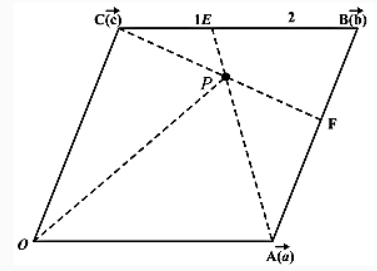
    In a parallelogram \(O A B C\), vectors \(\vec{a}, \vec{b}, \vec{c}\) are, respectively, the position vectors of vertices \(A, B, C\) with reference to \(O\) as origin. A point \(E\) is taken on the side \(BC\) which divides it in the ratio of \(2: 1\). Also, the line segment \(A E\) intersects the line bisecting the angle \(\angle A O C\) internally at point \(P\). If \(C P\) when extended meets \(A B\) in point \(F\), then the position vector of point \(P\) is:

    Solutions

    Let the position vector of \(A\) and \(C\) be \(\vec{a}\) and \(\vec{c}\) respectively. Therefore, Position vector of \(B=\vec{b}=\vec{a}+\vec{c} ~~\dots\)(i)

    Also Position vector of \(E=\frac{\vec{b}+2 \vec{c}}{3}=\frac{\vec{a}+3 \vec{c}}{3}~~\dots\)(ii)

    Now point \(P\) lies on angle bisector of \(\angle AOC\). Thus,

    Position vector of point \(P=\lambda\left(\frac{\vec{a}}{|\vec{a}|}+\frac{\vec{b}}{|\vec{b}|}\right)~~\dots\)(iii)

    Also let \(P\) divides \(EA\) in ration \(\mu: 1\). Therefore,

    Position vector of \(P\)

    \(=\frac{\mu \vec{a}+\frac{\vec{a}+3 \vec{c}}{3}}{\mu+1}=\frac{(3 \mu+1) \vec{a}+3 \vec{c}}{3(\mu+1)}~~\dots\)(iv)

    Comparing (iii) and (iv), we get

    \(\lambda\left(\frac{\vec{a}}{|\vec{a}|}+\frac{\vec{c}}{|\vec{c}|}\right)=\frac{(3 \mu+1) \vec{a}+3 \vec{c}}{3(\mu+1)}\)

    \(\Rightarrow \frac{\lambda}{|\vec{a}|}=\frac{3 \mu+1}{3(\mu+1)}\) and \(\frac{\lambda}{|\vec{c}|}=\frac{1}{\mu+1}\)

    \(\Rightarrow \frac{3|\vec{c}|-|\vec{a}|}{3|\vec{a}|}=\mu\)

    \(\Rightarrow \frac{\lambda}{|\vec{c}|}=\frac{1}{\frac{3|\vec{c}|-\vec{a}}{3|\vec{a}|}+1}\)

    \(\Rightarrow \lambda=\frac{3|\vec{a}||\vec{c}|}{3|\vec{c}|+2|\vec{a}|}\)

  • Question 6/10
    1 / -0

    \(\tan \left(2 \tan ^{-1}(\cos x)\right)\) is equal to:

    Solutions

    Given,

    \(\tan \left(2 \tan ^{-1}(\cos x)\right)\)

    As we know, \(2 \tan ^{-1} x =\tan ^{-1} \frac{2 x }{1- x ^{2}}\)

    Therefore,

    \(2 \tan ^{-1} \cos x=\tan ^{-1} \frac{2 \cos x}{1-\cos ^{2} x}\)

    \(=\tan ^{-1} \frac{2 \cos x}{\sin ^{2} x}\)\(\quad(\because 1 - cos^2{x} =sin^2{x})\)

    \(=\tan ^{-1}(2 \cot x \operatorname{cosec} x)\)

    \(\tan \left(\tan ^{-1}(2 \cot x \operatorname{cosec} x)\right)=2 \cot x \operatorname{cosec} x \quad\left(\because \tan \left(\tan ^{-1} x\right)=x\right)\)

  • Question 7/10
    1 / -0

    If \(\alpha\) and \(\beta\) are the roots of the equation \(x^{2}-6 x+3=0\), what is the value of \(\frac{\alpha}{\beta}+\frac{\beta}{\alpha} ?\)

    Solutions

    As we know,

    If \(\alpha\) and \(\beta\) are the roots of the equation, \(a x^{2}+b x+c=0\)

    Sum of roots \((\alpha+\beta)=\frac{-b}{a}\)

    Product of roots \((\alpha \beta)=\frac{c}{a}\)

    Given,

    \(x^{2}-6 x+3=0\)

    \(\alpha+\beta=-\left(\frac{-6}{1}\right)=6\)

    \( \alpha \beta=\frac{3}{1}=3 \)

    Now,

    \(\frac{\alpha}{\beta}+\frac{\beta}{\alpha}=\frac{\alpha^{2}+\beta^{2}}{\alpha \cdot \beta}\)...(1)

    \((\alpha+\beta)^{2}=\alpha^{2}+\beta^{2}+2 \alpha \beta\)

    \(\Rightarrow(6)^{2}=\alpha^{2}+\beta^{2}+2 \times 3 \)

    \(\Rightarrow \alpha^{2}+\beta^{2}=36-6=30\)

    Putting the value of \((\alpha^{2}+\beta^{2})\) in equation (1), we get

    \(\frac{\alpha^{2}+\beta^{2}}{\alpha \cdot \beta}=\frac{30}{3}\)

    \(\therefore \frac{\alpha^{2}+\beta^{2}}{\alpha \cdot \beta}=10\)

    So, the value of \(\frac{\alpha}{\beta}+\frac{\beta}{\alpha}=\frac{\alpha^{2}+\beta^{2}}{\alpha \cdot \beta}=10\)

  • Question 8/10
    1 / -0

    Find the middle terms in the expansion of \(\left(1+3 x+3 x^{2}+x^{3}\right)^{2 n}\).

    Solutions

    Given:

    \(\left(1+3 x+3 x^{2}+x^{3}\right)^{2 n}\)

    \(=(1+x)^{6 n}\)

    Here, \(n\) is an even number.

    So the middle terms is \((\frac{6 n}{2} { +1})=(3 n+1)^{\text {th }}\) term

    So terms \((3 n+1)^{\text {th }}\) term is:

    \(T_{3 n+1}={ }^{6 n} C_{3 n} x^{3 n} \)

    \(=\frac{(6 n) !}{(3 n!)^{2}} x^{3 n}\)

  • Question 9/10
    1 / -0

    The magnitude of the projection of the vector \(2 \hat{i}+3 \hat{j}+\hat{k}\) on the vector perpendicular to the plane containing the vectors \(\hat{\mathrm{i}}+\hat{\mathrm{j}}+\hat{\mathrm{k}}\) and \(\hat{i}+2 \hat{j}+3 \hat{k}\), is:

    Solutions

    Let \(\vec{a}=\hat{i}+\hat{j}+\hat{k}\) and \(\vec{b}=\hat{i}+2 \hat{j}+3 \hat{k}\)

    \(\therefore\) vector perpendicular to \(\overrightarrow{\mathrm{a}}\) and \(\overrightarrow{\mathrm{b}}\) is \(\overrightarrow{\mathrm{a}} \times \overrightarrow{\mathrm{b}}\)

    \(\therefore \vec{a} \times \vec{b}=\left|\begin{array}{ccc} \hat{i} & \hat{j} & \hat{k} \\ 1 & 1 & 1 \\ 1 & 2 & 3 \end{array}\right|=\hat{i}-2 \hat{j}+\hat{k}\)

    Now, projection of vector \(\vec{c}=2 \hat{i}+3=\hat{j}+\hat{k}\) on \(\vec{a} \times \vec{b}\) is

    \(=\left|\frac{\vec{c} \cdot(\vec{a} \times \vec{b})}{|\vec{a} \times \vec{b}|}\right|=\left|\frac{2-6+1}{\sqrt{6}}\right|=\frac{3}{\sqrt{6}}=\sqrt{\frac{3}{2}}\)

  • Question 10/10
    1 / -0

    A tea party is arranged for \(16\) people along two sides of a long table with eight chairs on each side. Four particular men wish to sit on one particular side and two particular men on the other side. The number of ways they can be seated is:

    Solutions

    There are \(8\) chair on each side of the table.

    Let the sides be represented by \({A}\) and \({B}\).

    Let four persons sit on side \({A}\), then number of ways of arranging \(4\) persons on \(8\) chairs on side \({A}={ }^{8} {P}_{4}\)

    And two persons sit on side \({B}\).

    The number of ways of arranging \(2\) persons on \(8\) chairs on side \({B}={ }^{8} {P}_{2}\)

    The remaining \(10\) persons can be arranged in remaining \(10\) chairs in \(10 !\) ways.

    Hence, the total number of ways in which the persons can be arranged is \({ }^{8} {P}_{4} \times{ }^{8} {P}_{2} \times 10 !=\frac{8 ! 8 ! 10 !}{4 ! 6 !}\)

Close button icon
User Profile
-

Correct (-)

Wrong (-)

Skipped (-)


  • 1
  • 2
  • 3
  • 4
  • 5
  • 6
  • 7
  • 8
  • 9
  • 10
Mockers logo Get latest Exam Updates
& Study Material Alerts!
No, Thanks
Arrow pointer icon
Click on Allow to receive notifications
Notification bell icon ×
Open Now