Bank
Bank


 SSC
SSC


 Railway


 State
State


 Other
Other


 Teaching


 Insurance


 Medical


 Engineering


 Defence


 GATE
GATE


 NTA CUET

 UPSC
UPSC

 MBA Entrance


 LAW
LAW

 CTET September 2026 Paper I
 Agniveer Vayu 2026
 SSC Selection Post (Phase 14) 2026
 SSC CGL Tier-I 2026
 SSC JE 2026
 SSC CPO Tier I 2026
 SBI Clerk Prelims 2026
 IBPS Clerk Prelims 2026
 IBPS PO Prelims 2026
 RRB ALP CBT-I 2026
 IBPS RRB Prelims 2026

AMU Question Papers
The AMU question papers practice in an online test format at Mockers is just not about solving questions but building an exam strategy. With the regular attempts at them, you will be able to find the important topics, improve your time management, reduce exam anxiety, and so on. These past papers allow you to check your preparation in a real exam-like environment rather than relying only on theory.
Moreover, by using the AMU PYQs, you can recognize the patterns. Over time, you will notice that there are certain concepts as well as question types that repeat. With this, you will gain a strategic edge and prioritize the topics with high weightage.
Why Should You Practice AMU PYQs?
If you want to understand how the actual Aligarh Muslim University Engineering Entrance Exam works as well as what it demands, there is no better resource than AMU exam question papers. They give you direct exposure to real questions, exam structure, difficulty level, etc., rather than preparing blindly. Here are some more points that explain why you should practice these papers.

- In this examination, a specific style of asking questions is followed. So, even if you know the concept, you might struggle to solve it if you don’t know the framing of the questions. But, by solving the AMU question papers with answer keys, you can understand how questions are asked, you get used to the exam-specific wordings, you reduce confusion during the actual exam, and so on.
- We have noticed that many students focus on what to study. The AMU question papers solved with answers train you how to think under the conditions of the exam. With their help, you will be able to apply concepts quickly, switch between subjects efficiently, make faster decisions under pressure, etc. In this way, you are able to transform your preparation from study mode to exam mode.
- With the attempts at the AMU past year question papers, you will be able to discover your real preparation level. They will reveal your actual strong and weak areas, show which topics you actually know, give you a reality check early, and so on. Through this, you can prevent any last-minute surprises.
- Not all topics of the syllabus are equally important. The AMU old question papers reveal the concepts that are tested frequently, chapters that have high weightage, question patterns that are predictable, etc. This way, you can study in a smarter and not harder way.
- Time management is a skill that you can build through practice. So, when you solve the AMU past year papers online tests, you learn how much time each section takes. You are also able to develop a personal strategy to attempt the paper and avoid spending too long on difficult questions. All this will directly improve your final score.
Year-Wise AMU Exam Question Papers
At Mockers, you get the benefit of exploring online question papers with answers for AMU across several years. All of these are the real papers that our experts have collected from the official sources. By solving them, you will be able to understand the changes in the exam pattern clearly. You can also learn about the topics that might be asked in the upcoming exam and check their level of difficulty. We advise you to practice them in a sequence so that you can track your progress, improve your accuracy, as well as build your confidence in a gradual manner. Here are the links to each of these papers.
AMU Question Paper 2020 to 2017
How To Access The AMU Question Papers With Answer Keys?
If you are planning to solve the free online question papers with answers for AMU on our platform, then here are the steps you need to follow one by one.
- You have to open a web browser on your preferred device and type www.mockers.in in the given search space.

- Once the website is accessible, you should click on the ‘Navigation’ tab and select the ‘Exam Categories’ section.

- This section will further expand, wherein you can easily tap on the ‘Engineering’ icon.
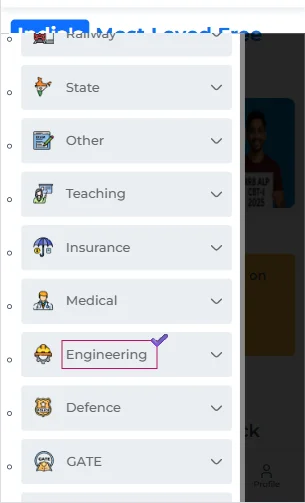
- Under it, you can explore all the engineering exams for which we provide study materials and select the ‘AMU’ option.

- Now, your browser will open a new web page. Here, you need to click on the ‘Question Paper’ icon.

- Then, the AMU question papers will be visible, and you should tap on the ‘Explore’ button to access them.

- Finally, from the year-wise AMU PYQs, you can choose any one, click on its ‘Start’ button, and attempt the given questions.

The Syllabus Of The AMU Engineering Entrance Exam
In the table below, you will get the syllabus through which the AMU question papers with answer keys are prepared.
| SUBJECT | TOPICS & SUBTOPICS |
| PHYSICS | Units & Measurements: Fundamental and derived units, SI system, dimensional analysis and its applications, conversion of units, errors (systematic & random), absolute and relative error, percentage error, significant figures, precision vs accuracy |
| Kinematics: Motion in a straight line, position-time graphs, velocity and acceleration, uniformly accelerated motion, equations of motion, motion under gravity, projectile motion (range, height, time), relative velocity in one and two dimensions | |
| Laws of Motion: Newton’s First, Second, and Third Laws, inertia, impulse, conservation of momentum, friction (static, kinetic, rolling), circular motion, centripetal force, free body diagrams, equilibrium of particles | |
| Work, Energy & Power: Work done by constant and variable forces, kinetic energy, potential energy, work-energy theorem, conservation of mechanical energy, power, elastic and inelastic collisions in one dimension | |
| Rotational Motion: Rigid body motion, axis of rotation, torque and angular acceleration, moment of inertia (various bodies), radius of gyration, angular momentum and its conservation, rolling motion, rotational kinetic energy | |
| Gravitation: Newton’s law of gravitation, gravitational field, potential energy, acceleration due to gravity (variation with height and depth), satellite motion, orbital velocity, escape velocity | |
| Properties of Matter: Elastic behavior (stress-strain curve, Hooke’s law), viscosity (Stokes’ law), surface tension, capillarity, fluid pressure, buoyancy, Archimedes’ principle, Bernoulli’s theorem, and applications | |
| Thermodynamics: Thermal equilibrium, Zeroth law, heat transfer (conduction, convection, radiation), First and Second laws of thermodynamics, internal energy, work done in thermodynamic processes, Carnot engine, entropy | |
| Kinetic Theory of Gases: Equation of state of gases, kinetic interpretation of temperature, root mean square speed, degrees of freedom, law of equipartition of energy | |
| Oscillations & Waves: Simple harmonic motion (SHM), time period, energy in SHM, damped and forced oscillations, wave motion, transverse and longitudinal waves, sound waves, Doppler effect | |
| Electrostatics: Electric charge and its properties, Coulomb’s law, electric field and field lines, electric flux, Gauss’s law, electric potential, capacitance, parallel plate capacitors, dielectric materials | |
| Current Electricity: Electric current, drift velocity, Ohm’s law, resistance, resistivity, temperature dependence, series and parallel circuits, Kirchhoff’s laws, Wheatstone bridge, electrical power | |
| Magnetism & EMI: Magnetic field due to current, Biot-Savart law, Ampere’s law, force on moving charge, electromagnetic induction, Faraday’s law, Lenz’s law, self and mutual inductance | |
| Optics: Reflection of light, spherical mirrors, refraction, Snell’s law, total internal reflection, lenses, lens formula, magnification, optical instruments (microscope, telescope), interference, and diffraction basics | |
| Modern Physics: Photoelectric effect, wave-particle duality, Bohr’s atomic model, nuclear structure, radioactivity, half-life, nuclear reactions, semiconductors, diodes, and transistors | |
| CHEMISTRY | Some Basic Concepts: Mole concept, molar mass, stoichiometry, limiting reagent, percentage yield, empirical and molecular formula |
| Atomic Structure: Thomson and Rutherford models, Bohr model, quantum numbers, orbitals, electronic configuration, Aufbau principle, Hund’s rule | |
| Periodic Table: Modern periodic law, periodic trends (atomic size, ionization energy, electron affinity), metallic and non-metallic character | |
| Chemical Bonding: Ionic bond, covalent bond, coordinate bond, VSEPR theory, hybridization (sp, sp2, sp3), molecular geometry, polarity | |
| States of Matter: Gaseous state (Boyle’s law, Charles’ law), ideal gas equation, real gases, liquid state properties, solid state classification | |
| Thermodynamics: System and surroundings, enthalpy changes, Hess’s law, entropy, Gibbs free energy, spontaneity | |
| Chemical Equilibrium: Law of mass action, equilibrium constant, Le Chatelier principle, ionic equilibrium, pH, buffer solutions | |
| Redox Reactions: Oxidation and reduction, oxidation number, balancing redox reactions, electrochemical series | |
| Solutions: Types of solutions, concentration units (molarity, molality), colligative properties, Raoult’s law | |
| Electrochemistry: Electrochemical cells, galvanic and electrolytic cells, Nernst equation, conductivity | |
| Chemical Kinetics: Rate laws, order of reaction, half-life, Arrhenius equation, activation energy | |
| Surface Chemistry: Adsorption (physical & chemical), catalysts, colloids, emulsions | |
| Organic Chemistry Basics: Nomenclature (IUPAC), isomerism (structural & stereoisomerism), reaction mechanisms, inductive and resonance effects | |
| Hydrocarbons: Alkanes (properties & reactions), alkenes (addition reactions), alkynes, aromatic hydrocarbons | |
| Functional Groups: Alcohols, phenols, ethers, aldehydes, ketones, carboxylic acids, amines, reaction mechanisms | |
| Biomolecules: Carbohydrates (glucose, fructose), proteins, amino acids, enzymes, vitamins | |
| Polymers: Addition and condensation polymers, natural and synthetic polymers, uses | |
| Environmental Chemistry: Air pollution, water pollution, ozone depletion, greenhouse effect | |
| MATHS | Sets, Relations, & Functions: Types of sets (finite, infinite, empty), subsets, power set, Venn diagrams, operations on sets (union, intersection, complement), De Morgan’s laws, Cartesian product, relations (reflexive, symmetric, transitive), equivalence relations, functions (one-one, onto, bijective), domain, range, composition of functions, inverse functions |
| Complex Numbers: Algebra of complex numbers, Argand plane, modulus and argument, conjugate, polar form, Euler form, De Moivre’s theorem, roots of complex numbers, quadratic equations with complex roots | |
| Quadratic Equations: Nature of roots, discriminant, relation between roots and coefficients, formation of equations, quadratic inequalities, maximum and minimum value of quadratic expressions | |
| Sequences and Series: Arithmetic progression, geometric progression, harmonic progression, sum of n terms, infinite GP, arithmetic-geometric series, special series | |
| Logarithms: Laws of logarithms, change of base, solving logarithmic equations, applications in exponential equations | |
| Permutation and Combination: Fundamental principle of counting, permutations (with and without repetition), circular permutations, combinations, binomial coefficients, applications in probability | |
| Binomial Theorem: General term, middle term, binomial coefficients, properties, approximation, using binomial theorem | |
| Trigonometric Functions: Basic identities, trigonometric ratios, graphs of trigonometric functions, periodicity, domain, and range | |
| Trigonometric Identities and Equations: Standard identities, transformations, solving trigonometric equations, multiple angles, submultiple angles | |
| Inverse Trigonometric Functions: Domain, range, principal values, properties, graphs, solving equations involving inverse trig functions | |
| Continuity and Differentiability: Continuity at a point, differentiability, and the relation between continuity and differentiability | |
| Probability: Sample space, events, conditional probability, independence, Bayes theorem, total probability theorem | |
| Statistics: Mean, median, mode, variance, standard deviation, grouped data, probability distributions | |
| Determinants: Properties of determinants, minors and cofactors, expansion, inverse of a matrix, solving linear equations using determinants | |
| Linear Programming: Formulation of problems, graphical method, feasible region, optimization (max/min problems) |
Mistakes Students Make While Solving The AMU Past Year Question Papers
Due to some mistakes that can be easily avoided, some students are not able to get the full benefit of the AMU question papers solved with answers or the AMU mock tests. In this section, we have mentioned some of these mistakes and how you can correct them. This will give you a powerful learning experience.
- You can reduce the effectiveness of the AMU past year question papers if you attempt them in a casual way with breaks or distractions. That’s why you should always solve the paper in a strict, as well as time-bound, environment. Only this way, you will be able to simulate the real experience of the exam.
- You will limit your learning if you rush to finish the AMU old question papers without focusing on the logic behind the problems. It is important that you focus on understanding the concepts as well as reasoning. This should be done even if you get to solve fewer questions.
- You can make repeated errors by moving on to the next AMU past year papers online tests without reviewing your mistakes. For this reason, you must spend proper time on analyzing your incorrect answers, weak areas, time-consuming questions, etc., after each test.
- It can create an imbalance in your preparation if you focus only on the subjects in which you are comfortable while solving the online question papers with answers for AMU. You must allocate more time to your weaker sections as well as maintain consistency in the stronger ones.
- By guessing randomly during the practice of the free online question papers with answers for AMU, you will have a false sense of confidence. That’s why you should attempt the questions only after eliminating the options in a logical manner. You also need to understand the reasoning behind them properly.
Analysis Of The AMU Old Question Papers
In the table below, you will get a detailed analysis of the AMU question papers for the past several years. You can surely rely on it and prepare accordingly, as it is prepared by our team of subject-matter experts.
| Year | Overall Difficulty | Question Pattern | Observations |
| 2025 | Moderate | Fully MCQ-based | There was a slight increase in tricky and application-based questions; focus on accuracy. |
| 2024 | Easy to Moderate | MCQ + some direct questions | Many questions from repeated topics and PYQ patterns. |
| 2023 | Moderate | Standard MCQ format | Questions required clarity of basics rather than memorization. |
| 2022 | Moderate to Difficult | MCQ with tricky options | There was an increase in analytical and elimination-based questions. |
| 2021 | Easy to Moderate | Mostly direct MCQs | Scoring paper; many predictable and repeated concepts. |
| 2020 | Moderate | Standard MCQs | The questions tested fundamentals with some twists. |
| 2019 | Moderate to Difficult | MCQs with confusing options | Required a deeper understanding and problem-solving skills. |
| 2018 | Easy to Moderate | Direct MCQs | The paper was easier, good for beginners, and base building. |
Conclusion
With the help of the AMU PYQs on the Mockers platform, you get a clear understanding of the exam pattern, highlight important topics, find the level of questions that are asked, and so on. Their consistent practice will not only strengthen your concepts but also improve your speed, accuracy, and confidence. So, in order to maximize your preparation, you should always attempt these papers in a real test-like environment.



 Get latest Exam Updates