Bank
Bank


 SSC
SSC


 Railway


 State
State


 Other
Other


 Teaching


 Insurance


 Medical


 Engineering


 Defence


 GATE
GATE


 NTA CUET

 UPSC
UPSC

 MBA Entrance


 LAW
LAW

 CTET September 2026 Paper I
 AIIMS (NORCET - 11) 2026
 NDA II 2026
 CDS II 2026
 Agniveer Vayu 2026
 SSC Selection Post (Phase 14) 2026
 SSC CGL Tier-I 2026
 SSC JE 2026
 SSC CPO Tier I 2026
 SSC Steno Grade C & D 2026
 SBI Clerk Prelims 2026
 IBPS Clerk Prelims 2026
 IBPS PO Prelims 2026
 RRB ALP CBT-I 2026
 IBPS RRB Prelims 2026

KCET Question Paper
The Karnataka Common Entrance Test (KCET) 2027 is an offline, pen-and-paper exam conducted by the Karnataka Examinations Authority (KEA). Students aspiring to pursue UG programs such as Engineering, Medicine, Architecture, etc., in Karnataka can appear for this entrance test. Through the KCET question paper, all appearing candidates are examined. Over 3.1 lakh students appeared for the KCET in 2025. To participate, you can start your preparation by understanding the exam paper, where solving the questions in an online test format helps.
Regular practice and performance analysis will help you understand how the KCET PYQs are developed, which chapters are prioritised, what the question structure and common traps are, and your overall preparation for this test so far. Mockers offers you free papers from 2011 to the present for practice.
Year-Wise KCET Exam Question Papers
Every year, the exam syllabus remains almost the same (except in 2024, when NCERT removed various topics), but the difficulty level and questions vary. In order to understand what types of questions are framed in the exam and how Physics or Maths topics are picked to examine candidates, you should solve year-wise KCET exam question papers. It will give you a broader idea of the examiner’s mindset, plus opportunities to solve hundreds of questions for practice and self-assessment.
With year-wise KCET question paper with answer keys, you get a blueprint of how your exam preparation strategy should be, what you should prioritise, and what exact study materials you need to avoid sinking into numerous study materials.
- KCET PYP 2025 to 2004
- KCET 2017 Question Paper
- KCET 2015 Question Paper
- KCET 2014 Question Paper
- KCET 2013 Question Paper
- KCET 2012 Question Paper
- KCET 2011 Question Paper
KCET Exam Pattern at a Glance
Before starting preparation, you must know the exam pattern to develop strategies for your studies. This exam is designed across three main papers: Physics, Chemistry, and Mathematics/Biology. Here is a glimpse of the KCET pattern:
| Particulars | Details |
| Exam | Karnataka Common Entrance Test |
| Mode | Offline (OMR Sheet) |
| Total Questions | 180 (60 per subject) |
| Total Marks | 180 (1 mark per correct answer) |
| Negative Marking | None |
| Time Duration | 80 minutes per subject |
| KCET Official Website | https://cetonline.karnataka.gov.in/kea/ |
Why Solve KCET Old Question Papers
There are various solid reasons to practice the KCET question paper solved with answers, but some of the most important are:

- Develop immense control over time utilisation: KCET tests how fast and accurately you can work under exam pressure. For instance, you have 60 MCQs to be solved in just 80 minutes per subject. Solving the KCET past year question papers gives you a clear idea of how much time to allocate to each section or question.
- Understand which topics to prioritise: Solving the last 10–20 years of KCET old question papers gives you a clear idea of which concepts or topics are repeated the most. It also helps you find the high-weightage chapters you should be paying attention to.
- Bridge the gap between Boards and KCET: Most candidates pass their board exams but struggle with the exam because the questions are structured differently in this test. When you solve the KCET past year papers online test, you learn how a simple NCERT concept becomes a trickier question. You get to know how examiners intentionally plan traps to cause mistakes, beautifully examining your attention to detail and grasp of concepts.
Steps to Get Online Question Papers With Answers for KCET
You can attempt online question papers with answers for KCET for free by following these steps:
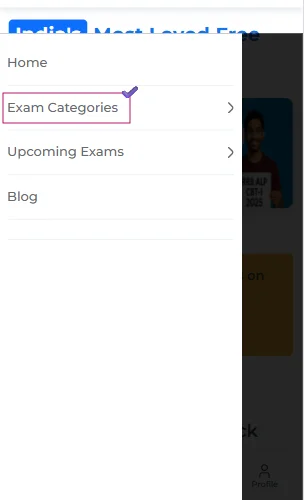
- Open Mockers.in and go to ‘Exam Categories’ to find ‘Engineering’.

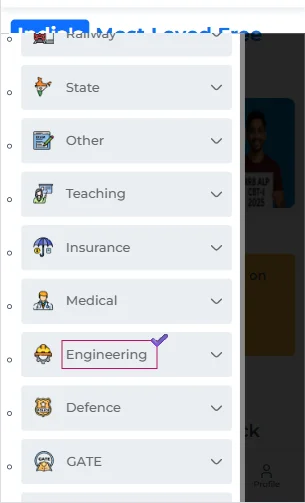
- Hovering over or clicking on ‘Engineering’ will show you various exam names; click on ‘KCET’ to proceed further.

- Now, you land on the KCET Mock Test page, where you are required to click on the ‘Question Paper’ button.

- There will be a year-wise list of free online question papers with answers for KCET. Click on the ‘Explore’ button for any PYQs you want.

- Next, another page opens where you have a ‘Start’ button to begin the KCET question paper for free.

How to Perform KCET Old Question Paper Analysis
Just solving the KCET PYQs isn't enough. If you want its maximum benefits, you should do a question paper analysis on your own. Here is the 'self-analysis' methodology:
- Attempt the KCET exam question papers under a strict time frame without taking any help or looking at the solutions.
- Once you complete an online test, go through each wrong answer you chose or avoided answering. Now, categorise those mistakes as a 'Conceptual Gap', 'Calculation Error', or 'Time Trap'. Now that you have a list of the mistakes you made in the KCET question paper with answer keys, simply refer to your study resources to improve them.
- Don't just find your mistakes in the KCET question paper solved with answers, but identify repeating question themes. For each subject, prepare a separate notebook to note down question types and where the question was picked from — is it from NCERT or a variation of a JEE Main question (which is common for KCET Physics)? Also, note down the topics that appear every year, such as Methods of Integration in Maths or Coordination Compounds in Chemistry.
- After the analysis, update your study materials and adjust your preparation strategy so that you can improve and score full marks in your KCET mock tests or the next KCET past year question papers.
Most Important Topics for KCET (Subject-Wise)
Over the last 5 years, some chapters have shown the highest repetition in the KCET old question papers; based on those chapters' frequency, we have created this table of Most Important Topics for KCET. If you focus on these topics, you can cover about 40–45% of the total marks.
| Subject | Chapter / Unit | Avg. Questions (approx.) | Expected Weightage |
| Mathematics | Calculus (Integration & Differentiation) | 12–15 | 20–25% |
| Chemistry | Organic Chemistry (All Units) | 18–21 | 30–35% |
| Mathematics | Algebra (Matrices & Determinants) | 6–9 | 10–15% |
| Physics | Electrostatics (Charges, Fields & Potential) | 6–7 | 10–12% |
| Physics | Optics (Ray & Wave Optics) | 6–7 | 10–12% |
| Physics | Current Electricity | 5–6 | 8–10% |
| Chemistry | p-Block Elements | 5–6 | 8–10% |
| Mathematics | Vectors & 3D Geometry | 6–7 | 10–12% |
| Chemistry | Coordination Compounds | 4–5 | 7–9% |
| Physics | Modern Physics (Atoms, Nuclei, Dual Nature) | 5–6 | 8–10% |
Conclusion
Regular practice with the KCET past year papers online test is important for your current exam preparation. The practice sessions help you understand the exam pattern, improve time management, and learn about important topics. Use the papers to self-evaluate and analyse them to improve your knowledge, avoid common mistakes, and build exam confidence to score higher.



 Get latest Exam Updates