Bank
Bank


 SSC
SSC


 Railway


 State
State


 Other
Other


 Teaching


 Insurance


 Medical


 Engineering


 Defence


 GATE
GATE


 NTA CUET

 UPSC
UPSC

 MBA Entrance


 LAW
LAW

 CTET September 2026 Paper I
 Agniveer Vayu 2026
 SSC Selection Post (Phase 14) 2026
 SSC CGL Tier-I 2026
 SSC JE 2026
 SSC CPO Tier I 2026
 SBI Clerk Prelims 2026
 IBPS Clerk Prelims 2026
 IBPS PO Prelims 2026
 RRB ALP CBT-I 2026
 IBPS RRB Prelims 2026

LPUNEST Sample Papers
While preparing for the Lovely Professional University National Entrance and Scholarship Test, you might feel a bit confused when you are unsure about the patterns of questions, difficulty level, time constraints, and so on. This is where you should use the LPUNEST sample papers on Mockers and make them an important part of your study strategy. With them, you will not only get a clear idea of what to expect in the exam but also practice in a structured as well as efficient way.
The team of Mockers brings a unique approach to your exam preparation by offering the LPUNEST sample papers with solutions in the form of mini test series. You can attempt these short and focused tests that take just 10 minutes to complete, rather than long and exhausting practice sessions. Moreover, you will be able to fit this format into your daily routine easily, which will make you stay consistent with your preparation.
What Happens When You Practice Just 10 Minutes Daily With The LPUNEST Exam Sample Papers?
Many students think that for exam preparation, they need long study hours and revision sessions. But in reality, you will get better results with the short bursts of focused practice. When you practice with our subject-wise mini LPUNEST exam sample papers, you will be able to shift from passive learning to active problem-solving. This small daily habit will further reshape how you understand concepts, manage time, handle exam pressure, and so on. Here are some more points that explain the use of these 10 minutes sample test series.
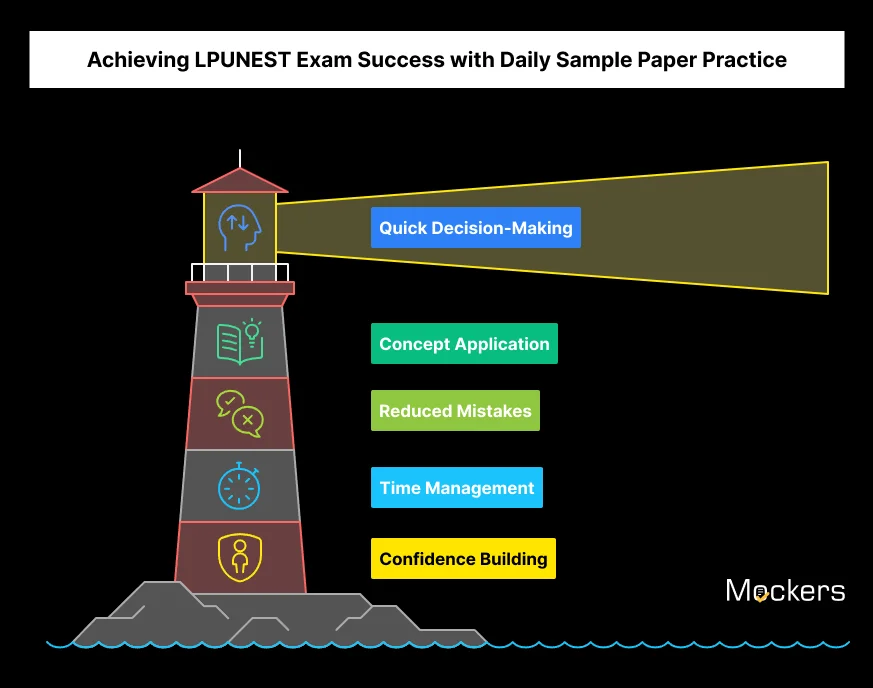
- By solving the LPUNEST entrance exam sample papers daily, your brain will adapt to quick decision-making. You will stop overthinking simple questions, start recognizing patterns faster, develop instant recall of concepts, and so on. All this is quite important for the exam, as your efficiency in time directly impacts your score.
- Rather than reading theory again and again, the daily practice of the LPUNEST entrance test sample papers will help you apply concepts repeatedly in different questions, understand where you lack clarity, strengthen your weaker topics naturally, etc. With these subject-wise tests, you can give focused attention to each of them as well as reduce your confusion significantly.
- The everyday short practice sessions of the sample papers for LPUNEST will naturally reduce your mistakes. It will happen because you will start noticing your careless errors, learn to read questions more carefully, become more confident in your answers, and so on. Ultimately, your accuracy will improve over days and weeks, even without any extra study time.
- One great advantage of these 10-minute LPUNEST exam sample question paper tests is that you will learn how to prioritize the questions quickly, stop wasting time on difficult problems, as well as develop an internal ‘exam clock’ sense. So, by the time you actually appear for the LPU National Entrance and Scholarship Test, time management will feel natural to you.
- Rather than avoiding difficult subjects, with the LPUNEST online sample papers, you will be able to focus on weak topics in small portions, build your confidence in a gradual manner, and reduce the fear of specific subjects. Through the subject-wise practice, you can also make sure that you don’t leave any area untouched.
How To Attempt The LPUNEST Sample Papers Online Tests?
Here is the step-by-step process that will take you to the web page where all the free online LPUNEST sample papers tests and you can attempt them easily.
- Firstly, you should type www.mockers.in into your preferred browser on any device.

- This will take you directly to our website, which you can explore and then tap on the ‘Navigation’ tab.
- Under this tab, two main sections will be available, and you have to select the ‘Exam Categories’ one.
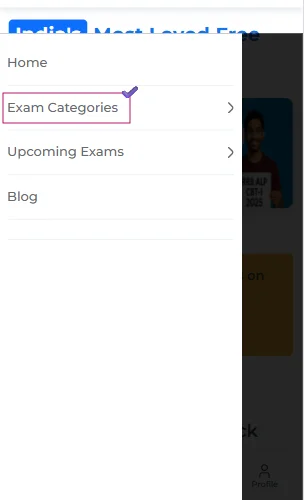
- Then, you can go through them and click on the ‘Engineering’ option.
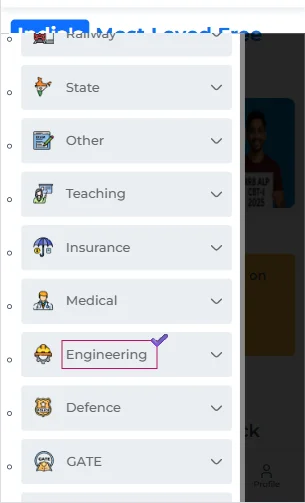
- This option will showcase a wide variety of engineering exams. Here, you should select the ‘LPU’ icon.

- Within a few seconds, you will reach a new web page that has the resources specifically for this exam.
- Now, you can tap on the ‘Sample Paper’ icon and access the subjects for which we have LPUNEST sample papers.
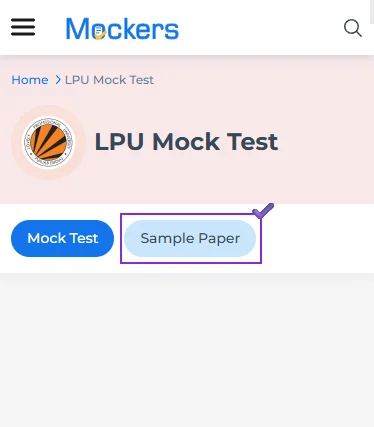
- You can either select the ‘Latest Tests’ or any subject to attempt the LPUNEST sample papers with solutions.
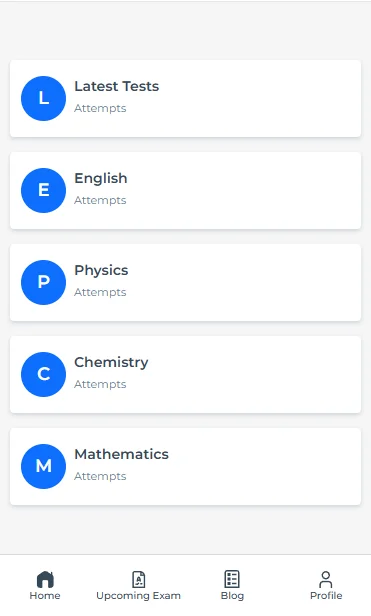
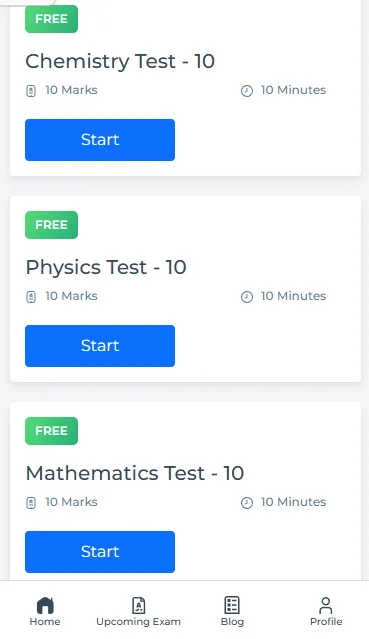
- Finally, the series of LPUNEST exam sample papers for your selected option will open up, and you can start taking them one by one.
Syllabus From Which LPUNEST Entrance Exam Sample Papers Are Prepared
The LPUNEST entrance test sample papers on Mockers are designed strictly on the syllabus of the official exam. Here, you will find a detailed table in which we have mentioned all the topics, as well as subtopics, for each subject that our experts have used in the sample papers.
| Main Topic | Detailed Subtopics |
| MATHS | |
| Sets, Relations & Functions | Types of sets (finite, infinite, empty), union, intersection, complement, Venn diagrams (2-set & 3-set problems), power set, Cartesian product, relations (reflexive, symmetric, transitive), equivalence relations, types of functions (one-one, onto, bijective), composite functions, inverse functions, domain & range analysis, graphical interpretation of functions |
| Algebra | Complex numbers (modulus, argument, polar form), quadratic equations (roots, nature of roots), arithmetic progression (AP), geometric progression (GP), harmonic progression (HP), binomial theorem (general term, middle term), mathematical induction, inequalities, logarithms, exponential functions |
| Matrices & Determinants | Types of matrices (square, diagonal, identity), matrix operations, transpose, adjoint & inverse, determinant properties, Cramer’s rule, consistency of equations, solving linear equations using matrices, application-based word problems |
| Trigonometry | Trigonometric ratios & identities, trigonometric equations, inverse trigonometric functions, general solutions, height & distance problems, graphs of trigonometric functions, transformation formulas, periodicity & symmetry |
| Coordinate Geometry | Distance formula, section formula, slope of line, equation of straight line (various forms), angle between lines, pair of lines, circle (standard & general equation), parabola, ellipse, hyperbola, eccentricity, focus-directrix properties |
| Calculus | Limits (standard limits, L’Hospital rule basics), continuity & differentiability, derivatives (rules, implicit differentiation), applications of derivatives (maxima-minima), integration (indefinite & definite), substitution method, partial fractions, area under curves |
| Statistics & Probability | Mean, median, mode (grouped & ungrouped data), standard deviation, variance, probability rules (addition & multiplication), conditional probability, Bayes theorem basics, permutations & combinations, factorial concepts |
| Vector Algebra | Vector addition & subtraction, magnitude & direction, unit vectors, dot product (scalar product), cross product (vector product), projection of vectors, angle between vectors, scalar triple product |
| Linear Programming | Linear inequalities, graphical method, feasible region, corner point method, optimization problems (maximization & minimization), real-life application problems |
| PHYSICS | |
| Mechanics | Newton’s laws of motion, inertia, momentum, impulse, friction (static and kinetic), circular motion, centripetal force, work-energy theorem, power, conservation of energy, rotational dynamics, torque, angular momentum |
| Kinematics | Motion in one dimension, equations of motion, motion under gravity, projectile motion, relative velocity, motion graphs (displacement-time, velocity-time, acceleration-time), uniform and non-uniform motion |
| Thermodynamics | Heat and temperature concepts, thermal equilibrium, specific heat, calorimetry, laws of thermodynamics (zeroth, first, second), isothermal and adiabatic processes, entropy basics, heat engines |
| Waves and Oscillations | Simple harmonic motion (SHM), restoring force, amplitude, frequency, phase, wave motion, longitudinal and transverse waves, sound waves, resonance, Doppler effect |
| Electromagnetism | Electric charge, Coulomb’s law, electric field and potential, capacitance, current electricity (Ohm’s law, resistivity), Kirchhoff’[s laws, magnetic effects of current, Lorentz force, electromagnetic induction, AC circuits |
| Optics | Reflection and refraction, laws of reflection, lens formula, mirror formula, refraction through a prism, total internal reflection, optical instruments (microscope, telescope), wave optics basics |
| Modern Physics | Photoelectric effect, de Broglie hypothesis, Bohr’s model, atomic structure, nuclear physics (radioactivity, half-life), semiconductors, diodes, logic gates |
| Units and Measurements | SI units, dimensional analysis, accuracy and precision, significant figures, errors in measurement (systematic and random), experimental techniques |
| Gravitation | Newton’s law of gravitation, gravitational field and potential, acceleration due to gravity, escape velocity, satellite motion, orbital velocity |
| CHEMISTRY | |
| Physical Chemistry | Mole concept (Avogadro number, molar mass, limiting reagent, percentage yield), stoichiometry (mass-mole relationships, volumetric analysis), atomic structure (Bohr model, quantum mechanical model, orbitals, quantum numbers, electronic configuration), Aufbau principle, Pauli exclusion principle, Hund’s rule, chemical bonding |
| States of Matter | Gas laws (Boyle’s law, Charles’ law, Gay-Lussac’s law), ideal gas equation, Dalton’s law of partial pressures, kinetic theory of gases, root mean square velocity, diffusion & effusion (Graham’s law), real gases (van der Waals equation) |
| Thermodynamics | System & surroundings, types of systems (open, closed, isolated), internal energy, heat & work, enthalpy (ΔH), entropy (ΔS), Gibbs free energy (ΔG), spontaneous & non-spontaneous processes, Hess’s law of constant heat summation, |
| Chemical & Ionic Equilibrium | Reversible & irreversible reactions, dynamic equilibrium, law of mass action, equilibrium constant (Kc, Kp), relation between Kc & Kp, factors affecting equilibrium, Le Chatelier’s principle, ionic equilibrium, strong & weak electrolytes, degree of ionization |
| Electrochemistry | Oxidation & reduction (OIL RIG concept), balancing redox reactions (ion-electron method), electrochemical cells (galvanic & electrolytic), standard electrode potential, electrochemical series, Nernst equation, cell EMF calculations, conductance (specific, molar, equivalent), Kohlrausch’s law, electrolysis |
| Chemical Kinetics | Rate of reaction, rate law expressions, order & molecularity of reactions, zero, first & second order reactions, integrated rate equations, half-life period, Arrhenius equation, activation energy, factors affecting reaction rate (temperature, catalyst, concentration), collision theory, catalysis |
| Surface Chemistry | Adsorption (physisorption & chemisorption), adsorption isotherms (Freundlich & Langmuir), colloids (types, properties), emulsions, coagulation, Tyndall effect, applications of colloids, catalysts & catalytic activity |
| Organic Chemistry Basics | IUPAC nomenclature, structural isomerism (chain, position, functional, metamerism), stereoisomerism (geometrical, optical), electronic effects, reaction intermediates, types of reactions, acidity & basicity in organic compounds |
| Hydrocarbons | Alkanes, alkenes, alkynes, aromatic hydrocarbons (benzene structure, resonance stability), electrophilic substitution reactions, combustion reactions |
| Inorganic Chemistry | Periodic table trends (atomic radius, ionization energy, electronegativity), chemical reactivity trends, s-block, p-block elements, coordination compounds, and crystal field theory basics |
| Metallurgy | Extraction of metals, concentration of ores, roasting and calcination, reduction methods, refining techniques, alloys |
| Environmental Chemistry | Air pollution, water pollution, soil pollution, greenhouse effect, global warming, ozone depletion, acid rain, waste management, green chemistry principles, sustainable development |
| ENGLISH | |
| Reading Comprehension | Passage-based questions, inference-based reasoning, tone detection, main idea identification, contextual vocabulary usage |
| Grammar | Tenses, subject-verb agreement, articles, prepositions, conjunctions, modifiers, sentence correction |
| Vocabulary | Synonyms and Antonyms, one-word substitutions, word usage in context, spelling correction, and commonly confused words |
| Sentence Correction | Error spotting, sentence improvement, rearrangement of phrases, and grammar accuracy checks |
| Verbal Ability | Para jumbles, sentence sequencing, paragraph completion, and logical flow of ideas |
| Cloze Test | Fill-in-the-blanks, contextual grammar usage, vocabulary-based blanks |
| Idioms and Phrases | Common idiomatic expressions, meanings in context, usage in sentences |
| Basic Writing Skills | Sentence formation, clarity of expression, coherence, punctuation rules, paragraph structure |
When Should You Start Practicing The Sample Papers For LPUNEST?
In order to start the practice of the sample papers for LPUNEST, you should not wait until you fully complete the syllabus. The right time for practicing depends less on how much you have studied and more on how effectively you apply what you are learning. With this resource, you can start early, stay consistent, and build your exam readiness in a gradual manner. Below are some techniques for different timings to use these papers.
- As soon as you finish a chapter, you can start attempting the LPUNEST exam sample question paper tests. In this way, you will be able to apply the concepts you learned immediately, find the gaps before they increase, build a habit of active learning, and so on.
- You can add these short LPUNEST online sample papers to your practice routine from the beginning of your preparation. Rather than waiting for long LPUNEST mock tests, you should use the sample tests as a daily warm-up. By doing so, you can turn your practice into a fixed habit as well as avoid any last-minute pressure.
- Our experts say that the best time to start practicing with the LPUNEST sample papers online tests is while you are studying, and not once you finish everything. For example, you study a topic - take a 10-minute test on that topic, you revise a subject - attempt a quick subject-wise test. It will create a learn - test - improve loop, which is considered to be far more effective than one-time revision.
- Once you have covered around 40 to 60% of the syllabus, you should start taking the free online LPUNEST sample papers tests every day. Also, you need to focus on mixing the topics to replicate the real exam thinking, and work on your speed as well as accuracy.
- Sometimes, the revision becomes harder as your syllabus grows. This is where timing matters a lot. Now, you should replace the passive revision with active testing, and for this, you can use the LPUNEST sample papers to revise multiple topics quickly. Furthermore, it will help in solidifying your memory through recall.
Conclusion
The LPUNEST sample papers with solutions on Mockers are not just an additional resource that you can use. They are a practical connection between your learning of the concepts and performing well in the real LPU National Entrance and Scholarship Test. No doubt that you will build your understanding by studying the concepts, but only through consistent practice can you apply that knowledge under the pressure of time. This is exactly where the sample papers make a real difference.



 Get latest Exam Updates