Bank
Bank


 SSC
SSC


 Railway


 State
State


 Other
Other


 Teaching


 Insurance


 Medical


 Engineering


 Defence


 GATE
GATE


 NTA CUET

 UPSC
UPSC

 MBA Entrance


 LAW
LAW

 CTET September 2026 Paper I
 AIIMS (NORCET - 11) 2026
 NDA II 2026
 CDS II 2026
 Agniveer Vayu 2026
 SSC Selection Post (Phase 14) 2026
 SSC CGL Tier-I 2026
 SSC JE 2026
 SSC CPO Tier I 2026
 SSC Steno Grade C & D 2026
 SBI Clerk Prelims 2026
 IBPS Clerk Prelims 2026
 IBPS PO Prelims 2026
 RRB ALP CBT-I 2026
 IBPS RRB Prelims 2026

Manipal Question Paper
If you are unsure about the exam pattern, important topics, and the level of questions that are asked in the Manipal Entrance Test, then the preparation can be quite challenging. One way with which you can overcome this uncertainty is by solving the Manipal question paper on the digital platform of Mockers. With them, you will get a clear idea of what to expect in the actual exam, as well as help you prepare in a focused and confident manner.
We have a collection of Manipal PYQs in a test-based format. They further reflect the real exam structure, marking scheme, commonly repeated questions, and so on. With the practice, you will also be able to understand how questions are framed as well as which topics carry more weight in the examination.
Schedule Of The Manipal Entrance Test (MET) 2027
Our team of experts has gathered the information about the MET 2027 calendar of events and explained them in the table below. You should have a look at it to plan your study sessions accordingly.
| EVENT | IMPORTANT DATES (Tentative) |
| PHASE 1 | |
| Application Submission along with Fee Last Date | 15th March, 2027 |
| MET Phase 1 Date | 13th April, 2027 and 14th April, 2027 |
| Counseling Commencement Date | 2nd week of June, 2027 |
| PHASE 2 | |
| Application Submission along with Fee Last Date | Applied after the last date of Application Submission for the 1st Phase and before the last date for Application submission for the 2nd Phase. |
| MET Phase 2 Date | 23rd May, 2027 and 24th May, 2027 |
| Counseling Commencement Date | 2nd week of June, 2027 |
| EXAM TIMINGS | |
| Phase 1 Reporting Time |
|
| Phase 1 Exam Start Time |
|
| Phase 2 Reporting Time |
|
| Phase 2 Exam Start Time |
|
Highlights Of The Manipal Entrance Test
With the help of the table described below, you can understand the structure of this exam more clearly.
| ASPECT | DESCRIPTION |
| Examination Name | MET: Manipal Entrance Test |
| Examination Conducting Authority | MAHE: Manipal Academy of Higher Education |
| Level of the Examination | National level |
| Examination Purpose | Admission to B.Tech, M.Tech, and other programs. |
| Mode of the Examination | Online: Computer-based test |
| Examination Duration | 2 hours (120 minutes) |
| Number of Questions and their Type |
|
| Total Marks in the Examination | 240 marks |
| Subjects for B.Tech. Examination | Total: 4 subjects
|
| Subject-Wise Questions in the Exam |
|
| Marking Scheme in the Examination | MCQs
|
Manipal PYQs Provided For Several Years
Here, you can explore the Manipal exam question papers across several years. By accessing them, you will be able to recognize the recurring patterns in questions, important topics, as well as changes in the exam format over time. When you solve these papers, you will have a deeper insight into the evaluation style of the University. This will further help you in improving your ability to handle a wide range of questions with ease and confidence. You can use the links given below to take the tests directly.
Manipal Exam Question Papers Come With Accurate Solutions
Our team of experts has created the Manipal question paper with answer key in each test. They are much more effective than the plain sets of questions. With the help of these solutions and step-by-step explanations, you will be able to clarify any complex concepts, learn proper problem-solving techniques, avoid any common mistakes, and so on. These accurate solutions will also allow you to self-evaluate your performance as well as find any gaps in your knowledge.
Steps To Take The Test Of Manipal Question Paper With Answer Key
In order to take the test of the Manipal question paper solved with answers, you need to complete the process mentioned below.
- First, you have to open up a web browser on a device that you prefer to use (smartphone, laptop, PC, tablet). In its search area, you need to type www.mockers.in, and the website will be displayed on your screen.

- There, you need to click on the ‘Navigation’ bar and select the section of ‘Exam Categories.’

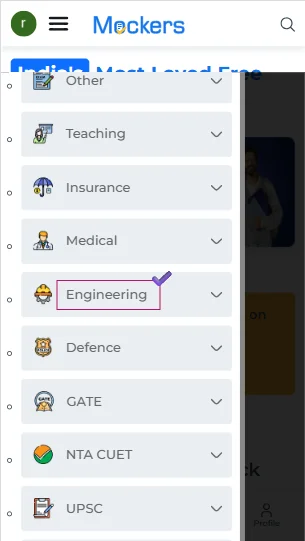
- From a number of options, you can tap on the ‘Engineering’ one.
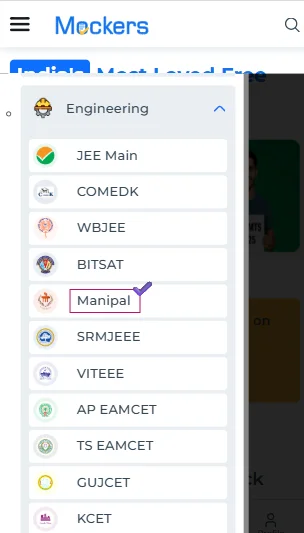
- A drop-down menu will open from where you have to select the ‘Manipal’ icon.
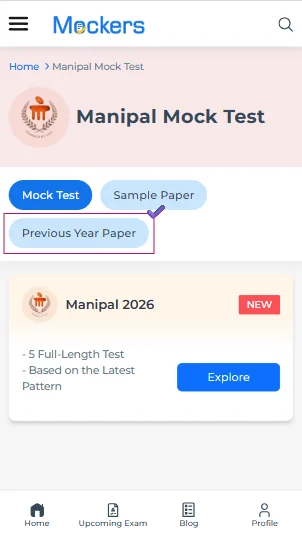
- Soon, a new web page will be opened, and you have to tap on the ‘Previous Year Paper’ option.
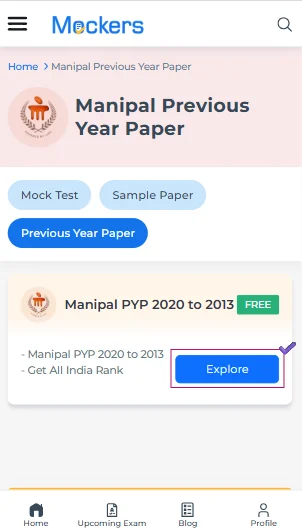
- Then, by just clicking on the ‘Explore’ icon, you can access every Manipal past year question paper.
- Finally, you can choose the year for which you want to take the Manipal old question paper and enhance your skills.
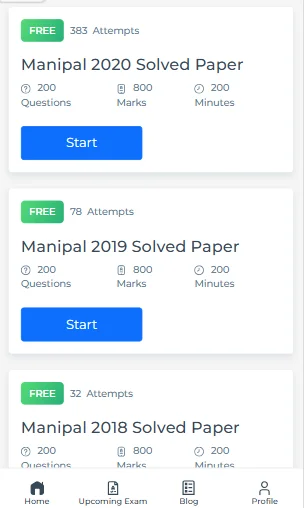
How Mockers Help You Practice The Manipal Past Year Question Paper?
For this exam’s preparation, you need to do real practice that matches the actual test experience closely. This is where our online question papers with answers for Manipal play a very important role. Each test has the real exam structure, question style, difficulty level, etc, that is seen in the Manipal Entrance Test. Below are some points that will explain how we help you in your practice sessions.
👍 On our platform, you get to solve the free online question papers with answers for Manipal actively, rather than just reading questions and answers. This way, you can have better concentration, a deeper understanding of concepts, improved problem-solving skills, and so on. It is something that you can’t get through the traditional PDFs.
👍 We allow you to practice the Manipal question paper in a timed environment. This trains you to allocate time wisely across all the sections as well as questions. Then, you can complete the paper within the given duration during the real exam.
👍 By attempting the Manipal PYQs as tests, you will be able to find the subjects or topics where you are confident, as well as the ones where you need to revise more. In this way, you will be able to make your preparation more targeted and efficient instead of revising everything.
👍 You can use Mockers for the Manipal exam question papers throughout the semester, as well as during exam time. You can first use our platform to understand the exam pattern and then make it a powerful resource for quick revision and building your confidence.
Manipal Entrance Test Syllabus For B.Tech Programs
At Mockers, you will get the Manipal question paper with answer key especially for B.Tech. programs. We have mentioned the entire syllabus for this exam below in a tabular form.
| SUBJECT | TOPICS |
| MATHEMATICS | SETS, RELATIONS AND FUNCTIONS: Sets and their representation; Union, intersection, and complement of sets and their algebraic properties; Power set; Relations, types of relations, equivalence relations, functions; one-one, into, and onto functions, the composition of functions. |
| COMPLEX NUMBERS AND QUADRATIC EQUATIONS: Complex numbers as ordered pairs of reals, Representation of complex numbers in the form a + ib, and their representation in a plane. | |
| MATRICES AND DETERMINANTS: Matrices, algebra of matrices, types of matrices, determinants, and matrices of order two and three, evaluation of determinants, area of triangles using determinants; Adjoint and inverse of a square matrix; Test of consistency and solution of simultaneous linear equations in two or three variables using matrices. | |
| PERMUTATIONS AND COMBINATIONS: The fundamental principle of counting, permutations and combinations; Meaning of P (n, r) and C (n, r). Simple applications. | |
| BINOMIAL THEOREM AND ITS SIMPLE APPLICATIONS: Binomial theorem for a positive integral index, general term, and middle term, and simple applications. | |
| SEQUENCE AND SERIES: Arithmetic and Geometric progressions, insertion of arithmetic, geometric means between two given numbers, Relation between A.M and G.M. | |
| LIMIT, CONTINUITY, AND DIFFERENTIABILITY: Real–valued functions, algebra of functions; polynomial, rational, trigonometric, logarithmic, and exponential functions; inverse functions. | |
| INTEGRAL CALCULUS: Integral as an anti-derivative, Fundamental integrals involving algebraic, trigonometric, exponential, and logarithmic functions. | |
| DIFFERENTIAL EQUATIONS: Ordinary differential equations, their order and degree, the solution of a differential equation by the method of separation of variables, and the solution of a homogeneous and linear differential equation. | |
| CO-ORDINATE GEOMETRY: Cartesian system of rectangular coordinates in a plane, distance formula, section formula, locus and its equation, the slope of a line, parallel and perpendicular lines, intercepts of a line on the coordinate axis. | |
| THREE-DIMENSIONAL GEOMETRY: Coordinates of a point in space, the distance between two points, section formula, direction ratios, direction cosines, and the angle between two intersecting lines. Equation of a line; Skew lines, the shortest distance between them, and their equations. | |
| VECTOR ALGEBRA: Vectors and scalars, the addition of vectors, components of a vector in two dimensions and three-dimensional spaces, scalar and vector products. | |
| STATISTICS AND PROBABILITY: Measures of dispersion; calculation of mean, median, mode of grouped and ungrouped data, calculation of standard deviation, variance, and mean deviation for grouped and ungrouped data. Probability: Probability of an event, addition and multiplication theorems of probability, Baye's theorem, probability distribution of a random variable. | |
| TRIGONOMETRY: Trigonometrical identities and trigonometrical functions, inverse trigonometrical functions, and their properties. | |
| PHYSICS | UNITS AND MEASUREMENTS: Units of measurement, System of units, SI Units, fundamental and derived units, least count, significant figures, Errors in measurements. Dimensions of Physics quantities, dimensional analysis, and its applications. |
| KINEMATICS: The frame of reference, motion in a straight line, speed and velocity, uniform and non-uniform motion, average speed and instantaneous velocity, uniformly accelerated motion, velocity-time, position-time graph. | |
| LAWS OF MOTION: Force and inertia, Newton’s first law of motion, momentum, Newton’s second law of motion, impulse, Newton’s third law of motion. Law of conservation of linear momentum and its applications. | |
| WORK, ENERGY, AND POWER: Work done by a constant force and a variable force, kinetic and potential energies, work-energy theorem, power. | |
| ROTATIONAL MOTION: Center of mass of a two-particle system, center of mass of a rigid body. Basic concepts of rotational motion, moment of a force, torque, angular momentum, conservation of angular momentum, and their applications. | |
| GRAVITATION: The universal law of gravitation. Acceleration due to gravity and its variation with altitude and depth. Kepler’s law of planetary motion. Gravitational potential energy, gravitational potential. Escape velocity, motion of a satellite, orbital velocity, time period, and energy of the satellite. | |
| PROPERTIES OF SOLIDS AND LIQUIDS: Elastic behavior, stress-strain relationship, Hooke’s law, Young’s modulus, bulk modulus, and modulus of rigidity. Pressure due to a fluid column, Pascal’s law and its applications, effect of gravity on fluid pressure, viscosity, Stoke’s law, terminal velocity. | |
| THERMODYNAMICS: Thermal equilibrium and the concept of temperature, the zeroth law of thermodynamics, heat, work, and internal energy. The first law of thermodynamics, isothermal and adiabatic processes. | |
| KINETIC THEORY OF GASES: Equation of state of a perfect gas, work done on compressing a gas, kinetic theoryof gases: assumptions, the concept of pressure, kinetic interpretation of temperature, RMS speed of gas molecules. | |
| OSCILLATIONS AND WAVES: Oscillations and periodic motion: time period, frequency, displacement as a function of time, periodic functions. Simple harmonic motion and its equation, phase, and oscillations of a spring. | |
| ELECTROSTATICS: Electric charges: conservation of charge, Coulomb’s law forces between two-point charges. Electric field: electric field due to a point charge, electric field lines, electric dipole, electric field due to a dipole, and torque on a dipole in a uniform electric field. | |
| CURRENT ELECTRICITY: Electric current: drift velocity, mobility, and their relation with electric current, Ohm’s law, electrical resistance, I-V characteristics of Ohmic and non-Ohmic conductors. | |
| MAGNETIC EFFECTS OF CURRENT AND MAGNETISM: Biot-Savart law and its application to the current-carrying circular loop, Ampere’s law and its applications to infinitely long current-carrying straight wire and solenoid. Force on a moving charge in uniform magnetic and electric fields. | |
| ELECTROMAGNETIC INDUCTION AND ALTERNATING CURRENTS: Faraday’s law, induced emf and current, Lenz’s law, eddy currents, self and mutual inductance. Peak and RMS value of alternating current/voltage, reactance, and impedance. | |
| ELECTROMAGNETIC WAVES: Displacement current, electromagnetic waves and their characteristics, transverse nature of electromagnetic waves. | |
| OPTICS: Reflection of light, spherical mirrors, mirror formula. Refraction of light at plane and spherical surfaces, thin lens formula and lens maker formula, total internal reflection and its applications, magnification, and power of a lens. | |
| DUAL NATURE OF MATTER AND RADIATION: Dual nature of radiation, Photoelectric effect, Hertz and Lenard’s observations, Einstein’s photoelectric equation, particle nature of light, wave nature of particle, de-Brogile relation. | |
| ATOMS AND NUCLEI: Alpha-particle scattering experiment, Rutherford’s model of the atom, Bohr model, energy levels, hydrogen spectrum. Composition and size of nucleus, atomic masses, mass-energy relation, mass defect, binding energy per nucleon. | |
| ELECTRONIC DEVICES: Semiconductors, semiconductor diode: I-V characteristics in forward and reverse bias, diode as a rectifier; I-V characteristics of LED, the photodiode, solar cell, Zener diode. | |
| CHEMISTRY | SOME BASIC CONCEPTS IN CHEMISTRY: Matter and its nature, Dalton’s atomic theory, concept of atom, molecule, element and compound, laws of chemical combination, atomic and molecular masses, mole concept, molar mass. |
| ATOMIC STRUCTURE: Nature of electromagnetic radiation, photoelectric effect, spectrum of the hydrogen atom, Bohr model of a hydrogen atom, dual nature of matter, de Broglie’s relationship, Heisenberg uncertainty principle. | |
| CHEMICAL BONDING AND MOLECULAR STRUCTURE: Kossel-Lewis approach to chemical bond formation, the concept of ionic and covalent bonds, Ionic bonding, covalent bonding, concept of hybridization. | |
| CHEMICAL THERMODYNAMICS: Fundamentals of thermodynamics, first law and second law of thermodynamics. | |
| SOLUTIONS: Different methods for expressing the concentration of solutions, the vapor pressure of solutions, and Raoult’s law, colligative properties of dilute solutions. | |
| EQUILIBRIUM: Equilibria involving physical and chemical processes, ionic equilibrium. | |
| REDOX REACTIONS AND ELECTROCHEMISTRY: Electronic concepts of oxidation and reduction, redox reactions, oxidation numbers, electrolytic and metallic conduction, Kohlrausch’s law, and its applications. | |
| CHEMICAL KINETICS: Rate of a chemical reaction, elementary and complex reactions, order and molecularity of reactions, rate law, rate constant, and its units. | |
| CLASSIFICATION OF ELEMENTS AND PERIODICITY IN PROPERTIES: Modern periodic law and present form of the periodic table, ionization enthalpy, electron gain enthalpy, valence, oxidation states, and chemical reactivity. | |
| p- BLOCK ELEMENTS: Group -13 to Group 18 Elements- Electronic configuration and general trends in physical and chemical properties of elements across the periods and down the groups, unique behaviour of the first element in each group. | |
| d - and f - BLOCK ELEMENTS: Transition Elements - General introduction, electronic configuration, occurrence and characteristics, general trends in properties of the first-row transition elements | |
| COORDINATION COMPOUNDS: Introduction, Werner’s theory, ligands, coordination number, denticity, chelation, IUPAC nomenclature of mononuclear compounds. | |
| PURIFICATION AND CHARACTERIZATION OF ORGANIC COMPOUNDS: Purification, qualitative analysis, quantitative analysis. | |
| SOME BASIC PRINCIPLES OF ORGANIC CHEMISTRY: Tetravalency of carbon, shapes of simple molecules, and isomerism. | |
| HYDROCARBONS: Alkanes, Alkenes, Alkynes, Aromatic hydrocarbons. | |
| ORGANIC COMPOUNDS CONTAINING HALOGENS: General methods of preparation, properties and reactions, nature of the C-X bond, mechanisms of substitution reactions. | |
| ORGANIC COMPOUNDS CONTAINING OXYGEN: Alcohols, Phenols, Ethers, Aldehydes and Ketones, Carboxylic Acids. | |
| ORGANIC COMPOUNDS CONTAINING NITROGEN: Amines, Diazonium Salts. | |
| BIOMOLECULES: Carbohydrates, Proteins, Vitamins, Nucleic Acids. | |
| ENGLISH | GRAMMAR AND LANGUAGE USE: Grammatical accuracy and sentence construction skills. Core Grammar Concepts: Tenses and verb forms; Subject-verb agreement; Articles and determiners; Prepositions and conjunctions. Advanced Grammar skills: Clauses, Conditional sentences, Types of sentences; Error Detection and Sentence Correction. |
| VOCABULARY: Understanding the right use of vocabulary through contextual vocabulary, synonyms, antonyms, and idiomatic usage. Synonyms and Antonyms, one-word substitutions, commonly confused pairs of words, collocations, phrasal verbs, and idioms. | |
| PUNCTUATION AND USAGES: Proper use of punctuation and appropriate usages that enhance clarity in writing. Punctuation marks: commas, semicolons, colons, dashes, and capitalization; Identification of incorrect usage and improvement of sentences; Redundancy and ambiguity in sentences; Avoidance of run-on sentences and fragments. | |
| READING COMPREHENSION: Understanding and interpreting diverse texts to assess comprehension and analytical abilities. Short comprehension passages on Narrative, Descriptive, Expository, and Argumentative topics. Skills tested: Identifying the main idea and supporting details; Drawing inferences and conclusions; Vocabulary in context; Critical reasoning and evaluating arguments. |
How To Turn Preparation Into Performance With The Manipal Past Year Papers Online Test?
No doubt that reading notes, watching lectures, revising concepts, etc., are all important for the MET. But in the exam, how well you apply that knowledge under time pressure is tested. That’s why you must utilize the Manipal question paper solved with answers from our platform. In this section, we have also discussed some ways in which you can use these papers and turn your preparation into performance.
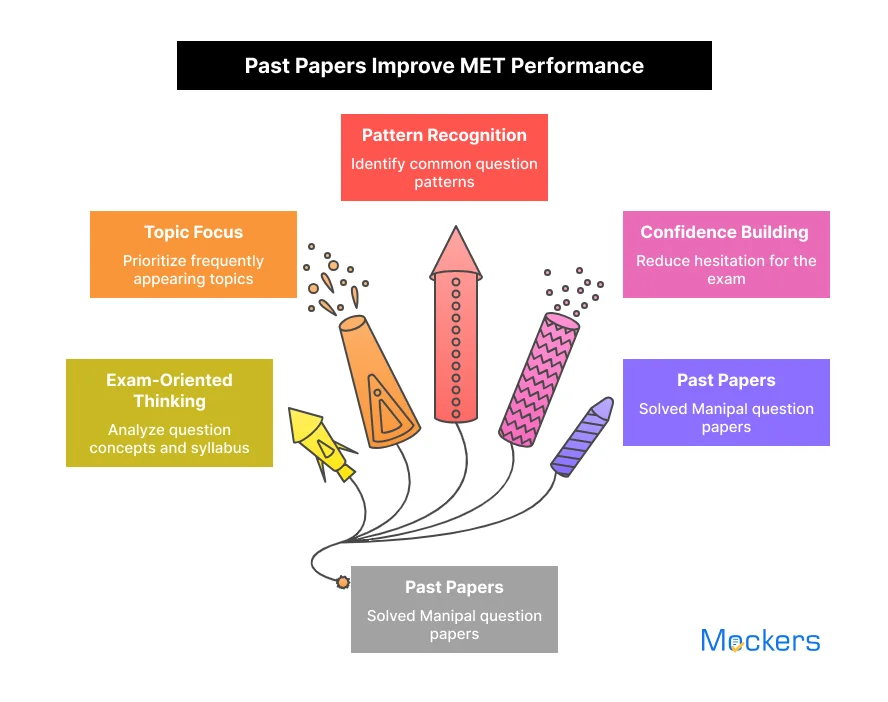
- Our experts have noticed that most of the students use the Manipal past year question paper as a checklist. They just solve the questions, check the answers, and move on. But for high performance, you need to analyze why a question is asked, what concept it targets, as well as how it connects to the syllabus. In this way, you will be able to build your thinking that is exam-oriented. This will also help you recognize the patterns that are similar instantly during the exam.
- You need to go through the Manipal old question paper for multiple years and note which topics appear again and again in the examination. Then, you should focus more on the areas that have high-return during your revision sessions. By doing so, you can make sure that you invest your time from where you can get the most marks.
- Rather than saving the Manipal past year papers online test for the last minute, you should solve them on a regular basis. It will help you in identifying the patterns of questions, wordings that are common, expected answer formats, and so on. Once you get familiar, you can reduce any hesitation and build your confidence for the real exam.
- In the last phase of your exam preparation, you need to rely heavily on the online question papers with answers for Manipal as well as the Manipal mock tests. You should also revise the questions that are commonly repeated and the important concepts that are highlighted. In this way, you will be able to keep your revision focused, efficient, as well as exam-oriented.
- For each PYQ in the free online question papers with answers for Manipal, you should keep a simple record of your scores, accuracy, and time taken. By tracking your progress, you can stay motivated as well as see whether your preparation is actually improving your performance or not.
Conclusion
Practice of the Manipal question paper is the smartest way to prepare for the Manipal Entrance Test in an effective manner. While you can build the concepts with the textbooks and notes, you will be able to truly determine your performance only after applying those concepts under exam-like conditions. Our online tests are what will bridge this gap by turning your preparation into a realistic as well as result-oriented experience. So, without any further delay, head to our website and take these tests now.



 Get latest Exam Updates