Bank
Bank


 SSC
SSC


 Railway


 State
State


 Other
Other


 Teaching


 Insurance


 Medical


 Engineering


 Defence


 GATE
GATE


 NTA CUET

 UPSC
UPSC

 MBA Entrance


 LAW
LAW

 SSC CGL Tier-I 2026
 RRB JE 2026
 RRB ALP CBT-I 2026
 SSC JE 2026
 SSC CPO Tier I 2026 (New Pattern)
 IBPS RRB Prelims 2026
 SSC CHSL 2026
 CTET September 2026 Paper I
 SSC GD 2027
 IBPS Clerk Prelims 2026

NEST Question Papers
You can enhance your preparation for the National Entrance Screening Test by solving the NEST question papers in a test-based format on the digital platform of Mockers. They are designed in such a way that you can understand the exam pattern, types of questions, difficulty level, time constraints, and so on before taking the actual exam. Practice with these papers is not just recommended but is essential for improving your speed, accuracy, as well as overall performance.
This exam is considered to be quite competitive and requires strong clarity of the concepts in Physics, Chemistry, Biology, and Maths subjects. If you just read the theory, then it will not be enough. You also need to apply those concepts under timed conditions, and for that, you must solve the NEST PYQs. With their help, you will be able to identify the topics that are asked repeatedly, understand the trends of the questions, develop better strategies to solve problems, and so on.
Can You Crack NEST By Solving Only PYQs?
You need to do more than just hard work in order to crack the National Entrance Screening Test. We have noticed that many students rely heavily on NEST exam question papers and think they are enough to secure a good rank. No doubt that the practice of these papers is essential, but it is not a complete preparation method on its own. For this exam, you need a deep knowledge of the concepts, analytical thinking, as well as the ability to apply your learning in unfamiliar situations. All this means that the effectiveness of the past papers totally depends on how you use them in your study plan. In this section, our experts have shared some points on whether you can rely only on these papers and how to use them the right way.
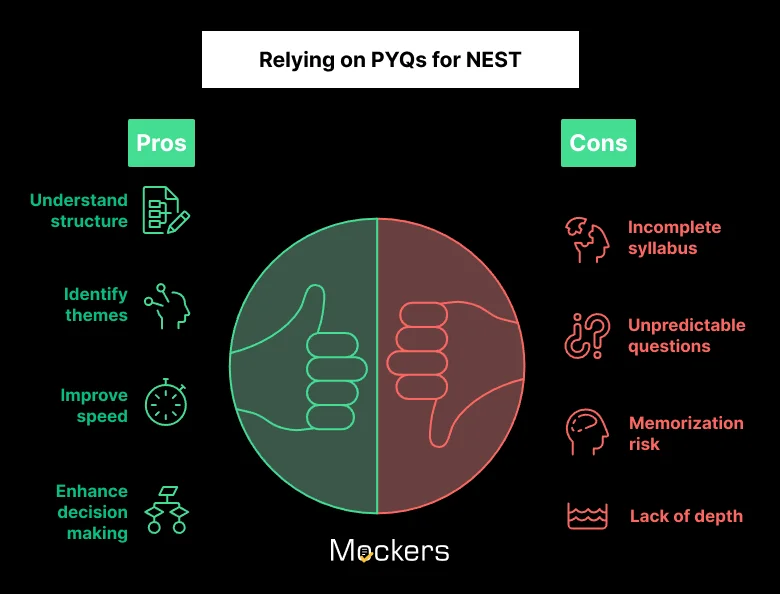
- With the help of the NEST question papers with answer keys, you will understand the structure, level of difficulty, question types, etc. However, they do not cover the full syllabus in a systematic way. By relying only on this resource, you might have gaps in your conceptual understanding, especially for the topics that are asked less frequently.
- Through the practice of the NEST question papers solved with answers, you will be able to identify recurring themes as well as concepts that are commonly tested. But you must remember that this exam is famous for including variations and new types of problems every year. This means that while you will get direction with the past papers, they will not help you predict every question type that you will face.
- One great advantage of solving the NEST past year question papers is that you can improve your ability to apply the concepts under the pressure of time. With their regular practice, you will be able to enhance your problem-solving speed and accuracy, as well as your decision-making. These are the skills that are critical for scoring higher in the exam.
- If you don’t study the theory and just depend on the NEST old question papers, then you will risk memorizing the patterns rather than understanding the concepts. In this exam, you will see that deeper logic is tested often, and you cannot master it through the practice of papers alone.
- By using the NEST past year papers online tests along with NEST mock tests, you can create a balanced preparation strategy. With the past papers, you will get real exam exposure, and with the mock test attempts, you can adapt to the new style of questions.
Year-Wise NEST Exam Question Papers
At Mockers, you get to solve the online question papers with answers for NEST in a year-wise format. They give you a structured as well as realistic way to understand how the exam has evolved over time. By solving them in a proper order, you can track changes in difficulty level, question styles, and subject-wise weightage across different years rather than random practice. Through this approach, you will not only build your familiarity with the exam pattern but also get insights into which topics are important as well as which areas have gained or lost focus. You can use the links below to attempt any of the papers directly.
NEST Question Papers 2024 to 2023
NEST Question Papers With Answer Keys
With the help of the free online question papers with answers for NEST, you will get a complete learning loop. You can attempt, evaluate, and improve. When you solve these papers and verify your responses with these solutions immediately, you will have clarity on both correct approaches and common mistakes. All this will not only help in calculating your score but also in understanding the logic behind every solution. These answer keys are a powerful study resource that allows you to revisit the difficult questions, solidify your weaker concepts, avoid repeating errors, and so on.
How To Attempt The NEST Past Year Question Papers?
Here are the steps with which you can access and solve the NEST question papers on our platform.
- You need to type www.mockers.in in the web browser that you prefer to use.

- As soon as you reach the website, you should tap on the ‘Navigation’ bar and select the ‘Exam Categories’ icon.
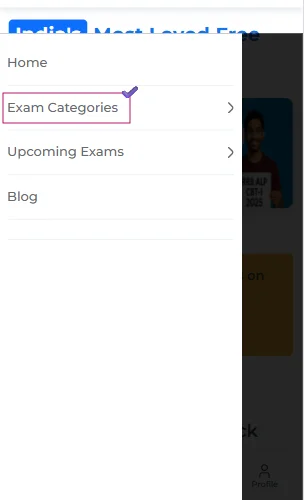
- Under this selection, you will find a variety of categories, and you should click on the ‘Engineering’ section.
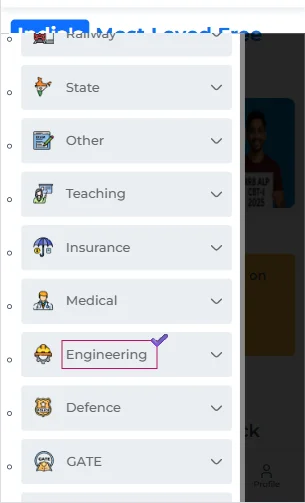
- Now, you can explore all the exams related to engineering and select the ‘NEST’ option.

- Soon, a new web page including different study materials for this exam will appear. Here, you can simply click on the ‘Question Paper’ icon to access all the year-wise NEST PYQs.
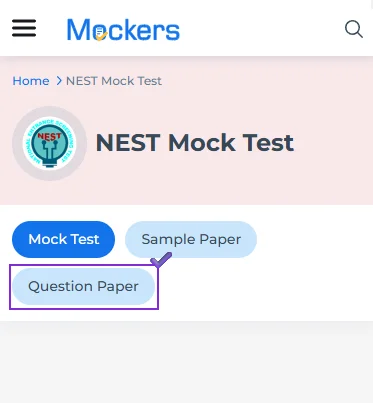
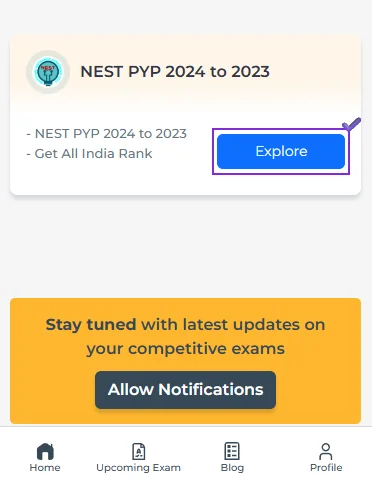
- Then, you have to tap on the ‘Explore’ button under the NEST exam question papers.
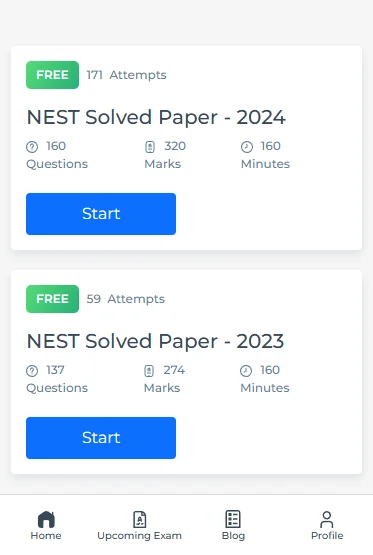
- Finally, you can choose any NEST question papers with answer keys, click on their ‘Start’ icon, and attempt the test for free.
Syllabus For The National Entrance Screening Test
The syllabus for the National Entrance Screening Test is quite extensive and designed to test your conceptual clarity, analytical thinking, application skills, etc. One of the most effective ways to cover it is by pairing every topic with the NEST past year question papers to understand how the concepts are tested in the actual exam. Here is a detailed breakdown of subjects, topics, and subtopics, along with their relevance in the PYQs.
| Subject | Topics and Subtopics | Question Types |
| Physics | Mechanics: Units and Dimensions, Vectors, Kinematics (1D and 2D), Laws of Motion, Friction, Circular Motion, Relative Motion | Multi-concept numerical problems |
| Work, Energy, and Power: Work-Energy Theorem, Potential Energy, Conservative Forces, Collisions (Elastic/Inelastic), Power | Application-heavy and formula-based questions | |
| Rotational Motion: Torque, Angular Velocity, Angular Momentum, Moment of Inertia, Rolling Motion | Multi-step conceptual and numerical questions | |
| Gravitation: Newton’s Law, Gravitational Potential, Satellites, Escape Velocity, Orbital Motion | Direct and calculation-based questions | |
| Properties of Matter: Elasticity, Surface Tension, Viscosity, Fluid Mechanics | Conceptual and real-life application questions | |
| Thermodynamics: Laws of Thermodynamics, Heat Transfer, Kinetic Theory, Specific Heat, Carnot Engine | Mixed numerical and conceptual questions | |
| Oscillations and Waves: SHM, Damped Oscillations, Wave Motion, Superposition, Sound Waves, Doppler Effect | Analytical and graph-based questions | |
| Electrostatics: Coulomb’s Law, Electric Field, Gauss Law, Potential, Capacitance | Numericals and concept-based questions | |
| Current Electricity: Ohm’s Law, Resistivity, Series and Parallel Circuits, Kirchhoff’s Laws, Wheatstone Bridge | Circuit-solving questions | |
| Magnetism: Magnetic Field, Biot-Savart Law, Ampere’s Law, Magnetic Materials | Conceptual reasoning questions | |
| Electromagnetic Induction: Faraday’s Law, Lenz’s Law, Inductance, AC Circuits | Application-based and derivation questions | |
| Optics: Ray Optics, Wave Optics, Interference, Diffraction, Polarization | Assertion-reason and conceptual questions | |
| Modern Physics: Photoelectric Effect, Bohr Model, Nuclear Physics, Semiconductors | High-weightage direct questions | |
| Chemistry | Mole Concept: Stoichiometry, Limiting Reagent, Concentration Terms, Normality, Molarity | Calculation-heavy questions |
| Atomic Structure: Quantum Numbers, Orbitals, Electronic Configuration, Dual Nature of Matter | Conceptual clarity questions | |
| Chemical Bonding: Ionic Bonding, Covalent Bonding, VSEPR Theory, Hybridization, Molecular Orbital Theory | Concept-heavy questions | |
| States of Matter: Gas Laws, Ideal Gas Equation, Kinetic Theory, Liquids | Concept + numerical questions | |
| Thermodynamics: Enthalpy, Entropy, Gibbs Free Energy, Hess | Numerical and theory-based questions | |
| Chemical Equilibrium: Equilibrium Constant, Le Chatelier Principle, Ionic Equilibrium, pH | Application-based questions | |
| Electrochemistry: Redox Reactions, Electrochemical Cells, Nernst Equation | Numerical-heavy problems | |
| Organic Basics: Nomenclature, Isomerism, Electronic Effects | Foundational questions | |
| Hydrocarbons: Alkanes, Alkenes, Alkynes, Aromatic Compounds | Reaction-based questions | |
| Functional Groups: Alcohols, Phenols, Aldehydes, Ketones, Carboxylic Acids, Amines | Mechanism-based questions | |
| Reaction Mechanisms: SN1, SN2, E1, E2, Electrophilic/Nucleophilic Reactions | Analytical reasoning questions | |
| Inorganic Chemistry: Periodic Trends, Coordination Compounds, Transition Elements, Metallurgy | Conceptual and trend-based questions | |
| Environmental Chemistry: Pollution, Green Chemistry, Water Treatment | Occasional direct questions | |
| Biology | Cell Biology: Cell Structure, Organelles, Cell Membrane, Cell Cycle, Mitosis and Meiosis | Conceptual questions |
| Biomolecules: Proteins, Carbohydrates, Lipids, Enzymes, Vitamins | Direct and analytical questions | |
| Genetics: Mendelian Genetics, Linkage, DNA Replication, Transcription, Translation | High-weightage analytical questions | |
| Evolution: Origin of Life, Darwinism, Natural Selection, Speciation | Conceptual reasoning questions | |
| Ecology: Ecosystem, Food Chain, Biogeochemical Cycles, Biodiversity | Application-based questions | |
| Human Physiology: Digestive, Respiratory, Circulatory, Nervous, Endocrine Systems | Conceptual questions | |
| Plant Physiology: Photosynthesis, Respiration, Plant Hormones, Mineral Nutrition | Concept + diagram-based questions | |
| Biotechnology: Genetic Engineering, PCR, Cloning, Bioprocessing | Modern application-based questions | |
| Diversity: Classification, Taxonomy, Kingdoms, Plant and Animal Diversity | Direct conceptual questions | |
| Maths | Algebra: Quadratic Equations, Progressions, Complex Numbers, Logarithms, Inequalities | Multi-step problem-solving questions |
| Permutations and Combinations: Counting Principles, Probability Basics, Binomial Theorem | Logical reasoning questions | |
| Calculus: Limits, Continuity, Differentiability, Applications of Derivatives, Integration | High-weightage application questions | |
| Coordinate Geometry: Straight Lines, Circles, Parabola, Ellipse, Hyperbola | Analytical geometry problems | |
| Vectors: Vector Algebra, Dot Product, Cross Product | Conceptual questions | |
| 3D Geometry: Direction Cosines, Planes, Distance Between Lines | Spatial reasoning questions | |
| Trigonometry: Identities, Equations, Inverse Trigonometric Functions | Formula-based questions | |
| General Ability | Logical Reasoning: Series, Analogies, Coding-Decoding, Puzzles, Syllogisms | Analytical reasoning questions |
| Quantitative Aptitude: Percentages, Profit and Loss, Ratio and Proportion, Time and Work | Speed-based questions | |
| Data Interpretation: Graphs, Tables, Charts, Caselets | Interpretation-heavy questions | |
| Scientific Comprehension: Experimental Data, Graph Analysis, Scientific Reasoning | Application-based reasoning questions | |
| Everyday Science: Basic Physics, Chemistry, Biology Applications | Direct concept-based questions |
Difficulty Level Analysis Of The NEST Old Question Papers
It is quite important that you understand the level of past exams to build an effective preparation strategy. By analyzing the NEST old question papers, you can find trends in the complexity of questions, subject-wise variation, overall exam toughness, and so on. Our experts have done this analysis and represented it in a table below so that you can adjust your preparation strategy accordingly.
| Year | Overall Difficulty | Section-Wise Difficulty | Key Observations |
| 2025 | Moderate to Difficult |
|
Higher weightage on analytical Physics and Maths. |
| 2024 | Moderate |
|
Balanced with no extreme difficulty spikes. |
| 2023 | Difficult |
|
Emphasized multi-step numerical problems. |
| 2022 | Moderate to Difficult |
|
Variation in section-wise difficulty. |
| 2021 | Moderate |
|
More concept-heavy than calculation-heavy. |
| 2020 | Moderate |
|
Relatively balanced across subjects. |
Quick Tips Before Attempting NEST Past Year Papers Online Tests
Your attempts at the NEST past year papers online tests will become more effective when you approach them with the right strategy. Below are some very good and detailed quick tips that you can utilize before attempting the papers.
- Your first 2 to 3 minutes should be spent on scanning the structure of the online question papers with answers for NEST. The exam often mixes multiple concepts in a single section, so you should tag the sections mentally as ‘easy scoring’, ‘time-consuming’, or ‘high-risk traps.’ This way, you will be able to plan your attempt in a strategic manner.
- Rather than solving the problems in the free online question papers with answers for NEST one by one, you should find a group of questions linked by a single concept, like mechanics, organic sections, or probability. The papers often test the variations of the same idea again and again.
- Before solving the NEST question papers, you should quickly think: ‘What concept is this likely testing?’ Through this reverse approach, you will be able to avoid getting trapped by lengthy wording as well as reduce any misinterpretation errors.
- Within the first 30 to 40 seconds of each question, you need to decide whether to attempt, skip, or revisit it. You have to remember that the test for the NEST PYQs is time-sensitive. And hesitation is often more costly than skipping.
- You will find that many questions include subtle words, such as ‘Not correct’, ‘except’, or ‘least likely.’ In the NEST exam question papers, if you miss these points, then it can change your answer completely.
- You can allocate rough time blocks for every section of the NEST question papers with answer keys in your head. This exam rewards consistency, so you should avoid spending a lot of time on a single difficult question.
- You should also try to remove obviously wrong options in the NEST question papers solved with answers first, instead of solving everything directly. This is especially useful in the exam, where options are designed to mislead through similar values.
- If a question in the NEST past year question papers feels heavy, you should mark it and move on immediately. This exam is known to reward clarity under fresh concepts more than confusion.
Conclusion
Practice of the NEST old question papers is not all about solving the questions. It is also about understanding the mindset of the exam. You can only score well in this exam if you are able to recognize the patterns, manage your time properly, and apply the concepts across multiple topics. With regular attempts on these papers, you can develop precision, speed, as well as confidence that is needed to handle the actual exam without any surprises.



 Get latest Exam Updates