Bank
Bank


 SSC
SSC


 Railway


 State
State


 Other
Other


 Teaching


 Insurance


 Medical


 Engineering


 Defence


 GATE
GATE


 NTA CUET

 UPSC
UPSC

 MBA Entrance


 LAW
LAW

 CTET September 2026 Paper I
 Agniveer Vayu 2026
 SSC Selection Post (Phase 14) 2026
 SSC CGL Tier-I 2026
 SSC JE 2026
 SSC CPO Tier I 2026
 SBI Clerk Prelims 2026
 IBPS Clerk Prelims 2026
 IBPS PO Prelims 2026
 RRB ALP CBT-I 2026
 IBPS RRB Prelims 2026

TS EAMCET Sample Papers
The TS EAMCET sample papers are an ultimate resource with which you can ace the upcoming Telangana Engineering, Agriculture, and Pharmacy Common Entrance Test. They are available in a test-based format for each subject separately on the educational platform of Mockers. Also, the papers follow the same pattern of questions and difficulty level as the actual examination. By solving them during your preparation journey, you can understand the format of the exam, improve your problem-solving speed, as well as find the topics that are important in Physics, Maths, and Chemistry.
Moreover, with the practice of the TS EAMCET sample papers with solutions, you will be able to evaluate your preparation level. When you attempt these papers in an online test format, you can get familiar with the style of questions, marking scheme, time constraints, and so on. This practice will further help in reducing your anxiety as well as building your exam confidence.
How Do TS EAMCET Sample Papers With Solutions Help Improve Your Rank?
While you are preparing for the exam, you need to do more than just read the theory. You should also develop the ability to solve questions quickly, manage time effectively, and stay accurate under exam pressure. This is where the TS EAMCET exam sample papers play a crucial role.

- This exam follows a fixed exam pattern that includes questions from Maths, Physics, and Chemistry. When you practice the TS EAMCET entrance exam sample papers on a regular basis, you will get a number of questions, subject distribution, as well as the way questions are framed. With this familiarity, you can reduce surprises on exam day and allow you to approach the paper with a clear strategy. Over time, you will begin recognizing patterns in question types, which will further help you solve problems more properly during the real exam.
- One big challenge in this exam is solving a large number of questions within a limited time. With the TS EAMCET entrance test sample papers, you will be able to improve your speed in solving problems. Regular practice will further train your brain to find the approach for solving questions quickly. As you keep attempting more papers, you will become faster at calculations as well. This will allow you to attempt more questions in the examination.
- By attempting the sample paper for TS EAMCET for different subjects, you will see the topics that appear again and again as compared to others. This is how you will find the high-weightage chapters in each subject. For example, a few concepts in Maths or important formulas in Physics might appear repeatedly in different sample tests. Once you recognize these patterns, you can prioritize the important topics and focus your revision in a more effective way.
- The solutions that are provided in the TS EAMCET exam sample question paper test show you shortcuts, alternate methods, smarter approaches, and so on. Once you learn these techniques, you will be able to reduce your time in calculations, avoid any steps that are unnecessary, as well as solve complex questions more efficiently. These types of strategies are quite valuable in the real examination.
- One of the best benefits of practicing the TS EAMCET online sample papers is the confidence boost that you get. As you keep solving the questions that are similar to the real exam repeatedly, you will get more comfortable with the format and pressure. In this way, you can reduce your anxiety as well as improve your mental preparedness.
Individual Test Series Of TS EAMCET Exam Sample Papers For Each Subject
In order to help you prepare in a more focused and effective way, our experts have created the TS EAMCET sample papers online test series for each subject. You should attempt these tests to strengthen one subject at a time, rather than a full-length TS EAMCET mock test. Through this targeted approach, you will be able to find your weak areas, improve your clarity in concepts, build your confidence in each section, etc. Moreover, with regular attempts, you can enhance your speed, time management, and problem-solving skills. You can click on the links given below to attempt any test completely free.
- TS EAMCET Sample Paper for Physics
- TS EAMCET Sample Paper for Chemistry
- TS EAMCET Sample Paper for Maths
Solutions Available In The TS EAMCET Entrance Exam Sample Papers
The free online TS EAMCET sample papers test comes with detailed solutions and explanations. This is done so that you can understand the correct approach for solving different types of questions. Our team of subject-matter experts further explains them in a step-by-step format, with which you will be able to see how formulas, concepts, as well as logical reasoning are applied in the problems. These well-designed solutions divide the process to help you find where you might have made mistakes and learn the correct method.
What Is The Process To Attempt The TS EAMCET Entrance Test Sample Papers?
By following the procedure mentioned below, you can easily get to the TS EAMCET sample papers and attempt them on Mockers.
- You can use any web browser on your preferred device to attempt our TS EAMCET sample papers with solutions.
- Once you have opened the browser, you should type www.mockers.in in the given space.

- On the homepage, you have to click on the ‘Navigation’ bar and from the main menu, you need to select the ‘Exam Categories’ section.
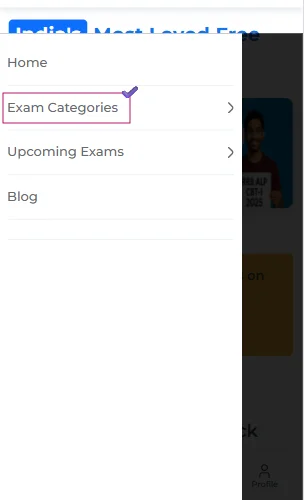
- Through this selection, you can check out all our resources and then tap on the ‘Engineering’ icon.
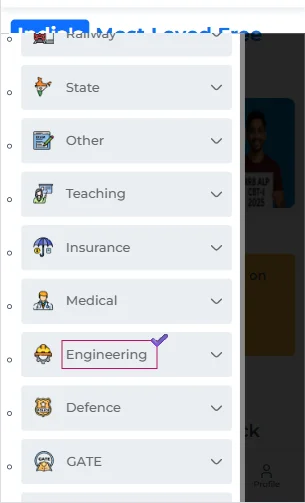
- Now, in the new menu, you should select the ‘TS EAMCET’ option to proceed further.
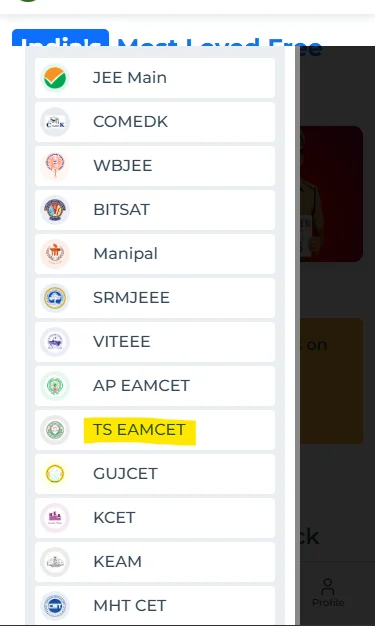
- A page that has all the study materials for this exam will open up, and you have to tap on the ‘Sample Paper’ icon.
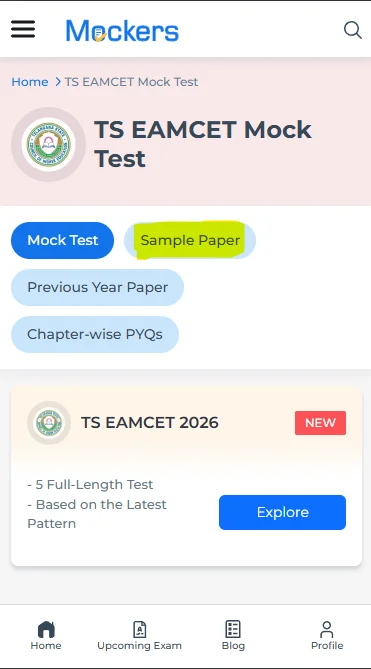
- Then, you will get options for subjects to choose from and attempt the TS EAMCET exam sample papers.
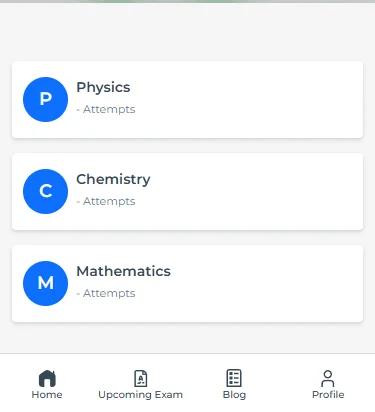
- After choosing the subject, you can access the test series for the TS EAMCET entrance exam sample papers.
- Finally, you can select any of the TS EAMCET entrance test sample papers from the series and attempt it.
Effective Study Plan Using The Sample Paper For TS EAMCET
For the Telangana Engineering, Agriculture, and Pharmacy Common Entrance Test, you need strategic practice as well as consistent evaluation. And this can be done easily with the practice of the TS EAMCET exam sample question paper test. You can follow the study plan mentioned in the table below to utilize these sample papers in an effective manner while you are preparing for the exam.
| Study Plan Step | How to use the TS EAMCET online sample papers |
| Initial Assessment | You should start your preparation by attempting one full TS EAMCET sample papers online test without any prior revision. Through this test, you will be able to evaluate your current level of preparation across Physics, Chemistry, and Maths. |
| Topic-Wise Practice | It is important that you divide the syllabus into smaller parts, study it, and then attempt the related free online TS EAMCET sample papers test. This will help you reinforce the concepts that you learned instantly. |
| Error Analysis | After completing the TS EAMCET sample papers, you must review the solutions carefully. Then, you should identify the reasons behind your incorrect answers. You can even note down whether it was a conceptual error, a calculation mistake, a question misunderstanding, and so on. |
| Tracking Performance Progress | You need to maintain a performance tracker for the TS EAMCET sample papers with solutions. In this, you can record your scores, accuracy rate, time taken, etc., and analyze your improvement over time. |
| Revision through Attempted Papers | After a few weeks, you should revisit the attempted TS EAMCET exam sample papers and solve them again. It will help in solidifying your memory retention. |
| Strategic Question Selection Practice | While you are solving the TS EAMCET entrance exam sample papers, it is necessary that you find the easy, moderate, and difficult questions quickly. This way, you will be able to solve them in a strategic order as well as maximize your marks. |
Syllabus Used To Prepare The TS EAMCET Exam Sample Question Paper Test
On our platform, you will get the TS EAMCET entrance test sample papers that are prepared as per the latest syllabus and exam guidelines. In the table below, you can find more details about this syllabus across the Physics, Chemistry, and Maths subjects.
| SUBJECT | TOPICS INCLUDED |
| Physics |
|
| Chemistry |
|
| Mathematics |
|
Conclusion
The sample paper for TS EAMCET is famous for being one of the best resources to prepare for the exam. With them, you will not only get a clear understanding of the exam pattern and question format, but also solidify your conceptual knowledge in all three subjects. Moreover, attempting these papers on a regular basis will improve your problem-solving speed, enhance your accuracy, as well as develop better time management skills. All these qualities are very important for performing well in the exam.



 Get latest Exam Updates