Bank
Bank


 SSC
SSC


 Railway


 State
State


 Other
Other


 Teaching


 Insurance


 Medical


 Engineering


 Defence


 GATE
GATE


 NTA CUET

 UPSC
UPSC

 MBA Entrance


 LAW
LAW

 CTET September 2026 Paper I
 AIIMS (NORCET - 11) 2026
 NDA II 2026
 CDS II 2026
 Agniveer Vayu 2026
 SSC Selection Post (Phase 14) 2026
 SSC CGL Tier-I 2026
 SSC JE 2026
 SSC CPO Tier I 2026
 SSC Steno Grade C & D 2026
 SBI Clerk Prelims 2026
 IBPS Clerk Prelims 2026
 IBPS PO Prelims 2026
 RRB ALP CBT-I 2026
 IBPS RRB Prelims 2026

UGEE Sample Papers
The UGEE sample papers at Mockers are mini practice test series with which you can prepare effectively for the Undergraduate Entrance Examination. They will improve your accuracy, speed, as well as exam readiness. Our experts make sure to follow the latest exam pattern and include questions that reflect the actual difficulty level of the exam.
Additionally, when you solve the UGEE sample papers with solutions, you can understand the types of questions that are asked, find important topics, adapt to the time constraints, and so on. Through consistent practice, you will be able to reduce the exam pressure as well as score higher in the upcoming exam.
Why 10-Minute UGEE Sample Papers With Solutions Are More Effective Than Long Practice Sessions?
With the help of short and focused UGEE exam sample papers, you can prepare in a smarter way for the exam. They will enhance your concentration, consistency, as well as retention. This 10-minute format of the Mockers platform will help you learn without any mental overload. Below is a table that explains clearly how these mini tests are better than long practice sessions.
| Aspect | 10-Minute UGEE Sample Papers | Long Practice Sessions |
| Focus Level | When you are solving the UGEE entrance exam sample papers, you can maintain high concentration as well as stay engaged with every question. | In long sessions, like for UGEE mock tests, your focus might drop because of mental fatigue over time. |
| Consistency | Through the practice of UGEE entrance test sample papers in short bursts, you will be able to stay consistent and build a daily study habit. | Here, it becomes difficult to attempt them regularly due to the time constraints. |
| Mental Fatigue | These short sample papers for UGEE will reduce any load as well as keep your brain fresh for repeated practice. | Extended practice in long sessions will lead you to exhaustion. This will further reduce your overall efficiency. |
| Retention Power | With regular practice of mini UGEE exam sample question paper tests, you can improve your memory retention, concept clarity, and so on. | Solving a number of mock tests or PYQs in one sitting might confuse your brain. It will reduce any retention of the material. |
| Performance Tracking | With 10-minute UGEE online sample papers, you will be able to analyze your results quickly. It will help you track your progress after each test. | In long practice sessions, analysis of multiple tests will consume a lot of your time and will be less effective as well. |
| Motivation Levels | By completing short UGEE sample papers online tests, you will have quick achievements. This will boost your confidence as well as motivation. | With these long sessions, you can feel tired. They might also reduce your motivation over time. |
| Time Management Skills | Through the practice of the free online UGEE sample papers tests in 10 minutes, you can train your brain to manage time in an efficient manner during the exam. | Sometimes, in the long sessions of practice, you might not be able to create the same level of time pressure. |
| Productivity | By solving multiple UGEE sample papers, you will be able to increase your productivity. This will happen because of more focused output in less time. | When you spend long hours on tests and past papers, you may not always have productive learning sessions. |
UGEE Exam Sample Papers Provided Separately For Each Section
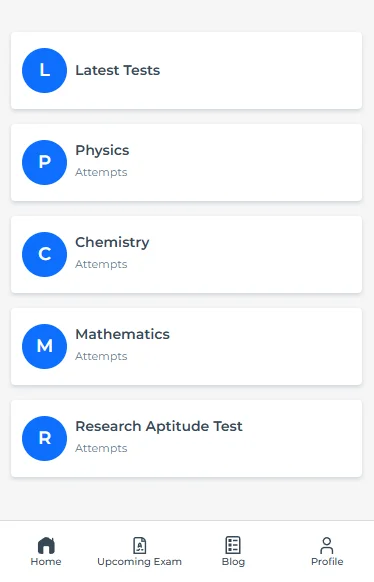
At Mockers, the UGEE sample papers with solutions are divided into 5 parts. These are Latest Tests, Physics, Chemistry, Mathematics, and Research Aptitude Test. For each section, there are a variety of mini test series available that you can solve completely free of cost. We follow this format so that you can master each section individually and take the actual exam with full confidence. You can find the links to these sample papers below.
How To Attempt The UGEE Entrance Exam Sample Papers?
By following the steps that given below, you can easily attempt any of the UGEE exam sample papers for free on our platform. You just need to have a stable internet connection for this process.
- You should visit our website on your preferred browser by typing www.mockers.in in its search area.

- After you are on the homepage, you can click on the ‘Navigation’ tab and select the section of ‘Exam Categories.’

- You can check out several categories of exams on our platform and tap on the ‘Engineering’ option.

- Now, under this option, you have to find and select the ‘UGEE’ icon.

- Through this selection, you will reach a new web page that has the resources for this specific exam.
- Here, you should tap on the ‘Sample Paper’ button to get the section-wise UGEE entrance exam sample papers.
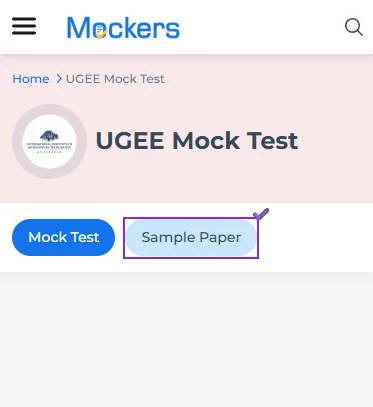
- Then, you can choose any section for the UGEE entrance test sample papers and explore its series.
- Finally, by clicking on the ‘Start’ button of the sample papers for UGEE, you can start attempting them.
Syllabus To Cover Before The UGEE Entrance Test Sample Papers Attempt
In the table below, you will get a detailed overview of the syllabus that needs to be covered before you attempt the UGEE online sample papers. This is also quite beneficial to focus on the frequently asked topics in the exam.
| SECTION | TOPICS | SUBTOPICS |
| Physics | Mechanics | Mechanics forms the foundation of Physics in UGEE. It includes Units and Dimensions (dimensional analysis, error calculation), Kinematics (motion in straight line, projectile motion), Laws of Motion (Newton’s laws, friction, circular motion), Work, Energy and Power (conservation laws), Rotational Motion (torque, angular momentum), Gravitation (Kepler’s laws), Center of Mass, and Fluid Mechanics (viscosity, Bernoulli’s principle). Questions often test conceptual clarity and real-life applications. |
| Thermodynamics | Covers Thermal Properties of Matter (expansion, heat capacity), Calorimetry, Laws of Thermodynamics, Heat Transfer (conduction, convection, radiation), and Kinetic Theory of Gases. Students should focus on numerical applications and understanding physical processes. | |
| Oscillations and Waves | Includes Simple Harmonic Motion (time period, energy), Damped and Forced Oscillations, Wave Motion, Sound Waves, and Doppler Effect. Emphasis is on mathematical representation and graphical interpretation. | |
| Electricity and Magnetism | Topics include Electrostatics (Coulomb’s law, electric field), Electric Potential, Capacitance, Current Electricity (Ohm’s law, circuits), Kirchhoff’s Laws, Magnetic Effects of Current, and Electromagnetic Induction. Problem-solving and circuit analysis are crucial here. | |
| Optics | Divided into Ray Optics (reflection, refraction, lenses, mirrors) and Wave Optics (interference, diffraction, polarization). Questions often involve diagrams and conceptual understanding of light behavior. | |
| Modern Physics | Covers Photoelectric Effect, Dual Nature of Matter, Atomic Models, Nuclear Physics, Radioactivity, and Semiconductors. This section is relatively scoring and concept-based. | |
| Advanced Mechanics | Includes Rigid Body Dynamics (moment of inertia, parallel axis theorem), Rolling Motion (pure rolling conditions), Elasticity (stress-strain relationships), and Advanced Circular Motion. Questions may involve multi-concept integration and require strong visualization skills. | |
| Properties of Matter | Covers Elasticity, Surface Tension, Viscosity, and Capillarity. Students should understand real-world applications and mathematical relations. | |
| Electromagnetic Waves | Includes displacement current, Maxwell’s equations (basic understanding), and properties of electromagnetic waves. Focus is on conceptual clarity rather than derivations. | |
| Alternating Current (AC) | Covers AC circuits, impedance, resonance, power factor, transformers, and LC oscillations. Numerical problem-solving is important here. | |
| Experimental Physics | Includes measurement techniques, error analysis, graph interpretation, and basic experimental setups. Questions test practical understanding rather than theory. | |
| Chemistry | Physical Chemistry | Includes Mole Concept (stoichiometry), Atomic Structure (quantum numbers), Chemical Bonding (VSEPR, hybridization), States of Matter (gas laws), Thermodynamics (enthalpy, entropy), Chemical Equilibrium, Ionic Equilibrium (pH, buffers), Electrochemistry, and Chemical Kinetics. Focus is on numerical problem-solving and conceptual clarity. |
| Inorganic Chemistry | Covers Periodic Table trends, Chemical Bonding, Coordination Compounds, s-block, p-block, d-block elements, Metallurgy, and Environmental Chemistry. Requires strong memorization along with conceptual understanding of reactions and properties. | |
| Organic Chemistry | Includes General Organic Chemistry (GOC), Isomerism (structural and stereoisomerism), Hydrocarbons, Aromatic Compounds, and Functional Groups such as Alcohols, Aldehydes, Ketones, and Carboxylic Acids. Reaction mechanisms and problem-solving are key areas. | |
| Applied Chemistry | Covers Surface Chemistry (adsorption, catalysis), Practical Chemistry (lab techniques), Qualitative Analysis, and real-life applications of chemistry. Questions may test application-based understanding. | |
| Advanced Organic Chemistry | Includes reaction mechanisms (SN1, SN2, E1, E2), electrophilic and nucleophilic substitutions, oxidation-reduction reactions, and named reactions. | |
| Coordination Chemistry (Advanced) | Covers crystal field theory, ligand types, bonding in coordination compounds, isomerism, and applications. Questions often test conceptual clarity and trends. | |
| Solid State Chemistry | Includes crystal lattices, unit cells, packing efficiency, defects in solids, and electrical/magnetic properties of solids. Important for conceptual and numerical questions. | |
| Nuclear Chemistry | Covers radioactive decay, half-life, nuclear reactions, and applications of radioactivity. Focus is on numerical and theoretical understanding. | |
| Industrial and Environmental Chemistry | Includes industrial processes (Haber process, Contact process), pollution control, green chemistry, and the environmental impact of chemicals. Questions may be application-based. | |
| Maths | Algebra | Includes Sets, Relations, and Functions, Complex Numbers, Quadratic Equations, Sequences and Series, Permutations and Combinations, Binomial Theorem, and Matrices and Determinants. Questions focus on logical thinking and algebraic manipulation. |
| Calculus | Covers Limits, Continuity, Differentiation, Applications of Derivatives (maxima/minima), Integration (definite and indefinite), and Differential Equations. This is one of the most important and high-weightage sections. | |
| Coordinate Geometry | Includes Straight Lines, Circles, Parabolas, Ellipses, Hyperbolas, and 3D Geometry. Focus is on geometric interpretation and equation-based problem-solving. | |
| Trigonometry | Covers Trigonometric Functions, Identities, Equations, Inverse Trigonometry, and Heights and Distances. Strong fundamentals are required for solving complex problems. | |
| Vectors and Probability | Includes Vector Algebra, Probability Theory, and basic Statistics (mean, variance, standard deviation). Questions test analytical and logical reasoning skills. | |
| Advanced Calculus | Includes Higher-Order Derivatives, Taylor and Maclaurin Series, Partial Differentiation, and Multivariable Calculus (basic concepts). These topics test deeper analytical thinking. | |
| Advanced Algebra | Covers Theory of Equations, Inequalities, Logarithmic Functions, and Progressions in depth. Focus is on solving complex algebraic expressions. | |
| Mathematical Reasoning | Includes logical statements, truth tables, implication, and reasoning-based questions. Important for building analytical skills required in REAP. | |
| Advanced Probability | Covers conditional probability, Bayes’ theorem, random variables, and probability distributions. Questions test the logical interpretation of data. | |
| Linear Programming | Includes optimization problems, constraints, and graphical solutions. Focus is on real-life application-based questions. | |
| Research Aptitude Test | Logical Reasoning | Includes Analogies, Series, Coding-Decoding, Blood Relations, Direction Sense, and Puzzles. Questions test pattern recognition and logical thinking ability. |
| Analytical Ability | Covers Data Interpretation, Graph Analysis, Pattern Identification, and multi-step problem solving. You need to analyze complex data efficiently. | |
| Quantitative Aptitude | Includes Arithmetic topics like Ratios, Percentages, Time and Work, Speed and Distance, and basic numerical reasoning. Focus is on quick calculations. | |
| Critical Thinking | Includes Statement and Conclusion, Assumptions, Logical Arguments, and inference-based questions. Tests reasoning and decision-making skills. | |
| Scientific Aptitude | Covers understanding of scientific methods, hypothesis testing, and experimental reasoning. Questions are application-based rather than theoretical. | |
| Creativity and Research Skills | Focuses on open-ended problems, innovative thinking, and applying concepts in unfamiliar situations. This is unique to UGEE and tests the originality of thought. | |
| Advanced Logical Reasoning | Includes syllogisms, statement-argument, cause-effect relationships, and advanced puzzles. Questions test the depth of logical structuring. | |
| Data Analysis and Interpretation | Covers caselets, charts (bar, pie, line graphs), tables, and mixed data sets. Requires quick calculation and interpretation skills. | |
| Decision Making and Problem Solving | Includes real-life scenario-based questions, prioritization, and decision-making under constraints. Focus is on practical reasoning. | |
| Research Fundamentals | Covers basic understanding of research methodology, variables, data collection, and experimentation logic. Unique to UGEE and highly conceptual. | |
| Innovation and Creativity-Based Questions | Includes open-ended and unconventional problems where students must apply concepts creatively. No fixed pattern; tests originality and thinking ability. |
Exam Preparation Tips Along With Sample Papers For UGEE
For the Undergraduate Entrance Examination preparation, you need a smart balance between clarity of concepts, analytical thinking, and consistent practice. As this exam tests your subject knowledge (SUPR) as well as research aptitude (REAP), just one strategy will not be enough. This is the reason you should utilize the UGEE sample papers online tests on Mockers. In this section, we have mentioned some tips that you can use while solving these papers.

- It is important that you treat the free online UGEE sample papers tests for specific purposes. For example, you should focus on one topic per test in SUPR (only algebra or mechanics) and practice one skill at a time for REAP (pattern recognition, logical sequencing, or data interpretation). In this way, you will build a deep familiarity with the concepts.
- You have to follow the 10-minute UGEE sample papers with at least 20 minutes of deep analysis. In this, you should find why you got a question wrong, rewrite the tricky questions, note down the thinking pattern, and so on. This is where you will be able to improve in reality.
- You should categorize your mistakes in the UGEE sample papers with solutions rather than just listing them. These can be conceptual errors, misreading patterns, time-pressure mistakes, etc. Over time, you will start to see patterns, and this is the key to improvement.
- While attempting the UGEE exam sample papers, you should practice switching strategies. If you get stuck for 30 to 40 seconds, then you need to skip it. You can return to it later with a fresh approach. By doing so, you will be able to replicate the real exam pressure.
- You can even divide the 10-minute UGEE entrance exam sample papers into two parts. In the first 6 to 7 minutes, you should solve the questions that you know properly, and in the last 3 to 4 minutes, you can attempt difficult or skipped ones. Through this habit, you can make sure that you score maximum under the time constraints.
Conclusion
The UGEE entrance test sample papers are not just additional resources but an effective part of your preparation strategy. With these papers, you can connect the gap between theory and real exam performance. It will happen because you will be able to apply concepts under time pressure as well as develop the right approach to solving problems. The key to taking these tests is to stay consistent, analyze your performance deeply, and focus on improving every time.



 Get latest Exam Updates