Bank
Bank


 SSC
SSC


 Railway


 State
State


 Other
Other


 Teaching


 Insurance


 Medical


 Engineering


 Defence


 GATE
GATE


 NTA CUET

 UPSC
UPSC

 MBA Entrance


 LAW
LAW

 CTET September 2026 Paper I
 Agniveer Vayu 2026
 SSC Selection Post (Phase 14) 2026
 SSC CGL Tier-I 2026
 SSC JE 2026
 SSC CPO Tier I 2026
 SBI Clerk Prelims 2026
 IBPS Clerk Prelims 2026
 IBPS PO Prelims 2026
 RRB ALP CBT-I 2026
 IBPS RRB Prelims 2026


UPSEE 2019 to 2010 Question Papers
At Mockers, you get the benefit of exploring the UPSEE 2019 to 2010 question papers and attempting them for free. Recently, this exam has been replaced by JEE and CUET, but solving them will surely help you score very well. Through these papers, you will get a clear understanding of the exam pattern, format of questions, level of difficulty, and so on.
With the practice of the UPSEE 2019 to 2010 PYQs, you will be able to analyze the trends in questions as well as understand the concepts that are tested frequently. In this way, you can prioritize the topics and focus on the areas that carry higher weightage. Moreover, it will build your confidence as well as reduce exam anxiety by making you familiar with the real exam environment.
What Makes UPSEE 2019 to 2010 PYQs A Must-Practice Resource?
The UPSEE 2019 to 2010 question papers with answer keys help you move beyond the theoretical application and understand how the concepts are applied under real exam conditions. You can find some more points below that explain why you must use this resource.
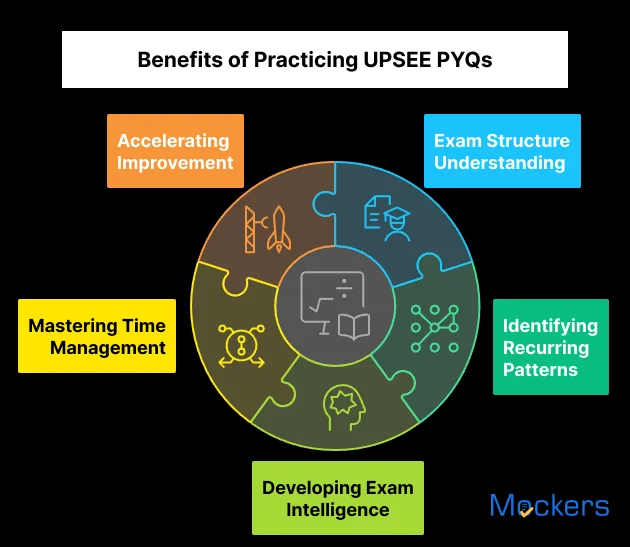
- By going through the UPSEE 2019 to 2010 question papers solved with answers, you can easily learn how the exam is structured. It includes types of questions, distribution across subjects, difficulty levels, and so on. Unlike books that have topics in a complex way, these papers reflect the actual standard of the exam.
- There are many question patterns as well as concepts that are repeated over the years. When you solve the UPSEE 2019 to 2010 year papers online tests, you can find the formulas that are frequently asked, important chapters, recurring numerical patterns, etc. This way, you will be able to focus on the topics that might appear in the examination.
- Random solving of the questions is not the same as solving the online question papers with answers for UPSEE 2019 to 2010. With them, you can train your brain to interpret tricky wording, apply concepts under pressure, solve within a limited time, and so on. It will build your exam intelligence and not just the knowledge of the subjects.
- You can never master time management through theory. When you solve the free online question papers with answers for UPSEE 2019 to 2010, you can surely do it. It includes learning how much time each section requires, developing a personal attempt strategy, reducing time wasted on difficult questions, and so on.
- It is a known fact that many students get stuck in the learning phase. The UPSEE 2019 to 2010 question papers push you into the testing phase. This is where the real improvement happens. You will start to find your weaker areas, apply concepts actively, measure actual performance, and so on.
Repeated Chapters In The UPSEE 2019 to 2010 Question Papers With Answer Keys
With the help of the table below, you can learn about the chapters and their subtopics that have been asked in the UPSEE 2019 to 2010 PYQs.
| Subject | Important Chapters | Subtopics Covered |
| Physics | Mechanics | Units & Dimensions, Errors & Measurements, Kinematics (1D & 2D), Laws of Motion, Friction, Work-Energy-Power, Circular Motion, Rotational Motion, Centre of Mass, Gravitation, Projectile Motion |
| Thermodynamics | Heat & Temperature, Thermal Expansion, Calorimetry, Laws of Thermodynamics, Heat Engines, Carnot Cycle, Entropy, Kinetic Theory of Gases | |
| Electrostatics | Electric Charges & Coulomb’s Law, Electric Field, Electric Potential, Potential Energy, Capacitance, Parallel Plate Capacitor, Dielectrics, Gauss’s Law | |
| Current Electricity | Ohm’s Law, Resistance & Resistivity, Series & Parallel Circuits, Kirchhoff’s Laws, Wheatstone Bridge, Potentiometer, Electrical Power & Energy | |
| Magnetism & EMI | Magnetic Field & Force, Biot-Savart Law, Ampere’s Law, Moving Coil Galvanometer, Electromagnetic Induction, Faraday’s Law, Lenz’s Law, Alternating Current, Transformers | |
| Optics | Ray Optics, Reflection & Refraction, Mirrors & Lenses, Lens Formula, Optical Instruments, Wave Optics, Interference, Diffraction, Polarization | |
| Modern Physics | Photoelectric Effect, Dual Nature of Matter, Atomic Models, Bohr Theory, Nuclear Physics, Radioactivity, Semiconductors, Logic Gates | |
| Chemistry | Physical Chemistry | Mole Concept, Atomic Structure, Thermodynamics, Thermochemistry, Chemical Equilibrium, Ionic Equilibrium, States of Matter, Surface Chemistry |
| Organic Chemistry | General Organic Chemistry (GOC), Isomerism, Hydrocarbons (Alkanes, Alkenes, Alkynes), Haloalkanes & Haloarenes, Alcohols, Phenols, Ethers, Aldehydes, Ketones, Carboxylic Acids, Amines, Reaction Mechanisms | |
| Inorganic Chemistry | Periodic Table & Trends, Chemical Bonding, Hybridization, VSEPR Theory, Coordination Compounds, Crystal Field Theory, Hydrogen & s-Block Elements | |
| Solutions & Electrochemistry | Types of Solutions, Concentration Terms, Colligative Properties, Electrochemical Cells, Nernst Equation, Conductance, Batteries | |
| p-Block Elements | Group 13–18 Elements, Oxides & Halides, Important Compounds, Trends & Properties | |
| d & f Block Elements | Transition Elements, Oxidation States, Complex Formation, Lanthanides & Actinides | |
| Applied Chemistry | Polymers, Biomolecules, Chemistry in Everyday Life, Environmental Chemistry, Drugs & Detergents | |
| Maths | Algebra | Sets & Relations, Quadratic Equations, Complex Numbers, Logarithms, Sequences & Series (AP, GP, HP), Permutation & Combination, Binomial Theorem |
| Calculus | Limits, Continuity, Differentiability, Derivatives, Application of Derivatives, Indefinite Integration, Definite Integration, Area Under Curve, Differential Equations | |
| Coordinate Geometry | Straight Lines, Pair of Lines, Circles, Parabola, Ellipse, Hyperbola, Locus Problems | |
| Trigonometry | Trigonometric Ratios & Identities, Equations, Inverse Trigonometric Functions, Heights & Distances, Properties of Triangles | |
| Vectors & 3D Geometry | Vector Algebra, Dot & Cross Product, Direction Cosines, Lines in Space, Planes, Shortest Distance Problems | |
| Probability & Statistics | Basic Probability, Conditional Probability, Bayes’ Theorem, Random Variables, Mean, Median, Mode, Variance, Standard Deviation | |
| Matrices & Determinants | Types of Matrices, Matrix Operations, Determinants, Adjoint & Inverse, System of Linear Equations |
How To Access The UPSEE 2019 to 2010 Question Papers Solved With Answers?
At Mockers, it’s just a few easy steps that will give you access to our collection of UPSEE 2019 to 2010 question papers with answer keys. You can go through them below and follow one by one.
- You can reach our platform by either searching for Mockers or typing www.mockers.in in the browser.

- Once there, you should click on the tab of ‘Navigation’ and select the ‘Exam Categories’ section.
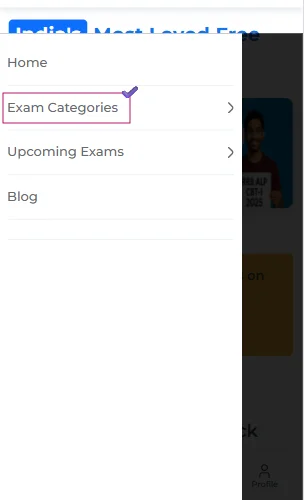
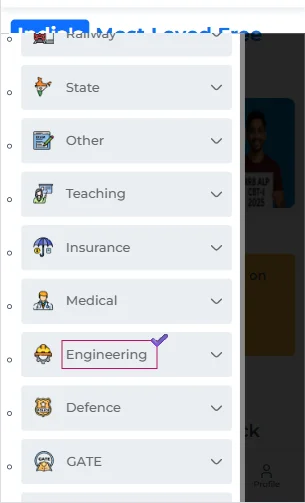
- This section will showcase various categories, and you have to tap on the ‘Engineering’ option.
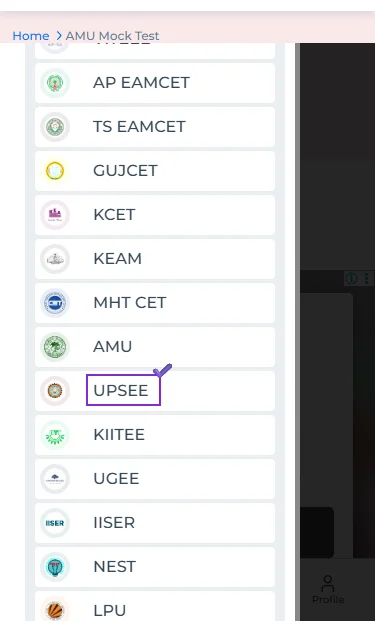
- Under the engineering exams, you will find the ‘UPSEE’ icon. You have to click on it to proceed further.
- Now, you should select the ‘Question Paper’ tab to access the UPSEE 2019 to 2010 question papers solved with answers.
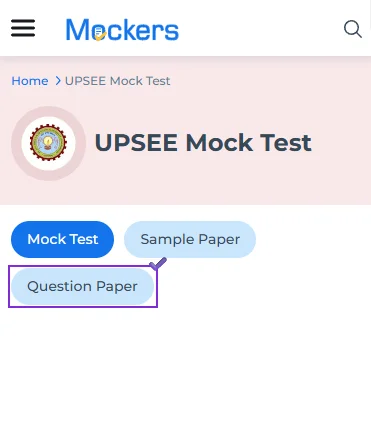
- After selecting this, you will see an ‘Explore’ button under the UPSEE 2019 to 2010 year papers online tests.

- By clicking on it, all the online question papers with answers for UPSEE 2019 to 2010 will be available on your screen.
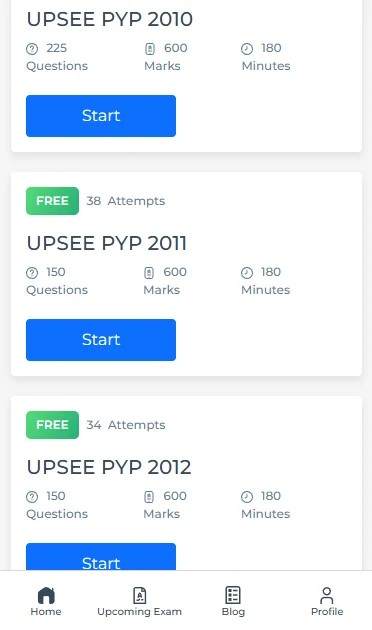
- Finally, you can start taking the free online question papers with answers for UPSEE 2019 to 2010 from the list.
How To Revise Using The UPSEE 2019 to 2010 Year Papers Online Tests?
Revision is very important while you are preparing for any type of examination, and this is where the UPSEE 2019 to 2010 PYQs become a powerful resource. They guide you actively on what you should revise as well as how you should revise it. Below are some techniques that you can apply to use these questions properly.
- You need to use the UPSEE 2019 to 2010 question papers with answer keys as well as UPSEE mock tests to test your memory, rather than revising the chapters. Firstly, you should attempt the questions without looking at the solutions because it will force your brain to recall the concepts. It will solidify your retention abilities far more than reading the notes.
- You can divide your revision schedule on the basis of the UPSEE 2019 to 2010 question papers solved with answers. For example, on day one, you should attempt one full paper. Then, on day two, you need to analyze as well as revise the weaker topics from that paper. In this way, you will be able to make your revision structured and exam-focused.
- As you go through the UPSEE 2019 to 2010 year papers online tests, you will start noticing some topics that repeat again and again. You will also be able to revise your theory after solving the related questions instantly.
- While solving the online question papers with answers for UPSEE 2019 to 2010, if you get a question wrong, you need to note down the concept that is involved. You should also write why you made the mistake, and add the correct approach. By revising them on a regular basis, you can prepare in a much more effective manner.
- You should not just solve the free online question papers with answers for UPSEE 2019 to 2010 once and move on. Instead, you have to attempt every paper again after 5 to 7 days. If you improve, then your revision is working, and if you repeat mistakes, then you need to revise that topic deeply. This way, you will reinforce your learning as well as track your real progress.
Conclusion
The UPSEE 2019 to 2010 question papers will help you start applying the concepts in an exam-oriented way. This shift is what will separate your average preparation from high-scoring performance. Whether you want to improve your time management, reduce mistakes, or build confidence, these papers will play a very important part at every stage of your preparation.



 Get latest Exam Updates