Bank
Bank


 SSC
SSC


 Railway


 State
State


 Other
Other


 Teaching


 Insurance


 Medical


 Engineering


 Defence


 GATE
GATE


 NTA CUET

 UPSC
UPSC

 MBA Entrance


 LAW
LAW

 SSC CGL Tier-I 2026
 RRB JE 2026
 RRB ALP CBT-I 2026
 SSC JE 2026
 SSC CPO Tier I 2026 (New Pattern)
 IBPS RRB Prelims 2026
 SSC CHSL 2026
 CTET September 2026 Paper I
 SSC GD 2027
 IBPS Clerk Prelims 2026

IISER (IAT) Question Papers
If you wish to understand how the IISER Aptitude Test actually evaluates the concepts, then you must solve the IISER (IAT) question papers on the digital platform of Mockers. These papers define the real standard of the exam. They cover Physics, Chemistry, Maths, and Biology with a focus on application, clarity, as well as problem-solving speed.
Here, you get the IISER (IAT) PYQs in a free, test-based format so that you can practice them just like the real exam. You can attempt the papers with a timer, track your performance, review detailed solutions, and so on. Furthermore, through this approach, you will be able to measure your preparation level, improve your accuracy, and build the stamina that is required for the real examination.
Features Of Mockers’ Test Interface For IISER (IAT) PYQs
Our platform is designed to match the structure as well as the demands of the IISER Aptitude Test. It aligns with the exam pattern, subject distribution, decision-making pressure, etc. Every feature is built to help you practice the IISER (IAT) exam question papers in a proper and exam-relevant manner. Some of these features are mentioned in detail below for your reference.

- The IISER (IAT) question papers with answer keys on Mockers have the same format. They include four subjects, a mixed flow of questions, a full-length timing structure, and so on. In this way, we make sure that when you attempt a paper, you practice under the same conditions that you will face in the actual exam.
- In this exam, you have to manage all the subjects together. And at Mockers, you can track how you distribute your time as well as attempts across them in the IISER (IAT) question papers solved with answers. This way, you can avoid any common mistakes like over-attempting one subject or neglecting the other.
- The timer for the IISER (IAT) past year question papers is tuned for the actual exam-level difficulty. Here, you have to think deeply about some questions. You can also decide when to skip lengthy questions, maintain a steady speed across the subjects, practice completing the paper within the given time, and so on. Then, over time, you will develop a pacing strategy that is needed for this exam.
- In the IAT, your marks are deducted for incorrect answers. This is the reason accuracy is as important as the attempts. While attempting the IISER (IAT) old question papers on our website, you can check your correct vs. incorrect ratio, questions attempted randomly, impact of negative marking on your score, etc. Then, you will be able to build a smarter attempt strategy instead of just blind attempts.
- At Mockers, you do not just get the scores for your attempts at the IISER (IAT) past year papers online tests. It highlights your conceptual weaknesses, repeated mistakes across papers, areas where your understanding is not exam-ready, and so on. In this way, we make sure your preparation becomes more targeted with every attempt at the tests.
IISER (IAT) Exam Question Papers For Several Past Years
We have the online question papers with answers for IISER (IAT) for several past years. They are presented as a full-length IISER (IAT) mock test with a proper interface. This allows you to practice under actual exam conditions with timing, subject balance, pressure, etc. By attempting these multiple year-wise papers, you will start to see patterns in how questions are framed. This repeated exposure will also help you find the high-weightage topics, improve your selection of questions, and build the speed that is required to handle the mixed difficulty of papers.
IISER Question Papers 2025 to 2020
How To Access The IISER (IAT) Question Papers With Answer Keys?
Every single step that you have to take to attempt the free online question papers with answers for IISER (IAT) is mentioned here.
- You have to first head to our platform, which can be done on any browser or device. You can just type www.mockers.in in the given space and reach it.

- The homepage will highlight a ‘Navigation’ bar in its left corner. You have to click on it and select the ‘Exam Categories’ section.
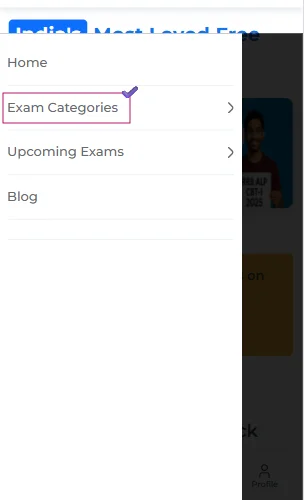
- Now, from these categories, you should tap on the ‘Engineering’ option.
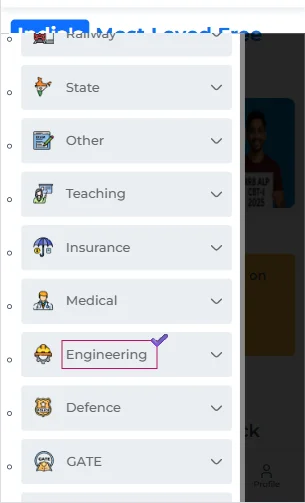
- This option will further open a new menu wherein you have to locate and select the ‘IISER’ icon.

- Then, your browser will load a new page on which you have to click on the ‘IISER (IAT) question papers’ button.

- You will now have the IISER (IAT) PYQs for several years in a single tab. You should click on its ‘Explore’ icon to proceed further.

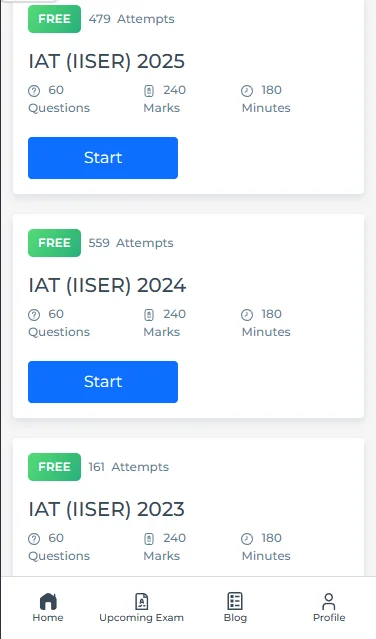
- Finally, you can take any of the IISER (IAT) exam question papers by clicking on its ‘Start’ button.
Most Important Topics Based On The IISER (IAT) Past Year Question Papers
In the IISER (IAT) question papers solved with answers, you will see that they follow a pattern that is driven by the concepts. There are certain topics that appear repeatedly across the years. These are the ones that test your core understanding, multi-step reasoning, as well as application across the subjects. For your benefit, we have mentioned all of these topics along with their subtopics in the table below.
| Subject | Chapter | Core Topics & Subtopics |
| Physics | Mechanics |
|
| Oscillations and Waves |
|
|
| Thermodynamics |
|
|
| Electricity and Magnetism |
|
|
| Optics |
|
|
| Modern Physics |
|
|
| Chemistry | Physical Chemistry |
|
| Organic Chemistry |
|
|
| Inorganic Chemistry |
|
|
| Maths | Algebra |
|
| Calculus |
|
|
| Coordinate Geometry |
|
|
| Trigonometry |
|
|
| Probability and Statistics |
|
|
| Vectors and 3D |
|
|
| Biology | Cell Biology |
|
| Genetics |
|
|
| Human Physiology |
|
|
| Plant Physiology |
|
|
| Ecology |
|
|
| Biotechnology |
|
High-Weightage Chapters Across IISER (IAT) Old Question Papers
In the table below, we have mentioned a few chapters that have carried higher weightage across the IISER (IAT) past year question papers. By knowing their approx. weightage, you can learn when and how much to focus on them during your preparation phase.
| Subject | Chapter/Area | Key Topics Covered | Approx Weightage (Per Exam) |
| Physics | Mechanics | Newton’s laws, friction, work-energy, rotation, and gravitation | 25 to 30% |
| Electricity and Magnetism | Current electricity, capacitors, magnetism, EMI | 20 to 25% | |
| Modern Physics | Photoelectric effect, atomic models, nuclear physics | 10 to 15% | |
| Waves and Oscillations | SHM, wave motion, sound waves, Doppler effect | 8 to 12% | |
| Thermodynamics | Laws of thermodynamics, heat engines, calorimetry | 5 to 8% | |
| Optics | Ray optics, lenses, interference, diffraction | 8 to 10% | |
| Chemistry | Physical Chemistry (Overall) | Mole concept, thermodynamics, equilibrium, electrochemistry | 25 to 30% |
| Organic Chemistry (GOC + Reactions) | GOC, reaction mechanisms, hydrocarbons, functional groups | 20 to 25% | |
| Inorganic Chemistry | Chemical bonding, periodic trends, coordination compounds | 15 to 20% | |
| Ionic Equilibrium | pH, buffers, solubility product | 8 to 10% | |
| Redox and Electrochemistry | Cells, EMF, Nernst equation | 8 to 10% | |
| Maths | Calculus | Limits, derivatives, integration, differential equations | 30 to 35% |
| Algebra | Quadratic equations, sequences, complex numbers | 15 to 20% | |
| Coordinate Geometry | Straight lines, circles, conics | 10 to 15% | |
| Probability and Statistics | Conditional probability, distributions, mean/variance | 8 to 12% | |
| Vectors and 3D Geometry | Vector algebra, line and plane, geometry | 8 to 10% | |
| Trigonometry | Identities, equations, inverse trigonometry | 5 to 8% | |
| Biology | Human Physiology | Digestion, respiration, circulation, nervous system | 25 to 30% |
| Genetics and Molecular Biology | Mendelian genetics, DNA/RNA, protein synthesis | 20 to 25% | |
| Cell Biology | Cell structure, cell cycle, transport | 10 to 15% | |
| Plant Physiology | Photosynthesis, transpiration, transport | 10 to 12% | |
| Ecology | Ecosystem, biodiversity, environmental science | 8 to 12% | |
| Biotechnology | PCR, genetic engineering, applications | 5 to 8% |
How To Improve Your Score By Using The IISER (IAT) Past Year Papers Online Tests?
The IISER (IAT) old question papers act as an excellent practice material that can improve your score in the real IISER Aptitude Test. With every paper that you solve, you will get insights about your preparation level, conceptual gaps, exam strategy, and so on. Below are some techniques that you can use in attempting these papers and enhancing your score.
- You have to attempt the IISER (IAT) past year papers online tests, as if you are taking the actual exam. This means you need to cover the full syllabus, solve it in the fixed time limit, and without any interruptions or shortcuts. By doing so, you will be able to stay calm as well as focused under pressure. This is what directly impacts your final score.
- Our experts have noticed that many students try to increase the number of attempts early. This leads to negative marking. While solving the online question papers with answers for IISER (IAT), you need to aim for higher accuracy first. Then, you can increase the number of questions gradually. In this way, you can make sure that you get a stable score growth.
- You need to keep in mind that your score improves after taking the free online question papers with answers for IISER (IAT) and not during it. So, after every paper, you should review the incorrect questions, find the type of mistake, and then resolve the question without any time limits. It will help in converting your mistakes into long-term learning.
- You should create a separate notebook or digital sheet for the IISER (IAT) question papers. In this, you have to track your repeated mistakes, weak topics, tricky concepts, and so on. Then, you must revise it on a regular basis, as it will help you not to repeat the same errors. This is considered to be one of the fastest ways to improve your scores.
- With the IISER (IAT) PYQs, you can learn the topics that appear again and again. You should use them to focus on these high-weightage chapters. Also, you have to spend more time on the topics that will give you maximum marks. In this way, you can improve your efficiency and not just the effort.
Conclusion
The IISER (IAT) exam question papers are more than just a collection of past questions. They give you the most accurate reflection of how the exam thinks. You further learn the depth of concepts that are required, the way questions are framed, and so on. By solving them, you are able to make a balance between speed, accuracy, as well as decision-making. They are a great resource that you must use to prepare in a smart way and align your strategy with the actual demands of the exam.



 Get latest Exam Updates