Please wait...

UPSEE Sample Paper UPSEE Sample Paper
Notification call to action illustration
Stay tuned with latest updates on your competitive exams

UPSEE Sample Papers

Proper practice with the right study resources, like UPSEE sample papers on Mockers, is all you need to prepare effectively for the examination. From the year 2027, the Uttar Pradesh State Entrance Examination has been replaced by national-level exams like JEE and CUET. But this doesn’t mean that you should not practice these sample papers. With their help, you will not only understand the exam pattern but also get a clear idea of the question types that are asked frequently. 

By using the UPSEE sample papers with solutions, you can bridge the gap between your preparation and the actual exam performance. These real exam conditions will allow you to test your knowledge under time constraints. This way, you can build your confidence as well as reduce exam-day anxiety. 

Benefits Of UPSEE Sample Papers With Solutions

The team of Mockers takes a modern approach by offering you the UPSEE exam sample papers in the form of mini test series for each subject. With this, you can practice in a smart way rather than the long way. Here are some more amazing benefits of this resource. 

  • The UPSEE entrance exam sample papers can be completed in just 10 minutes at Mockers. This makes them perfect for quick as well as distraction-free practice. You can concentrate fully on one topic instead of sitting for long, exhausting UPSEE mock tests. This will further lead you to a better understanding and retention of the content.
  • Each test for the UPSEE entrance test sample papers targets a specific concept or chapter. Through this structured approach, we help you build strong fundamentals step by step and not feel confused by full-length papers. Over time, this will lead you to complete the syllabus with clarity. 
  • As these sample papers for UPSEE are short and manageable, you can practice with them every day without any burnout. Even on the days when you are quite busy, you can fit in multiple tests and make sure that your preparation never breaks. 
  • By having regular exposure to the timed UPSEE exam sample question paper tests, you will be able to train your brain to think quickly. Then, you can gradually develop the ability to solve questions faster while minimizing your mistakes. These are the key factors for scoring well in any examination. 
  • After the UPSEE online sample papers, you can evaluate how well you performed instantly. With this quick feedback, you will be able to understand your mistakes right away as well as avoid repeating them in future tests.

What Is The Format Of The UPSEE Exam Sample Papers?

On the educational platform of Mockers, you get the UPSEE sample papers online tests separately for each subject, i.e., Physics, Chemistry, and Maths. Moreover, for each subject, there are around 30 to 35 mini test series that you can attempt completely free. With their attempts, you can easily understand the types of questions that are covered from each topic. Then, you can master them and enhance your problem-solving skills required for the exam. You can even use the links mentioned below for direct access to any subject’s sample tests. 

Steps To Solve The UPSEE Entrance Exam Sample Papers

For your benefit, we have described each and every step that is necessary to attempt the free online UPSEE sample papers tests on our website.

  • First, you need to head to the Mockers platform by typing www.mockers.in on any device’s web browser. 

UPSEE sample papers

  • Once your browser opens it, you can check out our homepage and click on the ‘Navigation’ tab. 
  • Under this tab, you will get two main options, and you have to select the ‘Exam Categories.’
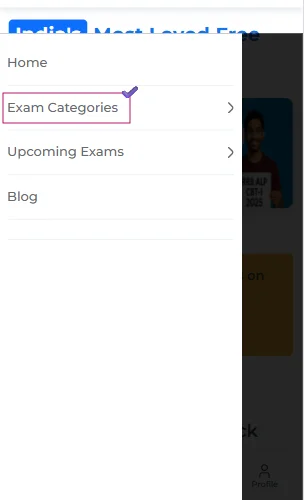
UPSEE sample papers with solutions

  • This selection will show you a variety of categories from which you need to tap on the ‘Engineering’ section. 
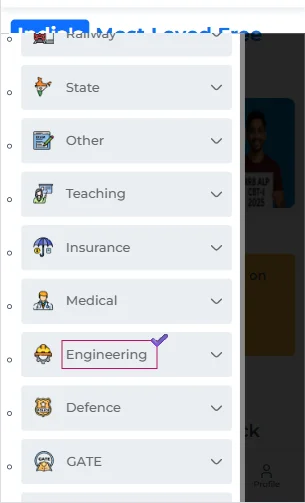
UPSEE exam sample papers

  • Then, you can easily find and select the ‘UPSEE’ option. It will be available as highlighted in the image below. 

UPSEE entrance exam sample papers

  • A new web page dedicated to this exam’s resources will open up. Here, you have to click on the ‘Sample Paper’ icon. 

UPSEE entrance test sample papers

  • Within seconds, you will get the subject-wise UPSEE sample papers.

sample papers for UPSEE

  • You have the choice to select any subject and access its series of UPSEE sample papers with solutions.
  • At last, you can start attempting the UPSEE exam sample papers by simply clicking on their ‘Start’ button. 
Note: On Mockers, you should complete a Google Log In or Sign Up beforehand to attempt the UPSEE entrance exam sample papers.

Important Topics To Cover Before Attempting The UPSEE Entrance Test Sample Papers

Here is a table in which you will get information about all the topics and subtopics that you must cover before you start with the UPSEE entrance test sample papers for B.Tech. 

Subject Topics along with Subtopics
Physics 
  • Mechanics (Kinematics): Motion in one dimension (displacement, velocity, acceleration), graphical analysis (velocity-time, displacement-time graphs), equations of motion, relative motion, projectile motion (range, time of flight, maximum height), motion in two dimensions, uniform circular motion
  • Laws of Motion: Newton’s three laws, free body diagrams, friction (static, kinetic, rolling), circular motion dynamics, pseudo forces, tension and pulley systems, applications of Newton’s laws in inclined planes
  • Work, Energy & Power: Work done by constant and variable forces, kinetic and potential energy, work-energy theorem, conservation of energy, power, collisions (elastic and inelastic), center of mass and motion
  • Rotational Motion: Angular displacement, velocity, and acceleration, moment of inertia (parallel and perpendicular axis theorem), torque, angular momentum, conservation laws, rolling motion
  • Gravitation: Universal law of gravitation, gravitational field and potential, acceleration due to gravity, motion of planets and satellites, escape velocity, Kepler’s laws
  • Properties of Matter: Elasticity (stress-strain curve, Young’s modulus), viscosity, surface tension, fluid dynamics (Bernoulli’s theorem), capillary action
  • Thermodynamics: Laws of thermodynamics, heat transfer (conduction, convection, radiation), specific heat capacity, calorimetry, entropy, Carnot engine, thermal expansion
  • Oscillations & Waves: Simple harmonic motion (equations, energy), damped and forced oscillations, resonance, wave motion, sound waves, Doppler effect, standing waves
  • Electrostatics: Coulomb’s law, electric field and potential, Gauss’s law, capacitors (series and parallel), dielectric materials
  • Current Electricity: Ohm’s law, resistivity, Kirchhoff’s laws, Wheatstone bridge, electrical power, drift velocity
  • Magnetism & EMI: Magnetic fields, Biot-Savart law, Ampere’s law, electromagnetic induction (Faraday’s law, Lenz’s law), AC circuits
  • Optics: Ray optics (reflection, refraction, mirrors, lenses), optical instruments, wave optics (interference, diffraction, polarization)
  • Modern Physics: Photoelectric effect, Bohr’s model, atomic spectra, nuclear physics, radioactivity, semiconductors, logic gates
Chemistry 
  • Mole Concept & Stoichiometry: Laws of chemical combination (law of conservation of mass, definite proportions, multiple proportions), mole-mass relationships, molarity, molality, normality, mole fraction, dilution calculations, limiting reagent problems, percentage yield, volumetric analysis basics, titration calculations
  • Atomic Structure: Thomson, Rutherford, Bohr models, limitations, dual nature of matter (de Broglie wavelength), Heisenberg uncertainty principle, Schrödinger wave equation basics, quantum numbers (n, l, m, s), orbital shapes (s, p, d), nodal planes, electronic configuration exceptions (Cr, Cu), ionization energy trends, electron affinity, shielding effect
  • Chemical Bonding: Lewis structures, octet rule limitations, formal charge, VSEPR shapes (linear, trigonal planar, tetrahedral, trigonal bipyramidal, octahedral), hybridization (sp, sp2, sp3, dsp2, sp3d, sp3d2), resonance structures, dipole moment, bond polarity, hydrogen bonding (intermolecular & intramolecular), lattice energy, Fajan’s rule
  • States of Matter: Gas laws (Boyle, Charles, Avogadro, Dalton), ideal vs real gases, compressibility factor, van der Waals equation, kinetic energy distribution, RMS velocity, mean free path, liquefaction of gases, surface tension, viscosity, vapor pressure, Raoult’s law
  • Thermodynamics: System and surroundings, types of systems (open, closed, isolated), internal energy, enthalpy change, heat capacity, Cp vs Cv, Hess’s law, Born-Haber cycle, entropy change, Gibbs free energy, spontaneity criteria, thermodynamic equilibrium
  • Equilibrium: Law of mass action, equilibrium constant (Kc, Kp), reaction quotient, Le Chatelier principle applications, degree of dissociation, pH scale, buffer solutions (Henderson equation), hydrolysis of salts, solubility product (Ksp), common ion effect
  • Electrochemistry: Galvanic and electrolytic cells, electrode potentials, standard reduction potential, Nernst equation applications, EMF calculations, electrochemical series, conductivity (specific, molar), Kohlrausch law, Faraday’s laws of electrolysis
  • Chemical Kinetics: Rate of reaction, factors affecting rate, rate law expression, integrated rate equations (zero, first, second order), half-life, activation energy, Arrhenius equation, collision theory, catalysis role
  • Surface Chemistry: Adsorption (physisorption vs chemisorption), Freundlich and Langmuir isotherms, catalysts (homogeneous, heterogeneous), enzyme catalysis, colloidal solutions, Tyndall effect, coagulation
  • Periodic Table & Periodicity: Modern periodic law, block elements, periodic trends (atomic size, ionic size, ionization enthalpy, electron gain enthalpy), electronegativity scales, diagonal relationships
  • s-Block Elements: Alkali and alkaline earth metals, properties, compounds
  • p-Block Elements: Group-wise study (13–18), oxides, halides, anomalies
  • d-Block & f-Block Elements: Transition metals, oxidation states, coordination compounds, lanthanides, and actinides
  • Coordination Chemistry: Ligands, coordination number, isomerism, crystal field theory
  • Organic Chemistry – Basics: IUPAC nomenclature, electronic effects (inductive, resonance), reaction intermediates
  • Hydrocarbons: Alkanes, alkenes, alkynes, aromatic hydrocarbons, reactions
  • Haloalkanes & Haloarenes: Substitution reactions, preparation, uses
  • Alcohols, Phenols, Ethers: Properties, reactions, preparation
  • Carbonyl Compounds: Aldehydes, ketones, carboxylic acids, nucleophilic addition reactions
  • Amines: Basicity, reactions, preparation methods
  • Biomolecules & Polymers: Proteins, carbohydrates, DNA basics, polymer types
Maths
  • Sets, Relations & Functions: Types of sets, Venn diagrams, operations on sets, relations (reflexive, symmetric, transitive), equivalence relations, types of functions (one-one, onto, bijective), inverse functions
  • Complex Numbers: Argand plane, modulus and argument, polar form, De Moivre’s theorem, roots of unity
  • Quadratic Equations: Nature of roots, discriminant, sum & product of roots, quadratic inequalities, graph interpretation
  • Sequences & Series: Arithmetic progression, geometric progression, harmonic progression, sum to n terms, infinite series, convergence
  • Binomial Theorem: General term, binomial expansion for fractional indices, Pascal’s triangle, properties
  • Permutations & Combinations: Circular permutations, combinations with repetition, probability applications
  • Matrices: Types (square, diagonal, identity), matrix multiplication, transpose, adjoint, inverse, rank of matrix
  • Determinants: Properties, minors, cofactors, solving systems of equations, Cramer’s rule
  • Trigonometry: Identities, trigonometric equations, inverse trigonometric functions, properties, graphs
  • Heights & Distances: Angles of elevation and depression, real-life applications
  • Straight Lines: Slope, intercept form, angle between lines, distance formula
  • Circle: Standard equation, tangent, normal, chord properties
  • Conic Sections: Parabola (focus, directrix), ellipse, hyperbola, parametric forms
  • Limits: Standard limits, L’Hospital rule, indeterminate forms
  • Continuity & Differentiability: Continuity conditions, differentiability, derivatives of functions
  • Differentiation: Product rule, quotient rule, chain rule, implicit differentiation, logarithmic differentiation
  • Applications of Derivatives: Increasing/decreasing functions, maxima/minima, tangents & normals, rate problems
  • Integration: Substitution, integration by parts, partial fractions, definite integrals, properties
  • Area Under Curve: Area between curves, bounded regions
  • Differential Equations: Formation, variable separable method, homogeneous equations
  • Vector Algebra: Magnitude, direction ratios, dot product, cross product, scalar triple product
  • 3D Geometry: Direction cosines, equation of line, plane, and shortest distance
  • Probability: Sample space, independent events, conditional probability, Bayes theorem
  • Statistics: Mean (direct & assumed), variance, standard deviation, probability distributions
  • Mathematical Reasoning: Logical statements, truth tables, implications
  • Linear Programming: Graphical method, feasible region, optimization
  • Miscellaneous Topics: Mathematical induction, inequalities, modulus function

How To Use The Sample Papers For UPSEE Effectively?

It is a smart and modern approach to practice the mini test series for the sample papers for UPSEE on Mockers. But it can happen only if you use them in a strategic manner. This way, you will be able to improve your focus, speed, and clarity of the concepts in a limited time. Here are the ways you can make the most out of these sample tests. 
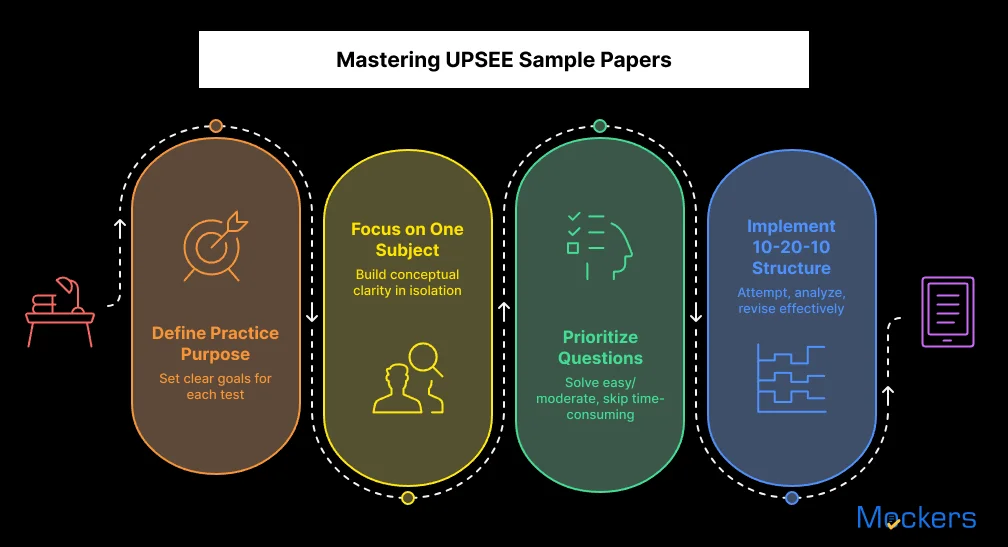
Mastering UPSEE Sample Papers

  • You should never start the UPSEE exam sample question paper tests randomly. It is important that you decide the purpose of your practice. It can be for applying concepts, improving your speed, checking your accuracy, and so on. In this way, you can make sure that every test has a clear outcome. 
  • Since we provide the subject-wise UPSEE online sample papers, it is advisable that you avoid mixing the subjects in one session. You should focus completely on one subject (Physics/Chemistry/Maths) in order to build a stronger conceptual clarity. 
  • Your goal is not to attempt each question that is available in the UPSEE sample papers online tests. Instead, you have to focus on solving the questions that are easy and moderate quickly, as well as skip the ones that are time-consuming. By doing so, you will be able to enhance your real exam temperament. 
  • For our free online UPSEE sample papers tests, you can follow a simple 10-20-10 structure. In this, you can first attempt the test in 10 minutes, analyze your solutions deeply in 20 minutes, and then revise the related concepts in the last 10 minutes. This will multiply the effectiveness of every sample test that you take. 
  • You should attempt the UPSEE sample papers that are based on similar topics repeatedly. It will help you to find the patterns in questions faster, reduce the time to solve them, increase your confidence in that topic, etc. 

Conclusion

The UPSEE sample papers with solutions are the resources that help you build your accuracy, speed, and confidence step by step. When you use them on a consistent basis, they will give you a clear understanding of the exam pattern, highlight your strong and weak areas, train you to perform under pressure, and so on. The key is not just to solve the questions, but to learn from each practice session. Every mistake that you correct, as well as every concept that you strengthen, will bring you closer to your goal.

FAQ's for UPSEE Sample Paper

If you want to get the best results, then you should practice the UPSEE entrance exam sample papers​ daily or at least 4 to 5 times a week. Through regular practice, you can have better retention, improve your speed, as well as track your performance properly.

The best way to analyze the sample papers for UPSEE is to spend more time reviewing the questions. Once you have solved the paper, you need to find your mistakes, understand the correct solutions, note down the weak topics, etc. You must remember that the analysis phase is important for real improvement.

Yes, the UPSEE online sample papers​ play a major role in improving your accuracy. By solving them on a regular basis and analyzing your mistakes, you will be able to reduce your errors. They will also help you develop a proper approach to solving the questions.

The free online UPSEE sample papers​ tests are considered to be a great revision tool. Rather than just reading the books or notes, these tests force you to apply concepts. This further solidifies your memory as well as improves retention.

Absolutely! It is quite important to solve the UPSEE sample papers with solutions​ in exam-like conditions. By doing so, you will be able to build discipline, increase your concentration, prepare mentally for the real environment of the exam, and so on.
Sign up for mock tests illustration
Sign up on Mockers for Free Mock Tests
Mockers logo Get latest Exam Updates
& Study Material Alerts!
No, Thanks
Arrow pointer icon
Click on Allow to receive notifications
Notification bell icon ×
Open Now